
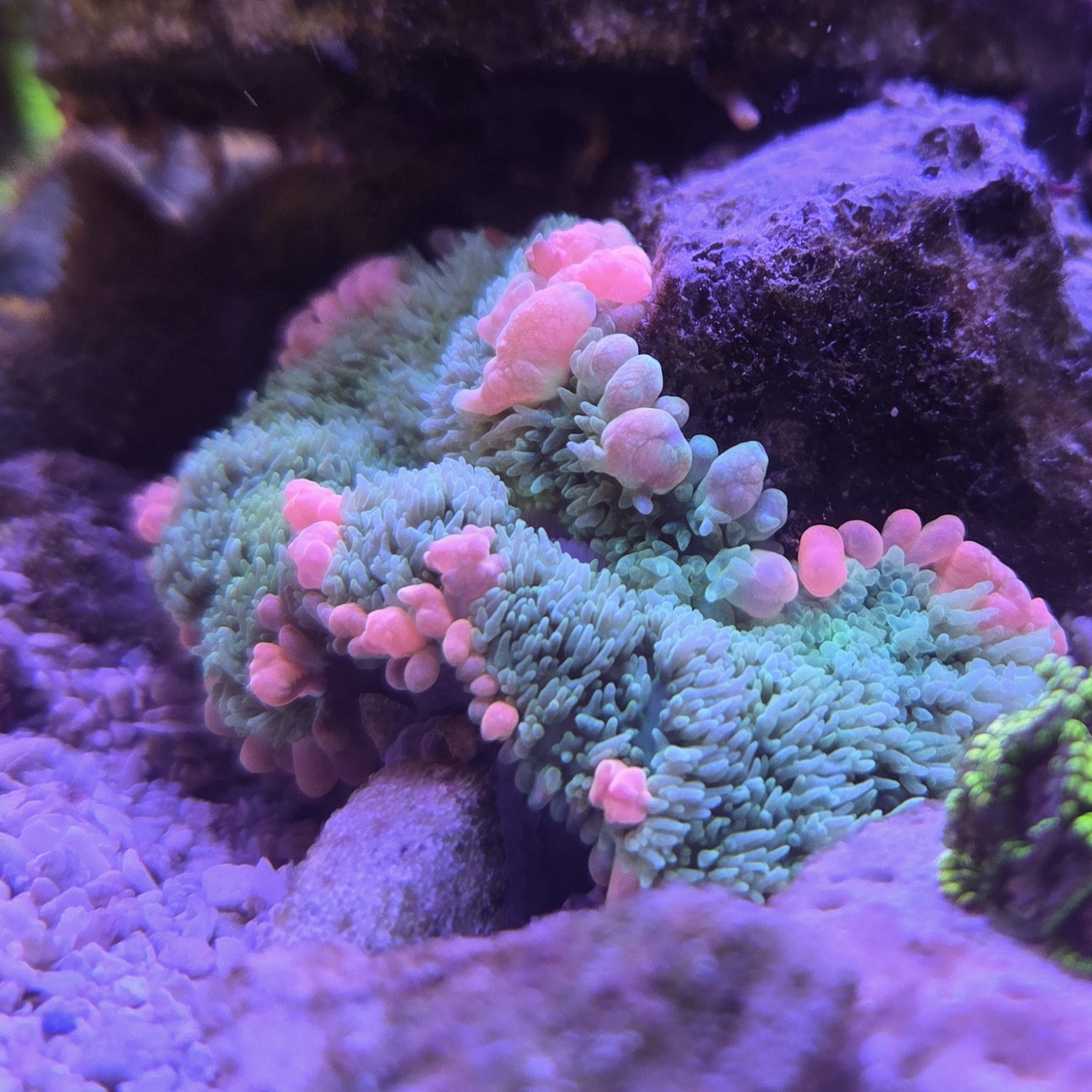
Bounce mushrooms are prized corallimorphs known for their inflated vesicles, bright color, and collector appeal. They are usually hardy once settled, but they dislike sudden change. Stable water, moderate light, gentle to moderate flow, and patient placement are the keys to long-term success.
If you want to keep bounce mushrooms well, focus on stability first and growth second. These corals can thrive in mixed reefs, mushroom gardens, and dedicated collector systems. In this guide, you will learn how to choose a healthy specimen, place it correctly, dial in lighting and flow, feed for faster growth, and solve common problems like shrinking, detaching, and bleaching. You will also learn how bounce mushrooms behave with nearby corals and when hobbyists should attempt propagation. That makes this a practical care guide for both beginners and intermediate reef keepers.
Quick Reference Table
| Common name | Bounce mushroom |
| Type | Corallimorph |
| Care level | Easy to moderate |
| Temperament | Peaceful but can crowd neighbors |
| Lighting | Low to moderate PAR, usually 50–120 |
| Flow | Low to moderate, indirect |
| Placement | Lower to middle rockwork, isolated if needed |
| Feeding | Optional but beneficial |
| Water temperature | 76–79°F |
| Salinity | 1.025–1.026 specific gravity |
| pH | 8.1–8.4 |
| Alkalinity | 8–9 dKH |
| Nitrate | 2–15 ppm |
| Phosphate | 0.03–0.10 ppm |
Use these numbers as a starting point, not a rigid rule. Different strains can prefer slightly different conditions. What matters most is consistency over time.
What Is a Bounce Mushroom?
Bounce mushrooms are corallimorphs with swollen bubble-like vesicles on the disc. These vesicles give them their unusual texture and collector value. Many hobbyists group them under Discosoma types, though trade names vary widely. You will see names based on color, lineage, and region. Some are affordable. Others are very expensive.
Not every mushroom with bumps is a true bounce. Young specimens can look plain for a long time. Vesicle development often improves with age, stable nutrients, and careful placement. This is why patience matters. A stressed or freshly imported specimen may look deflated for weeks.
Bounce mushrooms are popular because they combine strong color with easier care than many stony corals. They do not need intense lighting. They also tolerate a wider nutrient range than many SPS corals. Still, they can melt, wander, or shrink if conditions swing too fast. For a broader foundation, read our reef tank water parameters guide and our beginner coral placement tips.
Natural Habitat
In nature, mushroom corallimorphs occur in tropical reef environments with stable salinity and temperature. Many live in lower light zones than branching stony corals. They often attach to rock faces, rubble, or shaded reef sections where direct blast is limited. Water movement is present, but not harsh.
This habitat explains their aquarium preferences. Bounce mushrooms usually do best under gentler conditions than acropora or high-energy reef crest corals. They prefer enough light to maintain color and growth, but not so much that the tissue tightens and bleaches. They also prefer indirect flow that keeps debris from settling without folding the disc over itself.
Thinking about habitat helps with placement. If you imagine a calm reef ledge with moderate nutrients and filtered light, you are close to the right idea. That simple mental picture prevents many common mistakes.
Aquarium Setup
Bounce mushrooms can live in nano reefs, mixed reefs, and larger coral systems. Tank size matters less than stability. A mature tank is strongly preferred. New tanks often swing in nutrients, salinity, and pH. Those swings can stress mushrooms quickly.
Place them on a stable rock island, a low ledge, or a rubble cup if you want easy relocation. Many hobbyists isolate expensive mushrooms on small rocks. This reduces the chance of spreading into unwanted areas. It also helps if the mushroom detaches and moves. Bare-bottom frag systems can work well too, but they still need stable chemistry and moderate nutrients.
Avoid placing bounce mushrooms near aggressive sweepers. Give them room to expand. A fully inflated specimen can cover much more space than it appears to need at purchase. If you are building a dedicated mushroom zone, leave enough gap between colonies for future growth. For system planning, our mixed reef stocking guide and live rock aquascaping tips are helpful internal references.
Lighting Requirements
Bounce mushrooms usually prefer low to moderate light. A practical range is about 50 to 120 PAR. Some strains tolerate more, but intense light often causes trouble. Signs of excess light include bleaching, tight tissue, retracted vesicles, or a mushroom that stays shrunken all day.
Start lower than you think. Then adjust slowly. If you buy a bounce from a dim frag system and place it under strong LEDs, it may bleach within days. Use a light acclimation mode or reduce intensity with screening. Raise exposure over one to three weeks. Slow changes are safer than fast corrections.
Color can shift with light and nutrients. Brighter light may increase some pigments but reduce inflation. Lower light may improve expansion but darken the base. There is no universal sweet spot for every strain. Observe the coral daily. A happy bounce usually stays open, inflated, and attached. If you need help tuning LEDs, see our reef lighting schedule guide.
Water Flow
Flow should be low to moderate and indirect. The goal is gentle movement around the coral, not direct pressure on the disc. Strong, focused flow can make a bounce mushroom stay folded, detach, or fail to inflate its vesicles. Dead spots are also a problem because waste can collect around the foot.
A good test is simple. The disc should move slightly, but not whip or curl hard. If food and detritus settle on the mushroom for long periods, flow is too low. If the edge lifts and stays bent, flow is too strong. Adjust pumps in small steps. Sometimes moving the coral a few inches solves the issue.
Random flow works better than a constant jet. Gyres, return flow, and broad wavemakers are usually safer than narrow nozzles pointed directly at the coral. Stable flow matters as much as stable light. Once a bounce is happy, avoid frequent relocation.
Water Chemistry and Stability
Bounce mushrooms are forgiving compared with many stony corals, but they still need stable chemistry. Keep salinity at 1.025 to 1.026. Hold temperature between 76 and 79°F. Maintain pH in a normal reef range. Alkalinity around 8 to 9 dKH is a safe target for mixed reefs.
Nutrients should not be stripped to zero. Many bounce mushrooms respond better with measurable nitrate and phosphate. A practical range is 2 to 15 ppm nitrate and 0.03 to 0.10 ppm phosphate. Ultra-low nutrient systems can lead to poor inflation and faded color. Dirty water is not the answer either. High waste and unstable organics can trigger bacterial issues.
Calcium and magnesium matter less for the mushroom itself than for overall reef stability, but keep them in normal reef ranges. Avoid sudden corrections. Large water changes, rapid salinity shifts, and aggressive media changes often cause more harm than slightly imperfect numbers.
Feeding
Bounce mushrooms can survive without direct feeding under good lighting and normal reef nutrients. Still, feeding can improve growth, inflation, and recovery. Small portions work best. Offer finely chopped mysis, brine, reef roids, or other soft coral foods once or twice weekly.
Do not force large food onto the disc. Oversized pieces can rot or be rejected. Turn down flow briefly during feeding. Place a small amount near the mouth. If the mushroom accepts it, the tissue will slowly fold inward. If it releases the food, remove leftovers. This prevents nutrient spikes and pests.
Some bounce mushrooms feed eagerly. Others rarely show interest. That is normal. If your tank already has moderate nutrients and fish are fed well, direct feeding is optional. Use it as a tool, not a requirement. Consistent water quality will always matter more than heavy target feeding.
Compatibility
Bounce mushrooms are generally peaceful, but they can still cause problems in close quarters. They do not have long sweepers like some LPS corals, yet they can sting or crowd nearby tissue over time. Give them space from acans, euphyllia, chalices, and zoanthids. Their expansion can surprise you.
Most reef-safe fish ignore them. Clownfish may occasionally rub on larger mushrooms, which can irritate the coral. Some angelfish and butterflyfish may nip, depending on the species. Invertebrates are usually safe, though large hermits can bulldoze unattached specimens.
Keep expensive bounce mushrooms secure. A detached specimen can drift into pumps, overflows, or aggressive neighbors. Isolation boxes, rubble cups, and mushroom baskets are useful during acclimation. If you keep many corallimorphs together, watch for overgrowth. Fast-spreading mushrooms can overtake a rock island if left unmanaged.
Step-by-Step Acclimation and Placement
Step 1: Inspect the specimen before adding it. Look for firm attachment, intact tissue, and no foul smell. Mild deflation after shipping is normal.
Step 2: Match temperature and salinity slowly. Drip acclimation is useful if shipping water differs greatly from your tank.
Step 3: Dip only if appropriate and only with coral-safe products. Some mushrooms react poorly to harsh dips. Follow product directions carefully.
Step 4: Start in lower light and indirect flow. Use a rack, cup, or low ledge for the first week.
Step 5: Observe daily. A settled bounce should open more each day. Move it only if clear signs of stress appear.
Step 6: Feed lightly after it is fully attached and expanded. Do not feed a newly stressed specimen right away.
Step 7: Lock in stability. Avoid major changes for the next two weeks. This is when many losses happen.
Propagation and Fragging
Should hobbyists frag bounce mushrooms?
Fragging is possible, but it is not ideal for beginners. Bounce mushrooms are valuable, slow to recover, and not every cut heals well. If you own a rare strain, waiting for natural splitting is often safer.
Natural splitting
Healthy mushrooms sometimes divide on their own. This is the lowest-risk propagation method. Good nutrition, stable water, and time are the main ingredients. Some also leave small pedal lacerations as they move.
Manual fragging basics
If you choose to frag, use sterile tools and a clean workspace. Cut only healthy, well-established specimens. Place fresh cuts in low flow, low to moderate light, and very stable water. Infection control and cleanliness matter. Recovery can take weeks. Avoid handling the tissue more than necessary.
Common Problems
Why is my bounce mushroom shrinking?
Shrinking usually points to stress. Common causes include too much light, strong direct flow, salinity swings, fresh tank instability, or recent shipping stress. Check for rapid changes first. Reduce light, soften flow, and confirm salinity with a calibrated refractometer. Then give it time.
Why did my bounce mushroom detach?
Detachment often happens when the mushroom dislikes its location. Excess flow is a common trigger. Poor attachment surface and pest irritation can also play a role. Place the coral in a rubble cup or mushroom basket until it reattaches. Keep flow gentle and indirect.
Why is my bounce mushroom bleaching?
Bleaching usually means too much light or sudden light change. Lower the coral, reduce intensity, and avoid abrupt nutrient stripping. Recovery can be slow. Feed lightly if the coral accepts food, but do not overdo it.
Why are the bubbles not forming?
Vesicle size depends on genetics, age, light, nutrients, and overall health. New frags often need months to show their best form. Stable conditions and patience matter more than chasing a single magic setting.
Frequently Asked Questions
Are bounce mushrooms good for beginners?
Yes, many are beginner friendly if the tank is mature and stable. The biggest challenge is resisting constant adjustment.
How fast do bounce mushrooms grow?
Growth is usually slow to moderate. Feeding and stable nutrients can help, but rare strains may still grow slowly.
Can bounce mushrooms touch other corals?
It is best to avoid contact. They can irritate neighbors and may be harmed by more aggressive corals.
Do bounce mushrooms need target feeding?
No. They can live without it. Light feeding may improve growth and recovery in stable systems.
What is the best place in the tank for a bounce mushroom?
Start low to mid level with indirect flow and moderate shade. Then adjust slowly based on expansion and color.
Bounce mushrooms reward patience. Keep the tank stable. Avoid harsh light and direct flow. Feed lightly if needed. Give them room to expand. If you do those simple things well, these unique corals can become one of the most eye-catching parts of your reef.
Was this helpful?
Related Posts
Copper Treatment in Saltwater
Copper treatment helps control marine ich and velvet in quarantine tanks. Learn how to dose, test, and use…
 By
By
Saltwater Aquarium Setup Guide
Starting a saltwater aquarium is one of the most rewarding projects in the hobby. With the right plan,…