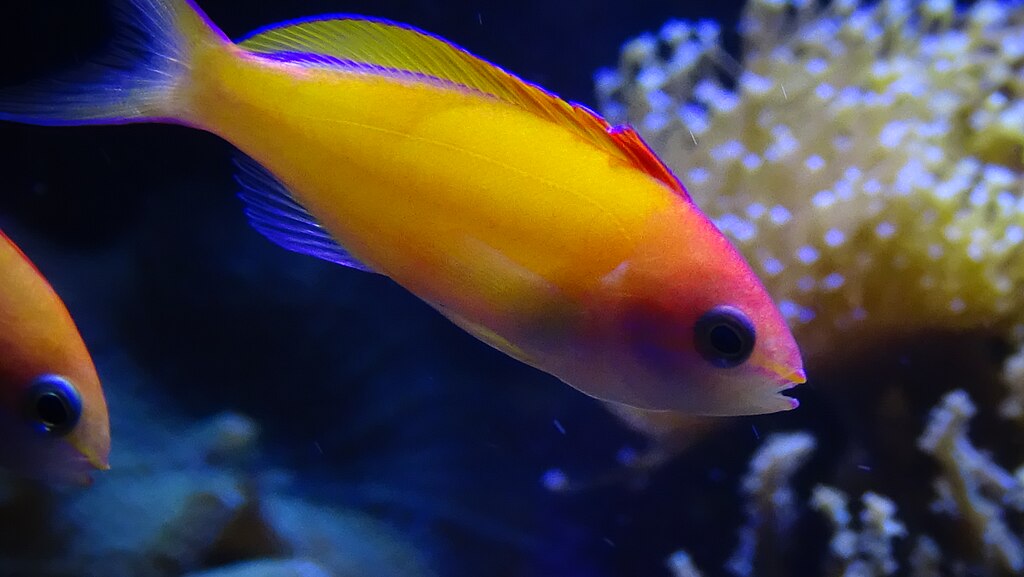
Dispar anthias are small, orange reef fish with big personality. They thrive in groups and reward steady care. This guide covers tank size, feeding, and long-term success.
Natural behavior and tank planning
Dispar anthias (Pseudanthias dispar) live in harems on reef slopes. One male leads several females. Females can change sex if the male is lost. Plan your group from the start.
Choose a tank with strong flow and open swimming space. A 70-gallon tank suits a small group. Aim for 90 gallons for five to seven fish. Add rock ledges and caves for quick retreats.
Keep lighting moderate to strong if you run a reef. They often hover in the water column. They will dart into cover when startled. Use a tight lid since anthias can jump.
Stable water matters more than chasing perfect numbers. Target 25–26°C (77–79°F), salinity 1.025–1.026, and pH 8.1–8.4. Keep ammonia and nitrite at 0. Nitrate under 10–20 ppm is ideal.
- Best group: 1 male with 3–6 females.
- Minimum tank: 70 gallons for 4 fish.
- Provide: tight lid, caves, and high oxygenation.
For more stocking context, see our reef fish stocking guide. It helps you match activity levels and tank footprint.
Feeding strategy that keeps anthias alive
Anthias burn energy fast. Many losses trace back to underfeeding. Plan for three to five small meals daily. An auto feeder can cover at least one dry feeding.
Start with foods they accept quickly. Offer frozen mysis, enriched brine, and finely chopped krill. Add small pellets at 0.5–1 mm once they settle. Soak food in vitamins twice weekly.
Watch the shy fish during meals. Dominant females may block food. Spread food across the tank with a turkey baster. Turn off the return pump for five minutes if food vanishes into overflow.
A real-world routine works well. Feed pellets at 9 a.m. Feed frozen at 1 p.m. Feed a mixed frozen blend at 7 p.m. Keep portions small and consistent to limit nutrients.
- Feed 3–5 times daily in small portions.
- Use 0.5–1 mm pellets after acclimation.
- Enrich frozen foods with HUFA and vitamins.
If nutrients climb, adjust export before cutting meals. Review our nitrate control tips for practical options. Anthias do best when fed often.
Quarantine, compatibility, and troubleshooting
Quarantine reduces losses and protects your display. Use a 20–30 gallon tank for a small group. Provide PVC elbows for shelter. Match salinity and temperature to the store water first.
Observe for 14–21 days and focus on eating. Many dispar anthias carry flukes. Look for flashing, cloudy eyes, or rapid breathing. Consider a praziquantel course if symptoms appear.
Choose peaceful tankmates. Good options include clownfish, gobies, and fairy wrasses. Avoid aggressive dottybacks and large hawkfish. Keep them away from fast feeders like big tangs in small tanks.
Common mistakes are simple. Too few feedings causes slow starvation. Low oxygen causes heavy breathing at the surface. Weak flow can also stress them. Add surface agitation and aim for steady skimmer performance.
- Signs of trouble: pinched belly, hiding, or frayed fins.
- First fixes: increase feeding frequency and improve aeration.
- Check: salinity swings and temperature spikes over 27°C.
Need a step-by-step setup? See our quarantine protocol for saltwater fish. It includes timelines and observation checklists.
Dispar anthias can be hardy once established. Give them a stable reef, high oxygen, and frequent small meals. Start with a proper group and you will see natural harem behavior for years.
Sources: Michael S. Kent, Fish Disease: Diagnosis and Treatment; Scott W. Michael, Reef Fishes; Fenner, Robert, The Conscientious Marine Aquarist.
Was this helpful?
Related Posts
Protein Skimmer Reef Tank Guide
Learn how a protein skimmer works, how to size one, and how to tune it for a cleaner,…
 By
By
Reef Aquarium Water Parameters
Learn the ideal reef aquarium water parameters, safe ranges, and how to keep salinity, alkalinity, nutrients, and pH…