Goniopora corals can look easy at the store. Many hobbyists lose them months later. The key is stable water, steady feeding, and gentle placement.
Understanding Goniopora needs and placement
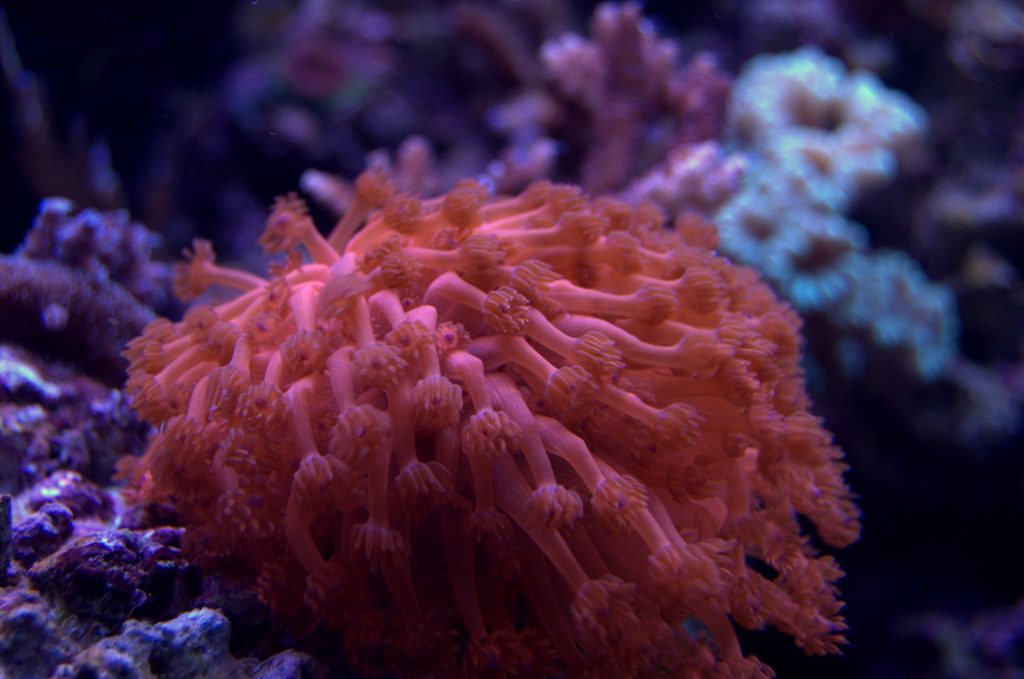
Goniopora are often called flowerpot corals. They extend long polyps during the day. They dislike sudden swings in light and flow. Aim for consistency over “perfect” numbers.
Start with moderate light in most tanks. Target 80–150 PAR at the coral. Use 200 PAR only for proven, established colonies. Acclimate over 10–14 days with a light ramp. Watch polyp extension each day.
Flow should be low to moderate and indirect. You want polyps to sway, not whip. Avoid blasting the tissue with a powerhead. Place them on sand or a low rock ledge. Keep 3–6 inches from stinging neighbors.
Give them a mature system. Six months old is a safer minimum. New tanks have unstable nutrients and bacteria. That instability often causes slow decline. If you are still dialing in alkalinity, wait.
- Start placement low and move up only after two stable weeks.
- Avoid direct flow from wavemakers and return nozzles.
- Use a frag tile or small rock to prevent sand irritation.
For tank planning, review your reef lighting guide and match PAR to coral response. If you run strong random flow, consider a sheltered corner. You can also adjust with a deflector or rock barrier.
Water parameters and daily stability targets
Goniopora respond best to stable reef parameters. Keep alkalinity steady within 0.3 dKH day to day. A common target is 8.0–9.0 dKH. Large swings often cause retraction and tissue thinning.
Maintain calcium at 420–460 ppm and magnesium at 1300–1450 ppm. Keep salinity at 1.025–1.026 specific gravity. Hold temperature at 25–26 C, or 77–79 F. Use a heater controller if your room fluctuates.
Nutrients matter for long-term success. Aim nitrate at 5–15 ppm and phosphate at 0.03–0.10 ppm. Ultra-low nutrients can starve them. High nutrients can fuel algae and irritate tissue. Test weekly until the tank is predictable.
Trace elements can help, but avoid blind dosing. If you dose iodine, keep it conservative. Many reefers see benefit from iron and manganese in balanced systems. Use water changes as your baseline. Check your water testing schedule and stick to it.
- Alkalinity: 8.0–9.0 dKH with minimal daily swing.
- Nitrate: 5–15 ppm to support color and growth.
- Phosphate: 0.03–0.10 ppm to avoid starvation.
- Salinity: 1.025–1.026 with calibrated refractometer.
Feeding, troubleshooting, and common mistakes
Feeding is often the missing piece. Many Goniopora accept small foods. Feed 3–5 times per week for best results. Use a mix of fine coral foods and meaty plankton. Good options include rotifers, reef roids, and small mysis.
Turn off pumps for 10–15 minutes during feeding. Use a pipette to gently cloud the polyps. Do not blast the tissue. Resume flow slowly if your controller allows it. Watch for better extension within 30–60 minutes.
Common problems show up as partial retraction or “bald” areas. Check alkalinity first. Then check phosphate and nitrate for sudden drops. Also inspect for sand abrasion and vermetid snails. A single stinging coral nearby can cause chronic stress.
If the coral stays closed for two days, act fast. Reduce light by 20% and lower flow slightly. Confirm temperature with a second thermometer. Consider a dip only if pests are visible. Use a quarantine plan from your coral quarantine basics article.
- Do not run zero nitrate or near-zero phosphate for weeks.
- Do not move the coral daily to “find the spot.”
- Do not increase light quickly after a water change.
- Do feed consistently, even if the coral looks fine.
Sources: Borneman, E. (2001) Aquarium Corals; Delbeek, J. & Sprung, J. (1994–2005) The Reef Aquarium volumes; Paletta, M. (2017) The New Marine Aquarium.
Was this helpful?
Related Posts
Dragonets Fish Care
Dragonets are beautiful reef fish, but they need mature tanks and steady food sources. Learn how to keep…
 By
By
Lighting For Aquarium
Lighting for Aquarium: Getting Saltwater Illumination Right Lighting for a saltwater aquarium is about much more than simply…