

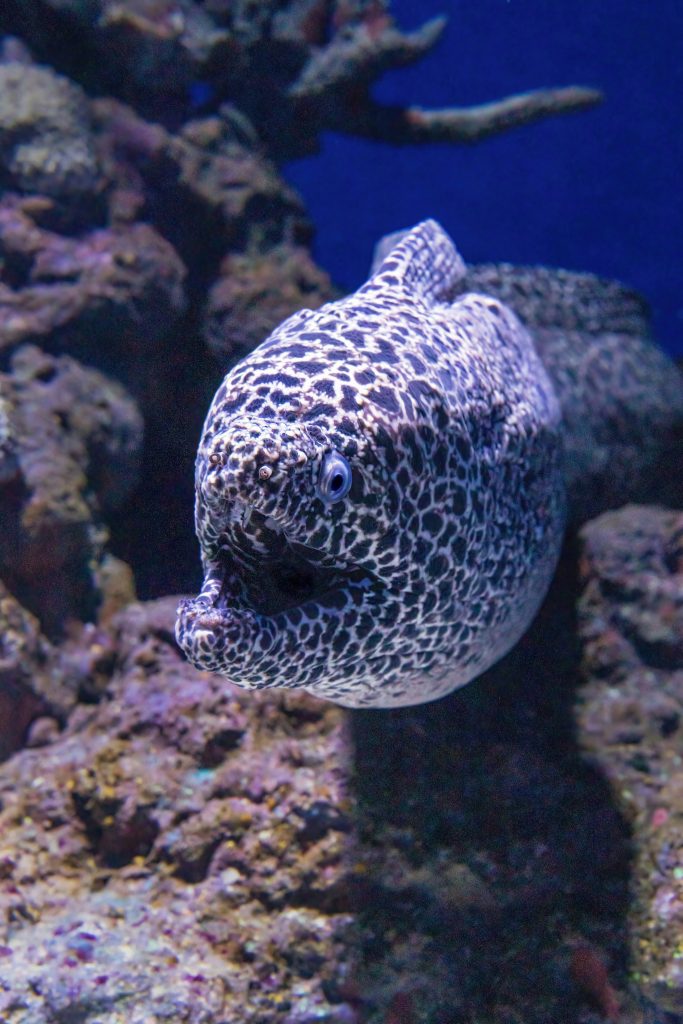
The Honeycomb Moray is a striking but demanding eel. It grows very large, eats meaty foods, and needs a secure aquarium. This species suits advanced keepers with oversized tanks, tight lids, and a strong plan for long-term care.
The Honeycomb Moray, Gymnothorax favagineus, is one of the most recognizable moray eels in the hobby. Its bold honeycomb pattern draws attention fast. Its adult size should give hobbyists pause just as quickly. This is not a typical reef fish. It is a heavy-bodied predator that can exceed the size of many home aquariums. In this guide, you will learn about tank size, feeding, behavior, compatibility, water quality, and common problems. You will also learn why this eel is usually better for very large fish-only systems than mixed reefs.
Quick Reference Care Table
| Common Name | Honeycomb Moray |
| Scientific Name | Gymnothorax favagineus |
| Care Level | Advanced |
| Temperament | Predatory, usually reclusive, can become bold |
| Adult Size | Up to about 6 feet in rare cases, often smaller in captivity |
| Minimum Tank Size | 300 gallons absolute minimum, larger strongly preferred |
| Diet | Meaty marine foods |
| Reef Safe | With caution; unsafe with many fish and crustaceans |
| Temperature | 75–80°F |
| Salinity | 1.023–1.026 |
| pH | 8.1–8.4 |
| Special Notes | Escape artist; needs a tight, eel-proof lid |
This table gives the short version. The real challenge is not basic water chemistry. The hard part is housing a huge predator safely for years. Most losses happen from escapes, poor feeding habits, or choosing tank mates that eventually become food.
Natural Habitat
The Honeycomb Moray lives across the Indo-Pacific. It occurs in coral reefs, rocky coastlines, lagoons, and outer reef slopes. Juveniles often hide deep in crevices. Adults use caves and holes in reef structure. During the day, they usually keep only the head exposed. At night, they hunt.
In nature, this eel feeds on fish, cephalopods, and crustaceans. It relies on smell more than sight. That matters in captivity. Food scent triggers feeding behavior fast. It also explains why this species may mistake a hand for food during maintenance. Their habitat has constant shelter, stable salinity, and strong oxygen levels. Replicating those conditions helps reduce stress. A moray that feels secure will feed better and show fewer frantic escape attempts.
Aquarium Setup
Tank size is the biggest issue with this species. A juvenile may look manageable in a dealer system. That stage does not last. The Honeycomb Moray becomes thick, powerful, and long. A 300-gallon tank is a bare minimum. Larger systems are much safer. Public aquarium scale is ideal for full adults.
Build the aquascape with stability first. Use large, locked rock structures. Create caves wide enough for the eel’s body. Avoid narrow tunnels that can trap it. Leave open swimming lanes too. This species needs room to turn around. Every opening in the tank must be secured. Cover overflow teeth, plumbing gaps, and lid corners. Morays are expert escape artists. Even heavy lids may need clips or weights. If you want more guidance on system planning, see: reef tank aquascaping ideas, marine aquarium filtration basics, and quarantine tank setup.
Lighting Requirements
The Honeycomb Moray has no special lighting demand. It does not need reef-level PAR. It only needs a stable day and night cycle. Moderate lighting works well in fish-only systems. In reef tanks, the eel will tolerate brighter light if it has deep shade and secure caves.
Bright light without shelter can make the eel hide constantly. That often leads hobbyists to think it is sick. In many cases, it simply feels exposed. Use overhangs, arches, and shaded retreats. If the tank also houses corals, design the rockwork so the eel can move beneath high-light zones. Keep in mind that large eels can knock frags loose. Secure corals firmly. This species is not demanding about light, but the rest of the system may be. If you keep mixed livestock, balance coral needs with the eel’s need for cover.
Water Flow
Strong oxygenation matters more than extreme flow. Honeycomb Morays come from environments with steady water movement. They do best in clean, well-filtered systems with good gas exchange. Aim for moderate to strong circulation overall. Avoid blasting the eel’s cave directly.
Large predators produce heavy waste. That means strong mechanical filtration helps. Efficient protein skimming is also important. Dead spots around caves can trap detritus and raise nitrate. Use return nozzles and pumps to keep debris suspended for export. Watch the eel’s behavior. If it constantly avoids a cave, the flow may be too direct. If debris settles around the shelter, flow may be too weak. Good circulation supports stable pH and oxygen. Both are important for a large, active carnivore.
Feeding
Feed marine-based meaty foods. Good choices include shrimp, squid, clam, silversides in moderation, and pieces of marine fish. Variety is important. A single food source can create nutritional gaps over time. Avoid freshwater feeder fish. They are poor nutrition and can introduce disease.
Juveniles may eat two to three times weekly. Larger adults often do well with one to two substantial feedings each week. Use feeding tongs. Never hand-feed this eel. Morays have poor vision and a powerful feeding strike. Soak foods in vitamins occasionally. That helps support long-term health. Do not overfeed. Obesity and water quality issues follow fast in closed systems. A healthy moray often begs once established. Do not let that behavior trick you into daily heavy feeding. For nutrition planning, see: best foods for saltwater fish.
Compatibility
Compatibility is where many hobbyists make costly mistakes. The Honeycomb Moray is not community safe in the usual sense. Small fish are at risk. Shrimp, crabs, and lobsters are especially vulnerable. Even if tank mates are ignored for months, predation can still happen later.
Larger, robust fish sometimes work. Good candidates may include large tangs, triggerfish with caution, puffers with caution, and sizable angelfish. Every pairing carries risk. Aggressive fish may nip the eel. The eel may retaliate during feeding. In reef tanks, corals themselves are usually not eaten. The problem is physical disruption and predation on mobile invertebrates. This species is best in a species-focused predator tank or a very large fish-only system. Research each tank mate carefully. If you are comparing predatory species, review: aggressive saltwater fish compatibility.
Step-by-Step Acclimation Guide
First, prepare the tank before the eel arrives. Secure every opening. Confirm caves are stable. Dim the lights. Second, float the transport bag to match temperature. Third, transfer the eel to a covered bucket for drip acclimation. Keep the container dark if possible. Morays stress easily in bright light.
Fourth, acclimate slowly for about 45 to 60 minutes if salinity differs. Fifth, move the eel with a container, not a net. Nets can snag teeth and skin. Sixth, release it near a prepared cave. Then leave the tank quiet. Do not try to feed immediately. Wait until the eel settles. Some eat within days. Others need longer. Test ammonia often during the first week. Large carnivores can stress immature systems quickly. Quarantine is strongly recommended when practical, though it can be difficult with very large specimens.
Propagation and Breeding
Has the Honeycomb Moray Been Bred in Home Aquariums?
Successful home breeding is not a realistic goal for this species. Morays have complex reproductive cycles. Their larval stage is very difficult to raise. Public institutions may observe spawning behavior, but captive propagation remains extremely rare and not practical for hobbyists.
Can You Frag or Divide This Species?
No. This is a fish, not a coral. There is no fragging or division method. Any article suggesting otherwise is incorrect. Hobbyists should focus on proper long-term care, not propagation.
Common Problems
Why Is My Honeycomb Moray Not Eating?
New arrivals often refuse food from stress. Bright lights, poor shelter, and excessive traffic worsen the issue. Offer food at dusk with tongs. Try different marine foods with strong scent. Check ammonia, salinity, and temperature. If the eel breathes heavily or shows mucus, disease or shipping damage may be involved.
Why Is My Moray Trying to Escape?
Escape attempts usually mean one of three things. The lid has a weak point. Water quality is poor. Or the eel feels insecure. Test water immediately. Improve shelter. Seal all openings. Many morays die on the floor, not in the aquarium. Prevention matters more than rescue.
Cloudy Eyes or Skin Damage
Cloudy eyes can follow shipping stress, scrapes, or poor water quality. Skin abrasions often come from unstable rock or rough decor. Check for sharp edges. Keep ammonia and nitrite at zero. Maintain strong oxygenation. If secondary infection appears, treatment may be needed in a suitable hospital system.
Tank Mates Disappearing
This is often not a mystery. If a fish or shrimp fits into the eel’s mouth, it is prey. Predation may happen at night. The safest fix is choosing larger tank mates and removing vulnerable invertebrates.
Frequently Asked Questions
Is the Honeycomb Moray reef safe?
With corals, usually yes. With fish and invertebrates, often no. It may ignore corals but eat shrimp, crabs, and smaller fish.
How big does a Honeycomb Moray get?
It can reach very large adult sizes, sometimes close to 6 feet. Many captive specimens stay smaller, but they still become massive aquarium predators.
What is the minimum tank size for a Honeycomb Moray?
Around 300 gallons is the practical minimum for a juvenile to subadult. Larger is far better. Full adults need extremely large systems.
How often should I feed a Honeycomb Moray?
Most established specimens do well with one to three feedings weekly, depending on size and body condition. Avoid heavy daily feeding.
Can a Honeycomb Moray bite?
Yes. It has a strong bite and poor aim during feeding. Always use tools, never fingers, when offering food or moving decor nearby.
Final Thoughts
The Honeycomb Moray is beautiful, intelligent, and impressive. It is also a serious commitment. Its size alone makes it unsuitable for most home aquariums. If you can provide a huge tank, secure cover, stable water quality, and careful feeding, it can become a fascinating centerpiece. If not, choose a smaller eel species with more realistic care needs. Success with Gymnothorax favagineus depends less on chasing perfect numbers and more on planning for its adult size, predatory nature, and escape-proof housing from day one.
Was this helpful?
Related Posts
Sohal Tang (Acanthurus Sohal)
Sohal Tang care centers on space, heavy feeding, and aggression control. Learn tank size, diet, compatibility, and common…
 By
By
Reef Safe Fish Guide
Learn which reef safe fish work best in coral tanks, plus species to avoid, compatibility tips, and beginner-friendly…
[favorite_button]
My Bookmarks:
To see full list click here
[user_favorites user_id="" include_links="true" site_id="" post_types="" include_thumbnails="true" thumbnail_size="thumbnail" include_excerpt="false"]