

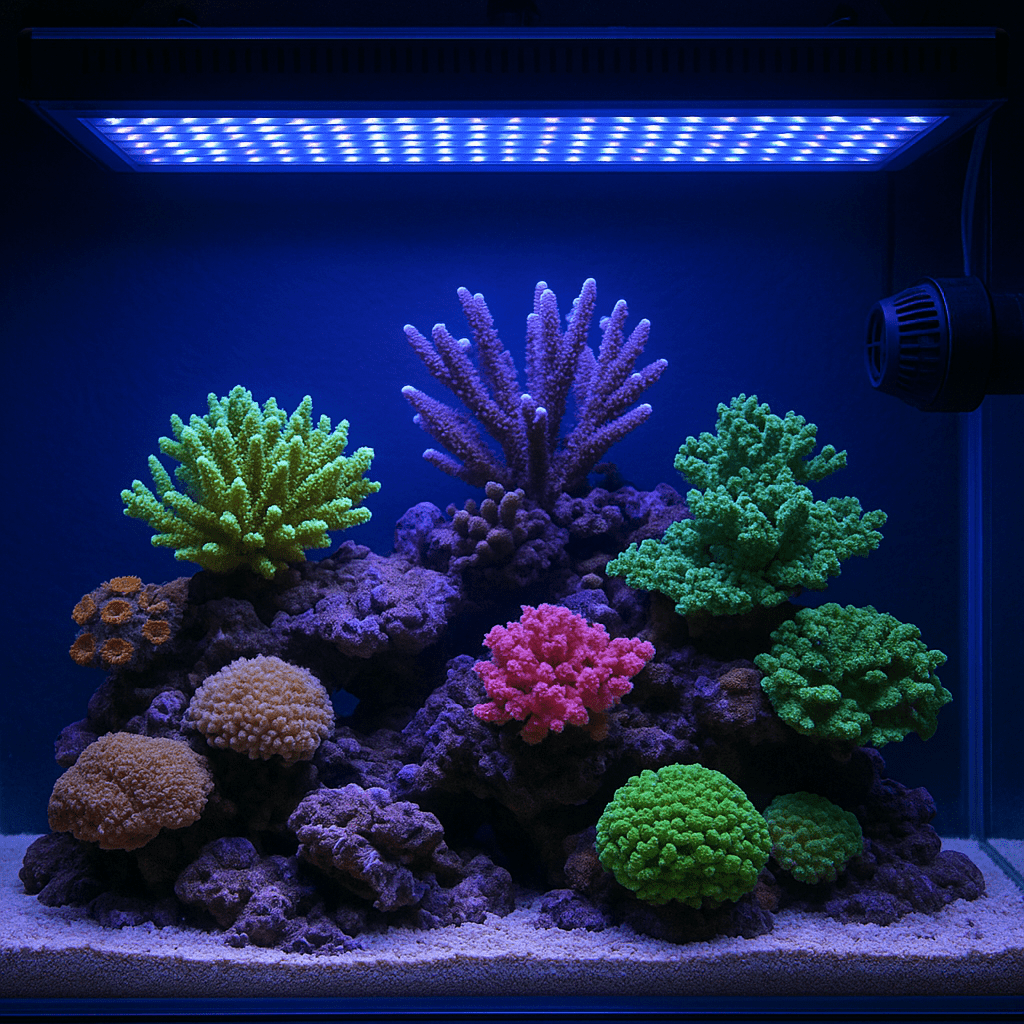
Reef LED spectrum settings matter because spectrum shapes coral color, growth, and algae pressure. Most reef tanks do best with a blue-heavy schedule, moderate white light, and slow changes over time. The goal is stable, usable light for corals, not the brightest look to your eyes.
Many reef keepers feel overwhelmed by LED channels. Blue, royal blue, UV, violet, white, red, and green sliders can make lighting seem complicated. The good news is that coral needs are simpler than many presets suggest. In most mixed reefs, success comes from strong blue wavelengths, controlled intensity, and a consistent photoperiod. In this guide, you will learn what each channel does, how to build a practical spectrum, how to adjust settings for soft corals, LPS, and SPS, and how to troubleshoot common issues like bleaching, browning, and nuisance algae.
Quick Reference Table
| Tank Type | Blue Channels | White Channel | Red/Green | Photoperiod | Target PAR |
|---|---|---|---|---|---|
| Soft coral tank | 70–90% | 10–25% | 0–5% | 8–10 hours | 50–150 |
| LPS reef | 75–100% | 10–20% | 0–5% | 8–10 hours | 75–200 |
| Mixed reef | 80–100% | 10–20% | 0–5% | 8–10 hours | 75–250 |
| SPS dominant reef | 85–100% | 5–15% | 0–3% | 8–10 hours | 200–350+ |
Use these ranges as a starting point. Every tank is different. Coral placement, rock height, water clarity, and fixture mounting height all change the final result. If you own a PAR meter, trust measured PAR more than channel percentages. If you do not, make changes slowly and watch coral response for two weeks before adjusting again.
What Reef LED Spectrum Really Means
Spectrum is the mix of light wavelengths your fixture produces. Corals rely on symbiotic algae called zooxanthellae. These algae use certain wavelengths more efficiently than others. Blue and violet light are especially useful in reef aquariums. They also penetrate water well. That is why most successful reef LED programs look very blue.
White LEDs are not bad. They simply add broad-spectrum light, including wavelengths your eyes see as brighter. Too much white can make a tank look washed out. It can also increase nuisance algae if nutrients are already high. Red and green channels usually need very little use. They can improve visual balance, but they rarely need strong output in a coral-focused schedule.
The key point is simple. Corals do not need every color turned up equally. They need stable light in the right range. A blue-heavy spectrum supports photosynthesis and fluorescence. It also gives many corals the crisp reef look hobbyists prefer.
Best Reef LED Spectrum Settings for Most Tanks
For most reef aquariums, start with royal blue and blue channels as the foundation. Run those channels high. Many hobbyists use 80 to 100 percent, depending on fixture power and mounting height. Violet and UV channels can also run high on many modern fixtures. These wavelengths help with coral coloration, but they should still be increased slowly.
Keep the white channel lower. A range of 10 to 20 percent works well in many mixed reefs. This keeps the spectrum coral-friendly while still giving some daylight appearance. Red and green should stay very low. In many tanks, 0 to 5 percent is enough. Some reef keepers leave them off entirely.
A practical starting schedule looks like this: royal blue 90 percent, blue 90 percent, violet 80 percent, UV 70 percent, white 15 percent, red 3 percent, and green 3 percent. This is not a universal formula. It is a safe baseline for many modern LED systems. Your final settings should match your coral types and measured PAR.
How to Set Spectrum by Coral Type
Soft corals usually tolerate lower PAR and a broad range of conditions. They often do well under blue-heavy light with moderate intensity. Mushrooms, zoanthids, and leathers may color up nicely with strong blue channels and restrained white output. Too much light can cause some soft corals to shrink or stay closed.
LPS corals usually prefer moderate light. Torches, hammers, acans, and favias often show better color under a heavy blue spectrum. They usually do not need intense white light. Excess intensity can bleach fleshy tissue, especially after recent placement or shipping stress.
SPS corals demand the most precision. Acropora and montipora often thrive under strong blue and violet output with high PAR. White light can remain modest. Stability matters more than chasing a specific color blend. If SPS tips pale, intensity may be too high. If colonies brown out, PAR may be too low, nutrients may be high, or the spectrum may be too weak overall.
Step-by-Step Guide to Dialing In Reef LED Spectrum
Start by resetting your thinking. Do not build your schedule based on what looks brightest in the room. Build it around coral health. First, identify your tank type. A soft coral lagoon needs less intensity than an SPS shelf reef. Second, mount the fixture at the manufacturer’s recommended height. This affects spread and hotspot risk.
Third, set blue and royal blue channels high, but not blindly. Use a conservative starting point if your fixture is powerful. Fourth, keep white low. Add only enough to improve visual balance. Fifth, keep red and green minimal. Sixth, set a stable peak photoperiod of about 8 to 10 hours. Long light periods do not replace proper intensity.
Seventh, acclimate corals slowly. Increase intensity by about 5 percent each week if needed. Eighth, watch coral tissue, extension, and color for at least 10 to 14 days before changing anything else. Ninth, use a PAR meter if possible. It removes guesswork. Tenth, avoid frequent spectrum changes. Corals adapt best when lighting stays predictable.
Photoperiod and Daily Lighting Schedule
Spectrum is only part of the equation. Duration matters too. A common mistake is running lights too long. Many reef tanks do well with an 8 to 10 hour main photoperiod. Ramp-up and ramp-down periods can add one to two hours on each side for viewing. The total day might be 10 to 12 hours, but peak output should stay shorter.
A simple schedule works well. Ramp blues up in the morning. Bring white up slowly near midday. Hold peak intensity for 6 to 8 hours. Then reduce white first and let blues taper off in the evening. This creates a natural viewing window and reduces sudden changes.
Moonlight is optional. Very dim blue after lights-out is fine for short viewing. It should not run bright all night. Corals and fish need a dark period. Constant nighttime lighting can disrupt normal behavior and recovery.
Lighting Requirements and PAR Targets
PAR matters more than percentage settings alone. One fixture at 50 percent may produce more PAR than another at 100 percent. That is why copied settings often fail. As a rough guide, soft corals usually prefer 50 to 150 PAR. Many LPS corals do well between 75 and 200 PAR. SPS often perform best from 200 to 350 PAR or higher, depending on species and nutrient balance.
Spectrum and PAR work together. A blue-heavy spectrum can still be too intense. A balanced-looking spectrum can still be too weak. If corals stretch upward, they may want more light. If tissue fades fast, they may need less. Place lower-light corals on the sand or shaded ledges. Reserve the top rockwork for higher-light species.
If you can borrow or rent a PAR meter, do it. It is one of the best tools for reef lighting. It helps you map hotspots, dim corners, and safe coral zones.
Aquarium Setup Factors That Change Spectrum Results
LED settings never exist in isolation. Tank depth changes how much light reaches the bottom. A shallow frag tank can run lower percentages than a deep display. Water clarity matters too. Yellow water from dissolved organics blocks light. Dirty lenses and salt creep also reduce output.
Aquascaping changes shadowing. Tall rock pillars can create dark caves and bright peaks. Branching SPS colonies also shade themselves over time. This means your ideal spectrum may stay the same while coral placement changes. Flow also matters. Corals under stronger light usually need adequate water movement. Good flow helps remove waste and supports gas exchange around coral tissue.
Finally, nutrients affect how corals respond to light. High light with very low nutrients can cause pale tissue. Moderate nutrients with stable alkalinity often support better color. Always evaluate lighting alongside nitrate, phosphate, alkalinity, and flow.
Common Problems
Why are my corals bleaching under LEDs?
Bleaching usually points to too much light, too fast a change, or unstable chemistry. New LEDs often look dimmer to your eyes than they are to corals. Reduce intensity by 10 to 20 percent. Shorten peak photoperiod if needed. Check alkalinity swings, temperature, and nutrient levels. Corals under stress handle light poorly. Use acclimation mode whenever you install a new fixture or major schedule change.
Why are my corals turning brown?
Brown corals often signal low PAR, excess nutrients, or both. Increase usable light slowly. Verify that blue channels are strong enough. Clean lenses and remove salt spray. Test nitrate and phosphate. If nutrients are elevated, improve export through skimming, water changes, or better feeding control. Do not make drastic lighting jumps. Brown tissue can recover, but sudden intensity spikes may cause bleaching.
Why do I get algae when I raise white channels?
White channels do not create algae by themselves, but they can make nutrient problems more obvious. If algae surges after increasing white, reduce white output and review nutrient control. Check feeding, filtration, and source water. Keep red and green low as well. A blue-heavy schedule usually gives a cleaner reef look while reducing the visual boost algae gets under broader light.
Why are zoas and LPS staying closed?
Closed polyps can mean too much light, too much flow, pests, or chemistry stress. If you recently increased spectrum or intensity, move the coral lower and reduce output slightly. Check for nudibranchs, flatworms, or stinging neighbors. Review alkalinity, salinity, and temperature. Lighting is often blamed first, but coral behavior usually reflects several conditions at once.
Compatibility With Other Reef Equipment
Your LED schedule should match the rest of your system. Stronger light usually increases coral demand for alkalinity and calcium. As coral growth improves, dosing needs may rise. Auto top off systems also matter because salinity swings can make corals react badly to otherwise safe light levels.
Flow pumps should support your lighting plan. High-light SPS need enough flow to prevent dead spots and tissue stress. Nutrient export should keep pace as feeding increases. A refugium can help, but it does not replace balanced display lighting. If you use diffusers or shading screens, remember they reduce PAR. Recheck coral placement after any hardware change.
For broader reef husbandry, see these guides: reef tank water parameters, PAR for reef tanks, best flow for coral growth, and reef tank algae control.
Frequently Asked Questions
Should I run UV and violet channels at 100 percent?
Not automatically. Some fixtures handle this safely. Others are very strong. Start lower and increase slowly. Coral response and PAR matter more than the number on the app.
Is more blue always better for coral growth?
Blue-heavy light is usually best, but intensity still matters. Too much blue can still bleach corals. Good growth comes from the right spectrum, correct PAR, and stable chemistry.
What is the best LED color for reef tanks?
Royal blue and blue are the core channels for most reef tanks. Violet also plays an important role. White is useful in moderation for visual balance.
How often should I change my LED spectrum settings?
Change them only when needed. Make small adjustments and wait at least one to two weeks. Constant tweaking often causes more problems than it solves.
Can I copy someone else’s reef LED settings?
You can use them as a starting point, but never as a guarantee. Tank depth, fixture height, water clarity, and coral placement all change the result. Always verify with coral response or PAR readings.
The best reef LED spectrum settings are usually simple. Keep the schedule blue-heavy. Use white sparingly. Keep red and green low. Match intensity to coral type and measured PAR. Most importantly, stay consistent. Corals reward stability far more than constant experimentation.
Was this helpful?
Related Posts
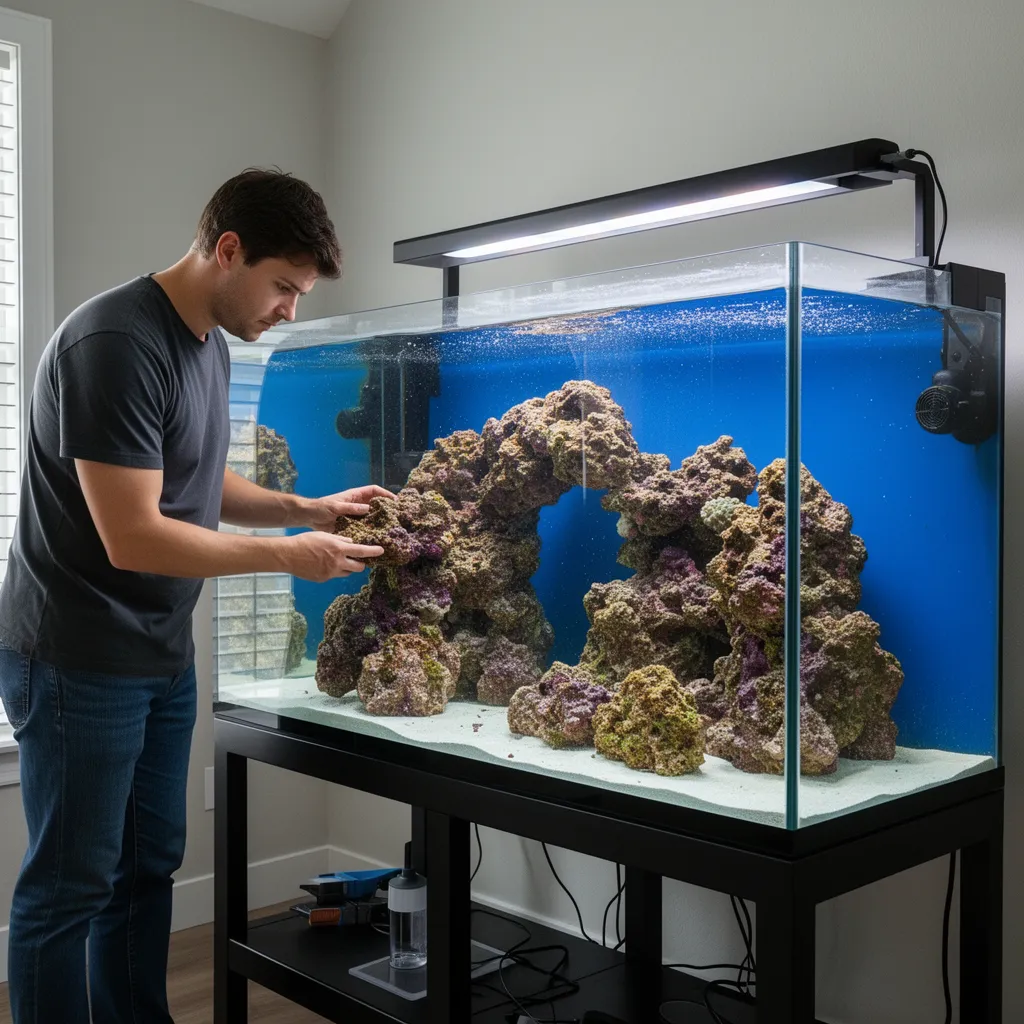
Setting Up A Reef Tank
Setting up a reef tank is easier when you focus on stability, smart equipment, and slow stocking. This…
 By
ByPowerhead Placement for Reef Tanks
Dial in reef tank flow with smart powerhead placement. Learn proven layouts, targets, and troubleshooting for cleaner sand…
[favorite_button]
My Bookmarks:
To see full list click here
[user_favorites user_id="" include_links="true" site_id="" post_types="" include_thumbnails="true" thumbnail_size="thumbnail" include_excerpt="false"]