

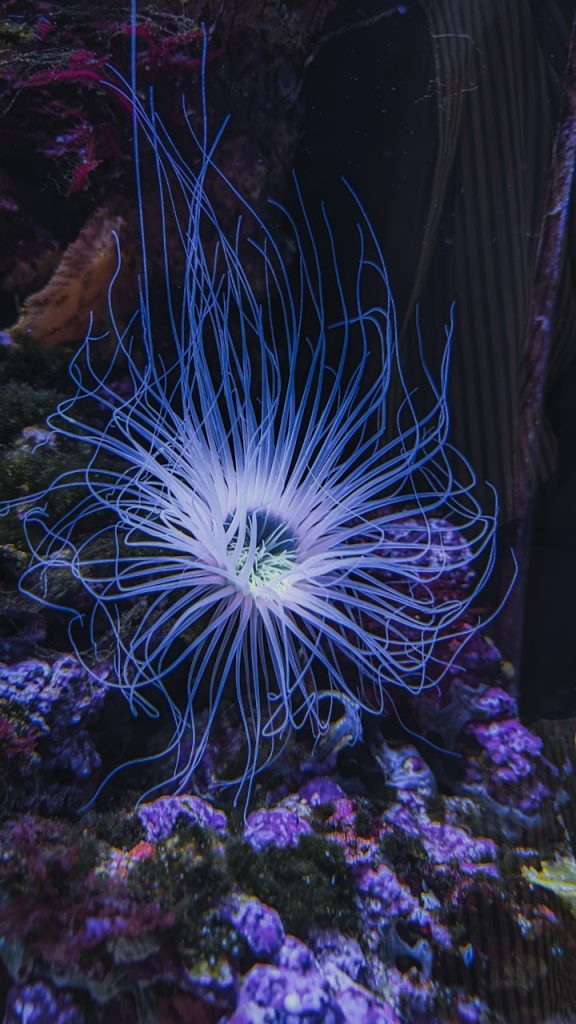
Tube anemones (often sold as Ceriathus sp.) are some of the most striking “anemone-like” animals in the hobby, with long, flowing tentacles and neon oral discs that look incredible under reef lighting. They are also one of the most misunderstood. Tube anemones are not true sea anemones, they do not host clownfish, and they can sting nearby corals and fish that blunder into their tentacles. The good news is that with the right substrate, placement, and feeding routine, a tube anemone can be a hardy, long-lived centerpiece for a sandbed-focused marine aquarium.
This guide covers tube anemone identification basics, ideal tank setup, water parameters, lighting and flow, feeding, compatibility, and troubleshooting the most common problems reef keepers run into.
Quick Care Summary
| Difficulty | Moderate (mainly placement and compatibility) |
| Tank size | 20+ gallons (larger is easier) |
| Placement | Deep sandbed, low rock contact, open space |
| Lighting | Low to moderate (species dependent) |
| Flow | Low to moderate, indirect |
| Feeding | Meaty foods 1–3x/week |
| Reef safe? | “With caution” (can sting corals and fish) |
| Special need | 4–6+ inches of sand to bury its tube |
What Is a Tube Anemone (Ceriathus sp.)?
Tube anemones belong to the order Ceriantharia (often called “tube-dwelling anemones”). Unlike true anemones, they live inside a protective tube they build from mucus and sand or detritus. In an aquarium, that means they need a deep, stable sandbed so they can anchor and feel secure.
Most specimens in the trade are labeled Ceriathus sp. or simply “tube anemone,” and coloration varies wildly. Common traits include:
- Two rings of tentacles: longer outer tentacles and shorter inner tentacles around the mouth
- Burrowing behavior: the animal retracts into its tube when startled
- Strong sting: potent nematocysts that can damage corals and injure fish
Natural Habitat
In the wild, tube anemones are found in sandy or muddy substrates, often in lagoons, seagrass beds, and sheltered reef slopes where fine sediment accumulates. They bury their tube deep into the substrate and extend their tentacles to capture zooplankton and small meaty particles drifting by. This lifestyle explains the two most important husbandry points:
- They need depth: a shallow sandbed makes them restless and prone to wandering.
- They prefer indirect flow: enough movement to deliver food, not so much that it blasts sand into their tentacles.
Tank Requirements and Aquascape
A tube anemone is a sandbed animal first and foremost. Many failures come from trying to “rock place” them like a bubble tip anemone. Plan your aquascape around giving it a dedicated zone.
Minimum Tank Size
While small specimens can live in a 20 gallon tank, 30–50+ gallons is a more comfortable starting point. Larger water volume helps stabilize salinity, temperature, and nutrients, which matters because tube anemones can react poorly to sudden changes.
Sandbed Depth and Grain Size
Provide 4–6 inches of sand minimum. For larger tube anemones, 6–8 inches is even better. Use fine to medium aragonite (sugar-sized to ~1 mm). Very coarse gravel can make it hard for the animal to build a stable tube and can irritate tissue.
Placement tip: Create a “sand cup” or deeper pocket in one area of the tank. Many keepers slope the sandbed so the tube anemone has a deep zone while the rest of the tank stays easier to maintain.
Open Space and Stinging Radius
Tube anemones can extend surprisingly far, especially at night. Leave a generous buffer between the anemone and corals. A practical rule is 6–12 inches of clearance in all directions, more for large individuals. If a tentacle brushes an LPS or soft coral repeatedly, expect tissue loss on the coral.
Avoid placing them where they can easily touch:
- Euphyllia (torch, hammer, frogspawn)
- Zoanthids and palythoas
- Most SPS (Acropora, Montipora)
- Clams (mantle damage risk)
Water Parameters
Tube anemones tolerate a range, but they do best with reef-stable parameters and consistent salinity. Stability is more important than chasing exact numbers.
| Parameter | Recommended Range |
|---|---|
| Temperature | 24–26°C (75–79°F) |
| Salinity | 1.025–1.026 SG (35 ppt) |
| pH | 8.1–8.4 |
| Alkalinity | 8–10 dKH |
| Calcium | 400–450 ppm |
| Magnesium | 1250–1400 ppm |
| Ammonia / Nitrite | 0 |
| Nitrate | 2–20 ppm |
| Phosphate | 0.03–0.15 ppm |
Tube anemones are not especially demanding about calcium and magnesium (they do not build a calcium skeleton), but keeping standard reef ranges supports overall system health and helps avoid pH swings.
Lighting Requirements
Most tube anemones in the hobby do well under low to moderate lighting. They can contain symbiotic algae (zooxanthellae) to varying degrees depending on species and collection location, but you should not assume light alone will sustain them long-term. Plan to feed.
Practical lighting guidance:
- Start low if the animal is newly imported or has been kept under dim lighting at the store.
- Acclimate gradually over 2–3 weeks if moving to stronger LEDs.
- Avoid blasting PAR directly over the oral disc. If the anemone stays retracted during peak photoperiod, lighting may be too intense (or flow is too strong).
Blue-heavy reef lighting often brings out the best fluorescence, but coloration is not a substitute for nutrition. A well-fed tube anemone typically shows fuller tentacle extension and quicker feeding responses.
Water Flow
Aim for low to moderate, indirect flow. You want enough movement to keep oxygen high and carry food to the tentacles, but not so much that the animal cannot fully extend or that sand is constantly kicked up.
Signs flow is too strong:
- The anemone stays partially closed most of the day
- Tentacles are pinned in one direction and look “stressed”
- Sand blows into the oral disc
- The animal repeatedly abandons its tube and relocates
Signs flow is too weak:
- Detritus accumulates around the tube opening
- Cyanobacteria or film algae builds up on the sandbed nearby
- Feeding response is sluggish because food does not drift past the tentacles
Feeding Tube Anemones
If you want long-term success, feeding is non-negotiable. Tube anemones are active predators and particle catchers. In a clean, heavily skimmed reef tank, they can slowly starve even if they look fine for months.
Best Foods
- Mysis shrimp
- Chopped krill or plankton
- Chopped raw shrimp, scallop, or clam (marine-sourced if possible)
- Enriched brine shrimp (as a supplement, not a staple)
- Small sinking pellets or frozen blends for carnivores (occasionally)
Food size matters. Offer pieces roughly the size of the anemone’s mouth or smaller. Oversized chunks are often dropped later, which can foul water and attract scavengers that irritate the anemone.
How Often to Feed
For most systems, feed 1–3 times per week. Smaller specimens benefit from smaller meals more often. If nutrients climb, reduce portion size rather than eliminating feeding entirely.
Feeding Technique
Target feeding works best:
- Turn off or reduce flow for 10–20 minutes.
- Use a turkey baster or pipette to gently deliver food to the tentacles.
- Let the tentacles capture and move the food inward naturally.
- Restore flow once the food is clearly being ingested.
If fish steal food, try feeding the tank first, then target feed the tube anemone after the fish are distracted.
Compatibility: Reef Fish, Corals, and Inverts
Tube anemone compatibility is where most “reef safe” assumptions break down. They are not automatically a community-friendly add. Think of them as a sandbed predator with a powerful sting.
Fish Compatibility
Most healthy, aware fish avoid tube anemones, but accidents happen, especially at night. Avoid keeping them with:
- Slow, perching fish (some gobies, blennies) that may rest near the sandbed
- Long-finned fish that can brush tentacles easily
- Very small fish that can be captured (tiny gobies, juvenile fish)
Clownfish do not host tube anemones reliably and may be stung. Do not buy a tube anemone expecting a clownfish relationship.
Coral Compatibility
Tube anemones can sting and damage corals on contact. They are best in:
- Fish-only systems with sandbed décor
- Soft coral or LPS tanks where you can dedicate an isolated sand zone
- Lagoon-style reefs with open sand channels
Invertebrates
Cleaner crews are usually fine, but watch for:
- Hermit crabs picking at food during feeding and irritating the anemone
- Peppermint shrimp or other opportunistic shrimp stealing food
- Sand-sifting stars and aggressive sand stirrers undermining the tube
Nassarius snails are often a good match because they stay in the sand and help with leftover meaty foods, but they can mob the feeding area. If that happens, feed smaller portions and keep flow low until the anemone finishes.
Acclimation and Placement (Do This First)
Tube anemones ship poorly compared to many corals because damage to the column or tube can lead to infection and rapid decline. Take your time with acclimation.
- Temperature acclimate 15–20 minutes.
- Drip acclimate 30–60 minutes to match salinity.
- Inspect for damage: tears, mushy tissue, foul odor are red flags.
- Do not force it into sand: place it on the sand in a low-flow area and let it dig on its own.
If you want to help it settle, you can place a short section of wide PVC (or a plastic cup with the bottom removed) into the sand to create a sheltered “starter burrow.” The anemone often anchors inside and then builds its tube more securely.
Common Problems and Troubleshooting
1) My tube anemone won’t bury itself
The most common causes are insufficient sand depth, flow blasting the sandbed, or the animal being placed on rock. Confirm you have at least 4–6 inches of sand and relocate it to a calmer, deeper pocket. Also check for sand-sifting animals undermining it.
2) It keeps moving around the tank
Tube anemones wander when they cannot establish a stable tube or when conditions are irritating. Common triggers include:
- Too much flow
- Sandbed too shallow or too coarse
- Predatory or nosy tankmates (wrasses, crabs) bothering it
- Rapid parameter swings, especially salinity
Fix the environment rather than repeatedly “replanting” it. Frequent handling increases stress and can tear tissue.
3) The anemone is shrinking or staying closed
Some contraction is normal, especially after lights out or after being disturbed. Persistent shrinking usually points to starvation, poor water quality, or physical irritation.
- Increase feeding frequency (smaller meals).
- Verify ammonia and nitrite are zero.
- Check nitrate and phosphate are not bottomed out in an ultra-low nutrient tank.
- Look for fish picking at tentacles or crabs stealing food.
4) It dropped food or regurgitated a meal
This usually means the food was too large, the anemone was stressed, or scavengers harassed it. Offer smaller pieces and reduce flow during feeding. Remove uneaten food promptly to avoid nutrient spikes.
5) It stung my coral (or a fish got too close)
Unfortunately, this is part of keeping a tube anemone in a mixed reef. Give it more clearance and consider isolating it in a dedicated sand zone. If a fish is stung, keep water quality high, run carbon, and reduce stress. For corals, move the coral away, maintain stable alkalinity, and watch for tissue recession or infection.
Propagation: Can You Frag a Tube Anemone?
In typical home aquariums, tube anemone propagation is uncommon and not something most hobbyists should attempt. Unlike some true anemones that can split, tube anemones do not reliably reproduce by simple division in captivity. Attempting to cut or “frag” one often results in fatal infection.
The best approach is to focus on long-term care: stable parameters, a deep sandbed, and consistent feeding. Healthy specimens can live for years and may occasionally produce larvae in mature systems, but this is not predictable.
Buying Tips: Choosing a Healthy Tube Anemone
When shopping, look for:
- Strong tentacle extension and quick retraction when startled
- Intact column with no tears or mushy areas
- No foul smell in the bag or holding container
- Good color (not bleached white), keeping in mind lighting can change appearance
If the store keeps it on bare bottom glass without sand, ask how long it has been there. A tube anemone that has been unable to anchor for weeks can be stressed even if it looks “open.”
FAQ
Do tube anemones host clownfish?
No. Tube anemones are not natural clownfish hosts and clownfish may be stung if they try to force a relationship.
Are tube anemones reef safe?
They are “reef safe with caution.” They can sting and damage corals and may capture small or sleeping fish. Give them space and plan placement carefully.
How deep should the sandbed be for a tube anemone?
Aim for 4–6 inches minimum, with 6–8 inches preferred for larger specimens. Fine to medium sand works best for tube stability.
How often should I feed a tube anemone?
Most do well with meaty foods 1–3 times per week. Feed smaller portions more often for small specimens, and adjust to keep nutrients stable.
Why does my tube anemone retract suddenly?
Sudden retraction is normal when startled by shadows, fish, or flow changes. If it stays closed for long periods, check for excessive flow, poor water quality, or inadequate feeding.
Takeaway: A tube anemone (Ceriathus sp.) thrives when it can bury deep in a calm sandbed zone, receive regular meaty feedings, and stay well separated from corals and clumsy tankmates.
Was this helpful?
Related Posts
Reef Lighting For Soft Corals
Learn the ideal PAR, spectrum, and photoperiod for reef lighting for soft corals, plus placement and troubleshooting tips.
 By
By
Coral Care Troubleshooting
Learn how to diagnose coral stress, match symptoms to causes, and fix common reef tank problems before they…
[favorite_button]
My Bookmarks:
To see full list click here
[user_favorites user_id="" include_links="true" site_id="" post_types="" include_thumbnails="true" thumbnail_size="thumbnail" include_excerpt="false"]