
Drip acclimation helps new fish and inverts adjust safely. It reduces shock from salinity, pH, and temperature swings. Use it when you want a slow, controlled transition.
Why drip acclimation works in reef tanks
Most losses after purchase come from fast parameter changes. Salinity is the biggest trigger. A store bag may be 1.018 to 1.022. Many reefs run 1.025 to 1.026. That jump can stress gills and osmoregulation.
pH also shifts quickly during transport. Carbon dioxide builds in the sealed bag. pH drops while ammonia stays less toxic. Once you open the bag, pH rises and ammonia becomes more dangerous. This is why timing and steps matter.
Drip acclimation lets you match salinity and pH slowly. It also gives you time to inspect the animal. Look for rapid breathing, clamped fins, or torn tissue. If you see severe distress, shorten the process and stabilize water fast.
Use drip acclimation most for shrimp, snails, crabs, starfish, and anemones. These animals handle salinity swings poorly. Many fish do fine with faster methods. Still, drip acclimation is a safe default for mixed reef stocking.
- Best candidates: shrimp, snails, urchins, starfish, anemones
- Common trigger: salinity swing over 0.002 specific gravity
- Goal: match salinity within 0.001 before transfer
Step-by-step drip acclimation setup
Prepare a clean bucket or specimen container. Keep it fish-only safe and soap-free. Dim the room lights to reduce stress. Gather airline tubing, a valve or knot, and a thermometer.
Float the sealed bag for 10 to 15 minutes. This matches temperature first. Then open the bag and pour the animal and water into the container. Keep water depth shallow for fish that may jump. Use a lid or mesh if needed.
Start a siphon from the display or quarantine tank. Use airline tubing and control flow. Aim for 2 to 4 drips per second for fish. Use 1 to 2 drips per second for inverts. If you have a valve, use it for stable control.
Double the container volume over 15 to 20 minutes. Then remove half the water and repeat. Do this for 45 to 90 minutes total. For sensitive inverts, go 90 to 120 minutes. Test salinity with a refractometer before transfer.
- Fish flow rate: 2–4 drips per second
- Invert flow rate: 1–2 drips per second
- Typical time: fish 45–60 minutes, inverts 90–120 minutes
- Transfer target: within 0.001 specific gravity of tank water
Parameters, timing, and common mistakes
Track three numbers during acclimation. Watch temperature at 24 to 26°C (75 to 79°F). Keep salinity stable at your tank target, often 1.025 to 1.026. Maintain pH around 8.0 to 8.4 in the receiving system.
Avoid long exposure to dirty bag water. This is the main drip mistake. Once the bag is opened, ammonia risk rises. If the bag smells sharp or the fish is gasping, shorten acclimation. Move the animal into clean water sooner.
Never pour bag water into your tank. It can carry parasites and copper traces. Use a net for fish and a cup for delicate inverts. For shrimp, keep them submerged during transfer. Air exposure can stress gills and soft tissue.
Quarantine improves results more than any acclimation trick. Use drip acclimation into quarantine when possible. Then observe for 2 to 4 weeks. For more planning, see quarantine tank setup. For baseline targets, review reef tank water parameters. If you need stable salinity, read how to calibrate a refractometer.
- Do not exceed 2 hours in bag water after opening
- Use a heater nearby if room temperature is cool
- Match salinity first, then focus on gentle transfer
- Skip drip for many fish if ammonia is high
Drip acclimation is simple and repeatable. It protects sensitive animals from sudden swings. Use measured flow, test salinity, and keep the process clean. With good quarantine and stable parameters, new arrivals settle in faster.
Sources: [Fenner, R. “The Conscientious Marine Aquarist.” TFH Publications], [Delbeek & Sprung. “The Reef Aquarium, Vol. 1.” Ricordea Publishing], [Hemdal, J. “Diseases of Marine Fishes.” Wiley-Blackwell]
Was this helpful?
Related Posts
Easy Corals for Small Reef Tanks
Easy corals for small reef tanks that stay hardy and colorful. Get simple picks, placement tips, and stable…
 By
By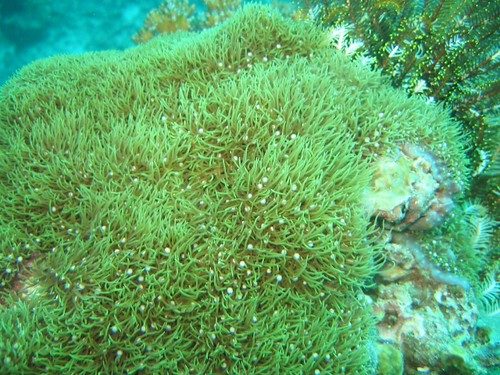
Green Star Polyps Care
Green star polyps are easy, fast-growing corals that love moderate light and flow. Learn how to keep them…