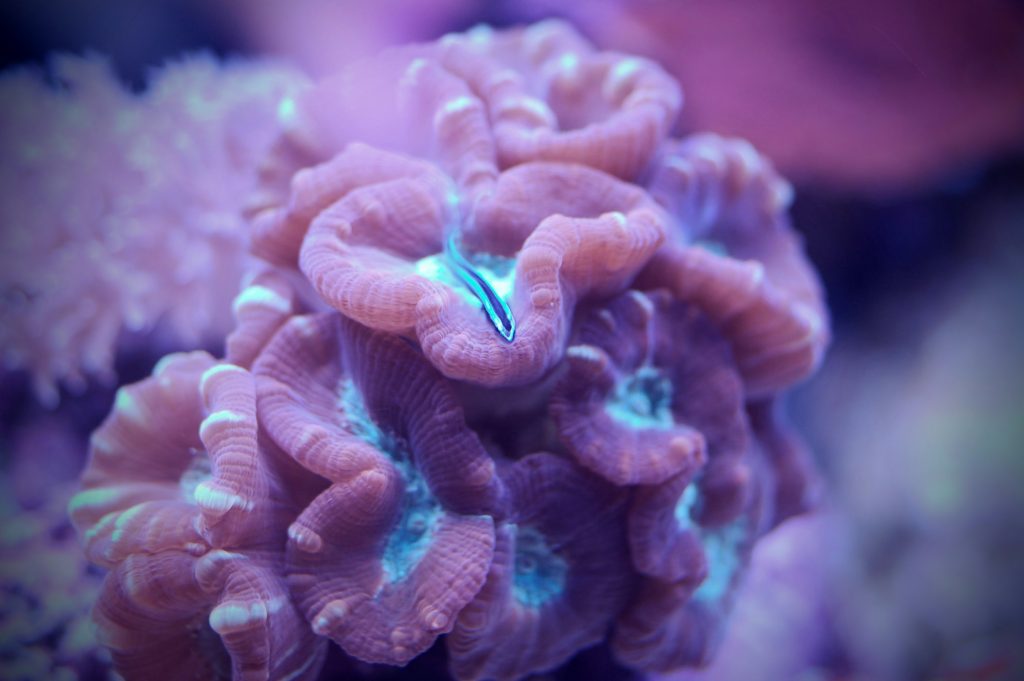
Candy cane corals are hardy LPS that suit many reef tanks. They inflate at night and show strong feeding responses. With stable parameters, they grow fast and split into new heads.
Placement, lighting, and flow
Candy cane corals (Caulastrea) like moderate light and gentle flow. Start them low to mid level in most reef LEDs. Aim for about 75–150 PAR at the coral. Raise PAR slowly over two weeks.
Flow should move the tentacles without folding tissue over the skeleton. Use indirect, turbulent flow instead of a jet. If tissue stays retracted, reduce flow and check for stinging neighbors. Give them space, since sweeper tentacles can reach 2–3 inches.
Mount the frag on a stable rock or plug. Avoid placing them where sand blasts the flesh. Keep them away from aggressive LPS like torches and galaxea. For more on spacing, see our reef tank coral placement guide.
- Start at 50–80 PAR, then increase by 10–15% per week.
- Target 5–15x turnover in the coral’s zone.
- Leave a 3–4 inch buffer from other LPS.
Water parameters and stability targets
Stable alkalinity drives candy cane growth more than high numbers do. Keep alkalinity at 8.0–9.0 dKH and avoid swings over 0.3 dKH per day. Maintain calcium at 400–450 ppm and magnesium at 1250–1400 ppm.
Keep temperature at 76–79°F with less than 1°F daily swing. Salinity should be 1.025–1.026 specific gravity. pH should sit around 8.1–8.4, with good gas exchange. Nitrate at 5–15 ppm and phosphate at 0.03–0.10 ppm often works well.
Test alkalinity two to three times per week in growing systems. Dose two-part or kalkwasser to match demand. If you run an ultra-low nutrient tank, feed more and reduce aggressive filtration. For dosing basics, read alkalinity and calcium dosing in reef tanks.
- Alk: 8.0–9.0 dKH (keep daily change under 0.3 dKH).
- Ca: 400–450 ppm, Mg: 1250–1400 ppm.
- NO3: 5–15 ppm, PO4: 0.03–0.10 ppm.
Feeding, growth, and common problems
Candy cane corals can live on light and dissolved nutrients. They grow faster with direct feeding. Feed one to three times per week, after lights dim. Look for feeder tentacles and a sticky mouth.
Use small foods that fit the polyp. Try thawed mysis chopped fine, brine shrimp, or reef roids mixed into a paste. Turn off pumps for 10–15 minutes. Target feed each head with a pipette. Resume flow slowly to prevent food theft.
New heads form at the base of each corallite. You may see a “bud” ridge on the skeleton. Growth often speeds up when alkalinity is steady and nutrients are not stripped. If tissue recedes, check for alkalinity swings, high flow, or stings.
Brown jelly can hit stressed LPS and spreads fast. Siphon the slime, then dip in iodine per label directions. Improve flow and remove dying tissue if needed. If heads stay closed, check for pests and fish nipping. Peppermint shrimp and some angels may pick at flesh. For a full prep routine, see reef coral quarantine and dip steps.
- Feed at night with pumps off for 10–15 minutes.
- Watch for tissue recession around sharp skeleton edges.
- Quarantine new frags for 14 days when possible.
Candy cane corals reward stable tanks with fast, visible growth. Keep light and flow moderate and consistent. Hold alkalinity steady and feed small portions weekly. With space and patience, they become a reliable show coral.
Sources: Borneman, E. “Aquarium Corals”; Delbeek & Sprung, “The Reef Aquarium” Vol. 1–3; Fenner, R. “The Conscientious Marine Aquarist”.
Was this helpful?
Related Posts
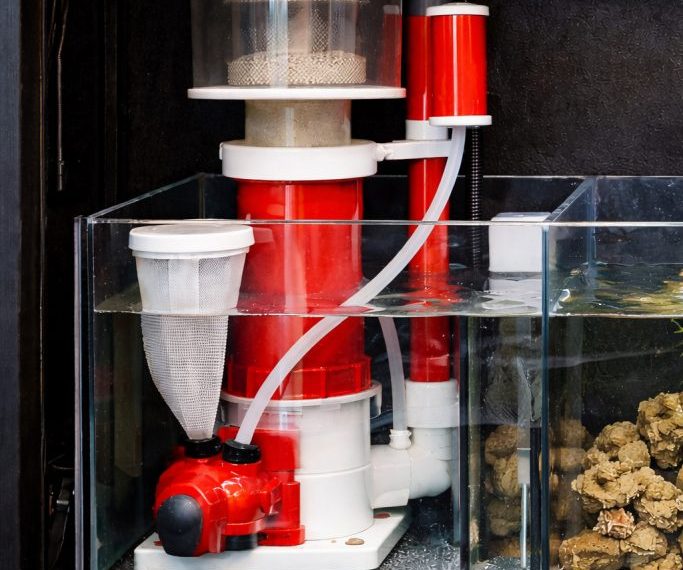
Protein Skimmer Reef Tank Guide
Learn how a protein skimmer works, how to size one, and how to tune it for a cleaner,…
 By
By
Reef Aquarium Water Parameters
Learn the ideal reef aquarium water parameters, safe ranges, and how to keep salinity, alkalinity, nutrients, and pH…