
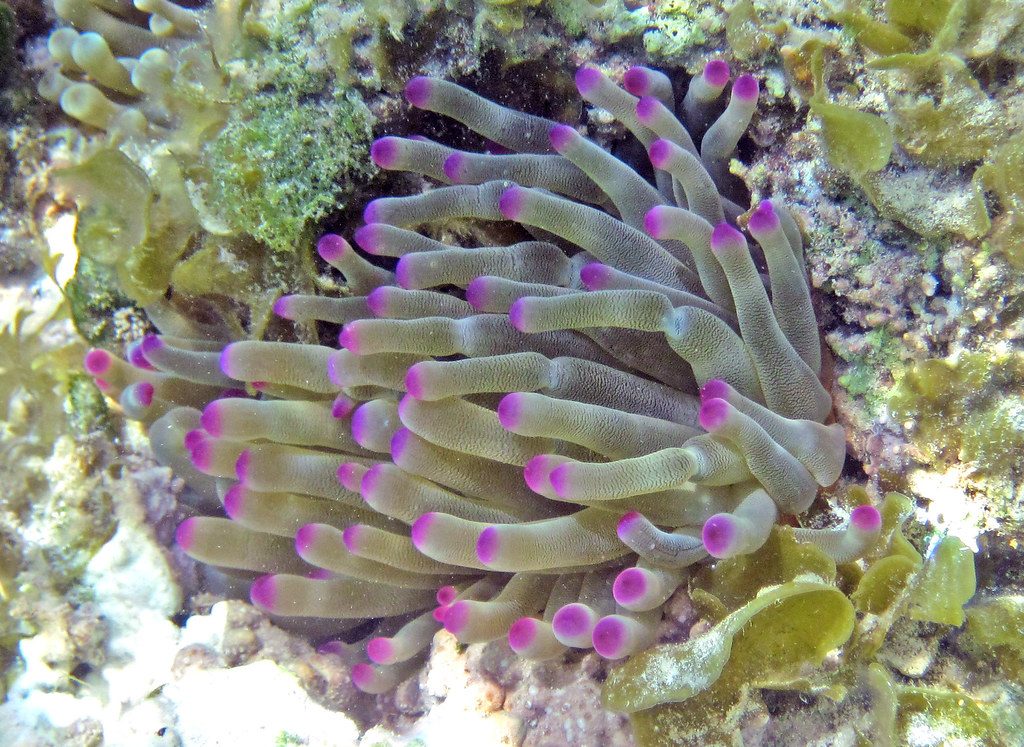
Condylactis anemones (Condylactis gigantea) are big, beautiful Caribbean anemones that show up in the hobby labeled as “condy anemone.” They’re hardy compared to many host anemones, but they come with an important catch: they are not natural clownfish hosts and they can wander, sting, and eat small fish if conditions push them to. This guide covers how to keep a Condylactis anemone healthy long-term, what tank setup actually works, and how to avoid the most common problems reef keepers run into.
Quick care overview
| Scientific name | Condylactis gigantea |
| Common names | Condylactis anemone, Condy anemone |
| Origin | Caribbean and Western Atlantic |
| Difficulty | Moderate (hardy, but mobile and predatory) |
| Tank size | 30+ gallons (50+ preferred) |
| Lighting | Moderate to high (PAR ~100–250) |
| Flow | Moderate, indirect, variable |
| Feeding | 1–2x weekly meaty foods |
| Reef safety | Not “reef safe” with corals due to stings and roaming |
| Key risk | Wandering into pumps, stinging neighbors, eating small fish |
Natural history and why it matters in captivity
Condylactis gigantea is a large anemone found on reefs, seagrass edges, and sandy or rubble zones throughout the Caribbean and parts of the Western Atlantic. In the wild it often anchors its foot (pedal disc) deep into crevices or under rocks while extending long, sometimes brightly tipped tentacles into the current to catch plankton and small prey.
This ecology explains three big husbandry points:
- It wants a secure “foot hold” (a protected hole or crack), not open sand with nowhere to attach.
- It expects real food. Like many anemones, it has zooxanthellae, but it thrives with supplemental feeding.
- It is built to capture prey. A hungry or stressed condy can and will grab small fish or shrimp.
Tank requirements for a Condylactis anemone
Tank size and maturity
A Condylactis anemone can be kept in a 30 gallon tank, but 50 gallons or larger is a lot easier. Bigger water volume buffers swings in temperature, salinity, and nutrients, and it gives the anemone space to settle without immediately touching corals.
Try to place condys in a stable, established aquarium (ideally 4–6+ months old). They are more forgiving than many host anemones, but they still react poorly to instability, especially salinity swings and sudden lighting changes.
Aquascape: give the foot a real home
The best setup is a rock structure with deep crevices and shaded holes that open to an area with light and flow. Many condys will wedge their foot under a rock ledge and extend outward. If you only provide flat rock or open sand, they often roam until they find something they consider safe.
Practical tips:
- Create a “cup” or crack between rocks where the pedal disc can disappear.
- Keep at least 6–10 inches of clearance from corals (more in smaller tanks).
- Use stable rockwork. A large anemone pulling on a loose rock can cause collapses.
Protect your equipment
Because condys can move, you must plan for the “anemone in a pump” scenario. Powerhead guards, foam covers, or anemone-safe intake screens are not optional in a serious anemone setup. A shredded anemone can crash a tank quickly through tissue decay and toxin release.
Water parameters (target ranges)
Condylactis anemones do best with reef-stable parameters. They tolerate less-than-perfect numbers better than many anemones, but they do not tolerate instability.
| Parameter | Recommended range |
|---|---|
| Temperature | 76–80°F (24.5–26.5°C) |
| Salinity | 1.025–1.026 SG (35 ppt) |
| pH | 8.1–8.4 |
| Alkalinity | 8–10 dKH |
| Calcium | 400–450 ppm |
| Magnesium | 1250–1400 ppm |
| Ammonia / Nitrite | 0 |
| Nitrate | 2–15 ppm |
| Phosphate | 0.03–0.15 ppm |
Stability beats chasing numbers. If you run ultra-low nutrients, be consistent and feed the anemone. If you run a “dirtier” mixed reef, keep nitrate and phosphate controlled and avoid sudden swings from aggressive nutrient removal.
Lighting requirements
Condylactis anemones contain symbiotic zooxanthellae and benefit from reef lighting. In most tanks they do well under moderate to high light, roughly PAR 100–250 at the oral disc once acclimated. Too little light often leads to stretching, shrinking, or chronic wandering. Too much light too fast can cause bleaching.
Lighting best practices:
- Acclimate slowly if moving from dim store lighting to strong LEDs. Use a ramp schedule or reduce intensity for 1–2 weeks.
- Provide a light gradient with shaded areas. Many condys choose a spot where the foot is shaded and the tentacles reach into brighter light.
- If the anemone becomes pale, prioritize stable light + feeding rather than constantly moving it.
Water flow: strong enough to breathe, not enough to get blasted
Aim for moderate, indirect flow that gently moves the tentacles but does not fold them over or keep the anemone contracted. Condylactis anemones use flow to deliver oxygen and food and to remove waste. In stagnant areas they can decline even if lighting is good.
What “good flow” looks like:
- Tentacles sway and extend, not whip violently.
- The oral disc stays open and relaxed most of the day.
- Detritus does not accumulate around the base.
What “bad flow” looks like:
- Constant shrinking or staying balled up.
- Tentacles pinned to one side all day.
- Frequent wandering, especially right after you change pump settings.
Feeding a Condylactis anemone
Even under strong lighting, a Condylactis anemone typically does best with regular meaty feedings. Feeding supports growth, coloration, and recovery from shipping stress or mild bleaching.
What to feed
- Thawed mysis shrimp
- Chopped raw shrimp, scallop, clam, or squid
- Small pieces of marine fish (use sparingly)
- Quality frozen blends for carnivores
Avoid large chunks that the anemone struggles to swallow. If it repeatedly spits food back out after 10–30 minutes, the pieces are too big, the anemone is stressed, or water quality is off.
How often to feed
For most tanks, feed 1–2 times per week. If the anemone is pale, recently imported, or recovering from injury, smaller meals 2–3 times per week can help. If nutrients climb, reduce feeding frequency and improve export rather than starving the anemone.
Feeding tips that prevent trouble:
- Use tongs or a turkey baster to place food onto the tentacles near the mouth.
- Turn off strong pumps for 10–15 minutes so the anemone can grab the food.
- Watch for fish stealing food. Use a feeding dome or gently distract fish with a small broadcast feed first.
Compatibility: fish, corals, and inverts
Is a Condylactis anemone a clownfish host?
No. Condylactis anemones are Caribbean species and clownfish are Indo-Pacific. Some captive clownfish may “try” to use a condy, but it is not a natural relationship and can end badly. Condys can sting clowns, and clowns can irritate an anemone that is not adapted to being hosted.
If your goal is a classic clownfish-anemone pair, you are better off with a true host anemone species and a mature, stable system built around it.
Reef compatibility with corals
Condylactis anemones are not reliably reef safe in mixed coral tanks. The main issue is not that they “attack” corals on purpose, but that they can move. When they wander, they can sting and kill LPS, soft corals, and even some SPS that get touched by the tentacles or the anemone’s foot.
If you keep one in a reef, plan your layout like you would for a high-sting LPS:
- Give it a dedicated island or zone with space around it.
- Keep high-value corals out of its potential path.
- Expect that it may relocate after major changes (new lights, new pumps, big water change).
Invertebrates and “cleanup crew”
Large condys can capture and eat small shrimp or crabs, especially at night or right after feeding when tentacles are sticky. Cleaner shrimp and peppermint shrimp sometimes coexist, but it is never guaranteed. Snails are usually safe unless they fall directly into the tentacles.
Fish safety
Most healthy medium-sized reef fish avoid a condy, but small fish (tiny gobies, firefish, newly added fish, sleeping fish near the anemone) are at risk. Risk goes up if the anemone is hungry, placed near a favorite sleeping ledge, or if fish are stressed and weak.
Common problems and troubleshooting
1) My Condylactis anemone keeps moving
Wandering is almost always the anemone telling you something is off. The usual causes are too much direct flow, not enough light, unstable salinity, or no secure place for the foot.
Fix it with a checklist approach:
- Confirm salinity with a calibrated refractometer (not a swing-arm hydrometer).
- Provide a crevice where the foot can attach under a ledge.
- Adjust flow so it is indirect. Point pumps away or bounce flow off glass/rock.
- Check PAR and photoperiod. If lighting is weak, move the rock structure, not the anemone itself.
- Avoid repeated manual relocation. It stresses the foot and can cause tears.
2) It shrinks up at night or periodically deflates
Some inflation and deflation is normal. Anemones periodically expel water and waste. However, extended deflation (many hours daily, day after day) is a red flag.
Common causes include:
- Recent shipping stress (give it time, stable conditions, and gentle feeding)
- Low oxygen or poor flow
- Rapid parameter swings, especially salinity and temperature
- Irritation from fish picking or crabs walking through it
If the mouth is gaping, tissue is turning to mush, or it is melting, treat it as an emergency: improve aeration, check ammonia, run fresh carbon, and be prepared to remove the anemone if it is clearly disintegrating.
3) Bleaching (turning pale or white)
Bleaching means the anemone has lost zooxanthellae or pigment, usually from light shock, temperature stress, or poor water quality. A bleached condy can recover, but it needs consistency.
Recovery plan:
- Stabilize temperature and salinity first.
- Keep light moderate and stable. Do not blast it with maximum intensity immediately.
- Feed small portions 2–3 times per week.
- Maintain detectable nutrients (avoid stripping nitrate/phosphate to zero).
4) The anemone won’t eat or keeps spitting food out
This is usually caused by oversized food, stress, or poor water quality. Try smaller pieces (mysis or finely chopped seafood). Make sure the anemone is sticky and able to hold food. If it is not sticky, focus on stability, light, and flow before pushing heavy feedings.
5) It got into a powerhead or overflow
Immediately shut down pumps, remove damaged tissue if possible, and run fresh activated carbon. Test ammonia and be ready for a large water change. If the anemone is severely shredded, removal is often the safest option to prevent a tank crash. This is why guarded intakes and anemone-proof flow planning matter from day one.
Propagation and splitting
Unlike some anemones that commonly split in captivity, Condylactis anemones do not reliably reproduce by splitting in home aquariums. Hobbyists should not plan on “fragging” a condy the way you might with certain corals or even some anemone species. Physical cutting is risky and can lead to infection, tissue necrosis, and loss.
If your condy grows too large for the space, the best solution is usually to rehome it to a larger, appropriately planned tank rather than attempting propagation.
Buying tips: choosing a healthy Condylactis anemone
Pick the animal, not the color. A healthy condy typically shows:
- Sticky tentacles that grab gently when touched (do not handle if you can avoid it)
- Closed, tight mouth (not gaping)
- Good inflation and responsiveness to light and flow
- Intact foot with no tears or exposed internal tissue
Skip specimens that are detached and tumbling around the store tank, have a wide-open mouth, or look like they are melting. Those are often already in a downward spiral.
FAQ
Are Condylactis anemones reef safe?
Not reliably. They can roam and sting corals. They are best in a species-focused tank or a reef with a dedicated anemone zone and lots of clearance.
Will a Condylactis anemone host clownfish?
They are not natural clownfish hosts. Some clowns may try, but it can stress the anemone and may lead to stings or injury. Choose a true host anemone if hosting is your goal.
How often should I feed a Condylactis anemone?
Typically 1–2 times per week with small meaty foods like mysis or finely chopped shrimp. Increase to 2–3 small feedings weekly during recovery or after bleaching.
Why does my condy anemone keep shrinking and expanding?
Some deflation is normal as it expels waste. Persistent or daily long deflation can indicate stress from unstable salinity, poor flow, low oxygen, or irritation from tankmates.
Can a Condylactis anemone eat fish or shrimp?
Yes. They are predatory and can capture small fish or shrimp, especially if hungry, if prey sleeps nearby, or if the animal is placed where fish hover close to the tentacles.
Was this helpful?
Related Posts
Kenya Tree Corals
Kenya Tree corals are hardy soft corals with easy care, moderate light needs, and fast growth. Learn placement,…
 By
By
Rhodactis Mushrooms Care
Rhodactis mushrooms are hardy reef corals that prefer low to moderate light, gentle flow, and stable water. Learn…
[favorite_button]
My Bookmarks:
To see full list click here
[user_favorites user_id="" include_links="true" site_id="" post_types="" include_thumbnails="true" thumbnail_size="thumbnail" include_excerpt="false"]