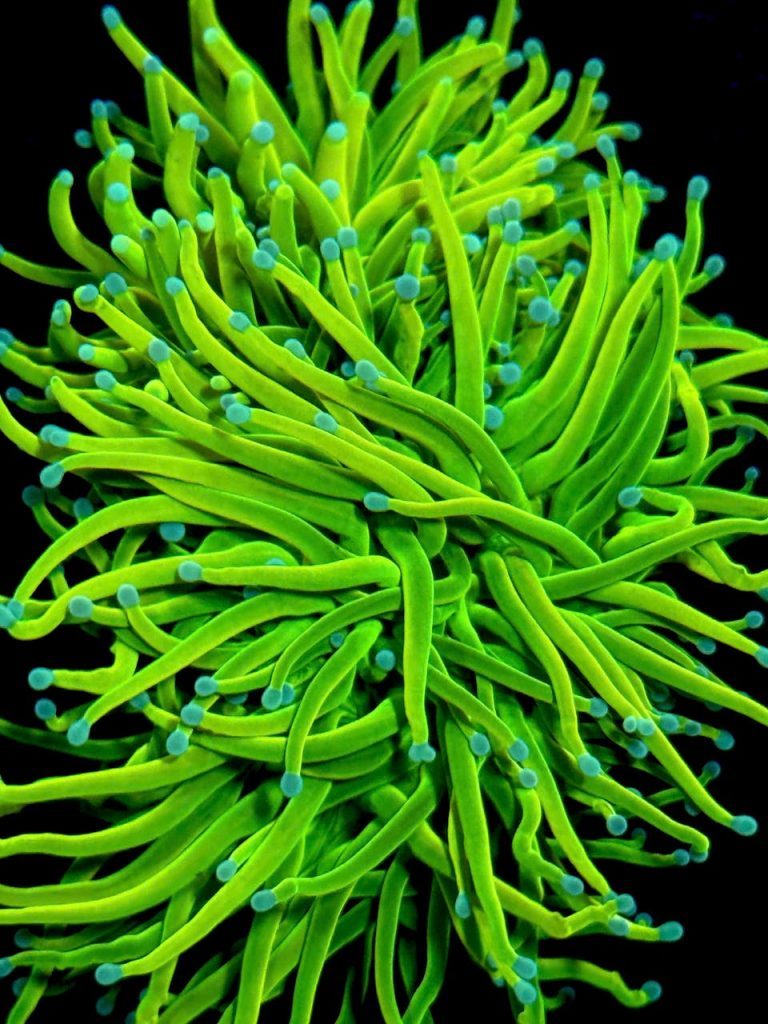
Torch corals add motion and color to reef tanks. Their long tentacles look calm, but their care needs are specific. Stable water and smart placement prevent most problems.
Tank setup and placement
Torch corals are Euphyllia with strong sweeper tentacles. Give them space from neighbors. Plan for 6 to 10 inches of reach at night. This prevents stings and tissue loss.
Use a mature tank that is at least 6 months old. Aim for 20 gallons or more for stability. Keep them on rock ledges or the sand edge. Avoid sharp rock that can cut flesh.
Flow should be low to moderate and indirect. The tentacles should sway, not whip. Too much flow causes retraction and torn tissue. Too little flow traps waste and can trigger brown jelly.
Lighting should be moderate for most torches. Start at 80 to 150 PAR at the coral. Increase slowly over two weeks if needed. Watch for bleaching, which signals too much light.
- Place torches away from other LPS by 8 to 12 inches.
- Use indirect flow that makes the tentacles wave in one direction.
- Acclimate to new light with 10% weekly intensity changes.
For more placement ideas, see reef tank flow guide. If you keep other Euphyllia, review Euphyllia Coral Care Guide.
Water parameters and stability
Torch corals hate swings more than “imperfect” numbers. Keep salinity at 1.025 to 1.026 specific gravity. Hold temperature at 77 to 79°F. Use an ATO to stop daily salinity drift.
Maintain alkalinity at 8 to 9 dKH for most mixed reefs. Keep calcium at 420 to 460 ppm. Keep magnesium at 1300 to 1400 ppm. Test alkalinity two to three times per week at first.
Nutrients should not be zero. Aim for nitrate at 5 to 15 ppm. Keep phosphate at 0.03 to 0.10 ppm. Very low nutrients can cause pale tissue and poor extension.
Use regular water changes to reset trace elements. A 10% weekly change works well. Run carbon if the tank has chemical warfare. Replace carbon every two to four weeks.
- Check salinity with a calibrated refractometer every week.
- Match new saltwater to tank temperature within 1°F.
- Correct alkalinity slowly, at 0.5 dKH per day maximum.
If you need a dosing plan, read alkalinity and calcium dosing basics. Stable dosing beats chasing test results.
Feeding, health checks, and troubleshooting
Torch corals can live on light, but feeding helps growth. Target feed once or twice per week. Use small meaty foods like mysis or finely chopped shrimp. Feed after lights dim for best response.
Turn off pumps for 10 to 15 minutes during feeding. Gently place food on tentacles with a baster. Do not overfeed, since excess rots in the head. If fish steal food, use a feeding dome.
Inspect the coral daily for early warning signs. A healthy torch shows steady extension and full color. Mild shrinking can be normal after handling. Persistent retraction often means flow, light, or pests.
Brown jelly disease is a common emergency. It looks like brown slime and rapid tissue loss. Increase flow slightly and siphon the slime fast. Consider an iodine dip for 5 to 10 minutes in a separate container.
- If tentacles whip hard, reduce flow or redirect the nozzle.
- If the skeleton shows, lower light by 20% and stabilize alkalinity.
- If heads split, keep parameters steady and avoid moving the coral.
Common mistakes include placing torches too close together. Another mistake is fast alkalinity correction after a low test. Also avoid adding a new torch without quarantine. A simple frag tank can prevent pests.
Sources: Borneman, E. (2001) Aquarium Corals; Delbeek & Sprung (1994–2005) The Reef Aquarium, Vol. 1–3; Julian Sprung (2007) Corals: A Quick Reference Guide.
Was this helpful?
Related Posts
Dragonets Fish Care
Dragonets are beautiful reef fish, but they need mature tanks and steady food sources. Learn how to keep…
 By
By
Lighting For Aquarium
Lighting for Aquarium: Getting Saltwater Illumination Right Lighting for a saltwater aquarium is about much more than simply…