New corals often fail from fast changes. Light, flow, and chemistry shifts stack up. A careful acclimation plan lowers stress and prevents tissue loss.
Prep before the coral arrives
Start with stable tank numbers for one full week. Keep salinity at 1.025 to 1.026. Hold temperature at 77 to 79°F. Aim for alkalinity 8 to 9 dKH, calcium 420 to 450 ppm, and magnesium 1300 to 1400 ppm.
Set nutrients in a safe range. Keep nitrate 5 to 15 ppm for most mixed reefs. Keep phosphate 0.03 to 0.10 ppm. Avoid zero readings, since corals can pale fast.
Plan a quarantine or observation space if you can. A 10 to 20 gallon coral QT works well. Use a small heater, a wavemaker, and a simple light. Read our coral quarantine basics for a simple setup.
Have tools ready before you open the bag. Use a clean bucket, a thermometer, and a refractometer. Keep coral dip, gloves, and paper towels nearby. Turn off white lights to reduce shock.
- Mix 2 to 5 gallons of fresh saltwater the day before.
- Match salinity within 0.001 specific gravity if possible.
- Prepare frag plugs and gel glue for quick mounting.
Temperature and water acclimation steps
Float the sealed bag for 15 to 20 minutes. This equalizes temperature. Do not open the bag during this step. Cold air and splashes can harm tissue.
Next, test the bag water salinity with a refractometer. Many vendors ship at 1.023 to 1.025. If your tank is 1.026, you need a slow change. A 0.002 jump can stress some LPS.
Use a drip acclimation for 20 to 40 minutes. Place the coral and bag water in a small container. Drip tank water at 2 to 4 drops per second. Stop when volume doubles, then discard half and repeat once.
Keep the coral submerged during transfers. Avoid exposing fleshy LPS to air. Some SPS tolerate brief air, but do not rely on it. If the coral shipped in very dirty water, shorten acclimation and prioritize a dip.
- If bag salinity is within 0.001, skip drip and do a short 10 minute mix.
- If temperature differs by more than 2°F, extend floating to 30 minutes.
- Never pour shipping water into your display tank.
Dip, inspect, and light acclimate
After water acclimation, inspect the coral under blue light and white light. Look for bite marks, eggs, and flatworms. Check the base for nuisance algae. Use a turkey baster to blow between branches and polyps.
Dip the coral in a separate container with tank water. Follow the product label for dose and time. Many dips run 5 to 10 minutes with gentle flow. Rinse in a second container of clean tank water before placement.
Light acclimation prevents bleaching. Start new corals low and shaded for 3 to 7 days. Reduce intensity by 30 to 50% if you use high PAR LEDs. Increase output by 5 to 10% every 3 to 4 days.
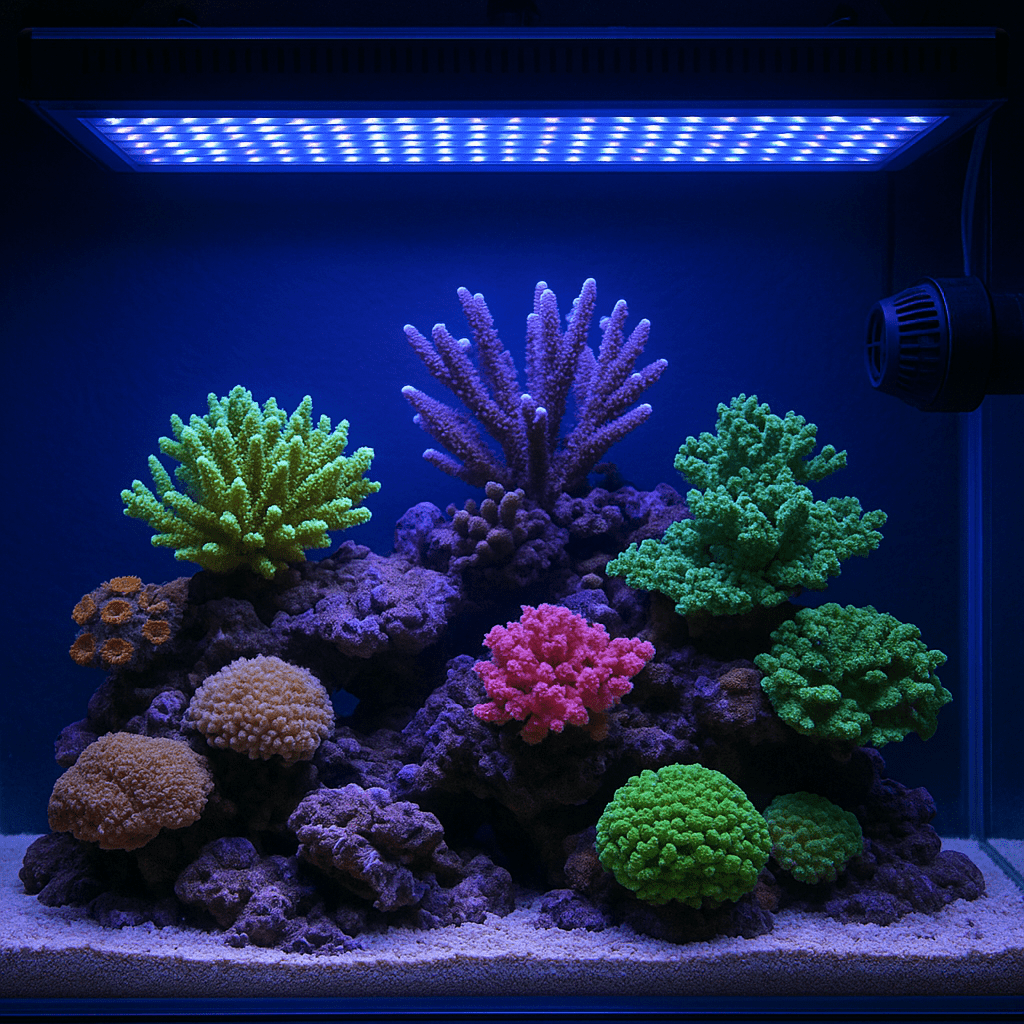
Use a real placement plan based on coral type. Many soft corals like 50 to 150 PAR. Most LPS prefer 75 to 200 PAR with moderate flow. Many SPS thrive at 200 to 350 PAR with strong, random flow. Our reef lighting PAR guide can help you estimate targets.
- Mount frags on a rack first for easy adjustment.
- Keep flow indirect to avoid tissue tearing on LPS.
- Label the date, vendor, and starting light level.
Troubleshooting and common mistakes
Closed polyps in the first 24 hours are common. Check temperature swings and salinity drift first. Verify alkalinity stability, since swings can burn tips. Keep daily alkalinity change under 0.3 dKH.
Bleaching often comes from too much light, too fast. Move the coral lower and reduce intensity 20%. Feed lightly to support recovery. Try small portions of reef roids or fine plankton twice weekly.
Tissue recession can come from pests or low alkalinity. Re-dip if you see flatworms or nudibranchs. Check for stinging neighbors and give 2 to 4 inches of space. Review our coral placement and flow tips for safer spacing.
A common mistake is chasing numbers right after adding coral. Do not change salt brands that week. Avoid large water changes unless ammonia is present. Stability beats perfection during the first month.
Sources: Borneman, E. “Aquarium Corals”; Delbeek & Sprung, “The Reef Aquarium” Vol. 1–3; Fenner, R. “The Conscientious Marine Aquarist”.
Acclimating corals is a repeatable process, not a guessing game. Match temperature and salinity, then dip and inspect. Ramp light and flow slowly, and you will see better color and growth.
Was this helpful?
Related Posts
Reef Aquarium Aquascaping Basics
Learn reef aquarium aquascaping basics, including rock layout, flow, coral placement, and common mistakes to avoid in a…
 By
By
Building Your First Reef Tank
Building your first reef tank is easier with a simple plan. Learn the best setup, equipment, cycling steps,…