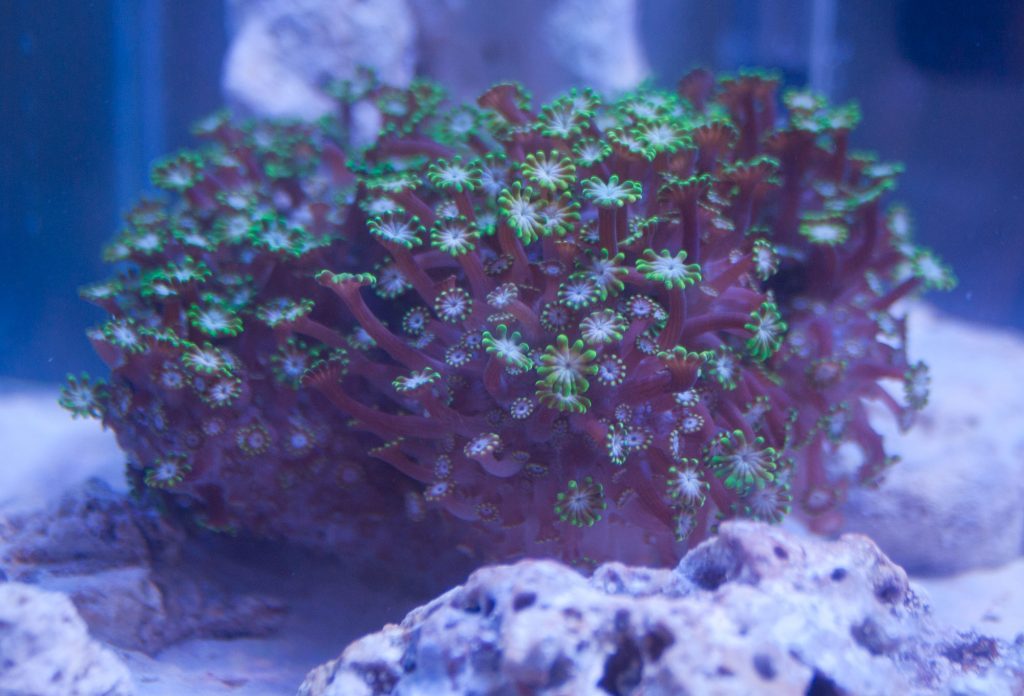
Alveopora corals are often called “flowerpot corals,” but they behave differently than Goniopora. They can be hardy in stable tanks, yet they still need targeted care. This guide covers placement, flow, lighting, feeding, and common fixes.
Water parameters, placement, and stability
Alveopora does best in mature systems. Aim for a tank that is at least 6 months old. Stable chemistry matters more than chasing exact numbers. Sudden swings cause retraction and tissue loss.
Keep salinity at 1.025 to 1.026 specific gravity. Hold temperature at 25 to 26°C (77 to 79°F). Maintain alkalinity at 8 to 9 dKH and calcium at 420 to 460 ppm. Keep magnesium at 1300 to 1400 ppm for balance.
Nutrients should not be stripped to zero. Nitrate at 2 to 10 ppm often works well. Phosphate at 0.03 to 0.10 ppm supports color and growth. If your tank runs ultra-low, feeding becomes more important.
Place Alveopora on the sandbed or lower rockwork. Give it space for full polyp extension. Leave 10 to 15 cm (4 to 6 inches) from neighbors. Sweeper tentacles are usually mild, but contact still irritates tissue. For more on spacing, see reef coral placement guide.
- Match salinity during acclimation within 0.001 specific gravity.
- Do not change alkalinity more than 0.5 dKH per day.
- Quarantine if possible to avoid pests and bacterial issues.
Lighting and flow that keep polyps extended
Alveopora prefers moderate light in most tanks. A good starting PAR is 80 to 150 at the coral. Some specimens adapt to 150 to 200 PAR, but increase slowly. Raise intensity by 5% per week, or move the coral upward in small steps.
Watch the polyp tips for feedback. If polyps stay short and pale, light may be too high. If the coral stretches upward, light may be too low. Use a consistent photoperiod of 8 to 10 hours. Avoid sudden spectrum changes.
Flow should be gentle to moderate and indirect. You want polyps to sway, not whip. Direct jet flow can tear tissue at the skeleton edge. Random flow from a wavemaker often works best. If detritus settles, increase flow slightly or adjust angle.
Alveopora can sulk after handling. Give it 3 to 7 days to settle. Keep hands out of the tank during this period. If you need a baseline, compare behavior with Goniopora vs Alveopora care notes.
- Start at 80 to 150 PAR and adjust based on extension.
- Use indirect, pulsing flow and avoid straight blasts.
- Keep a stable schedule for intensity and photoperiod.
Feeding, supplementation, and troubleshooting
Alveopora benefits from regular feeding, especially in clean tanks. Feed 2 to 3 times per week at first. Use fine foods like reef roids, rotifers, or a blended coral slurry. Turn off return flow for 10 to 15 minutes to reduce waste.
Target feed gently with a pipette. Aim above the polyps and let food fall. Do not blast the tissue. If fish steal food, feed the fish first. Then feed the coral when the tank calms down.
Trace elements can help, but only with testing and restraint. Keep alkalinity and calcium stable before dosing extras. If growth stalls, check magnesium and phosphate. Also check for low pH at night. Aim for pH 8.1 to 8.3 with good aeration.
Common problems include persistent retraction and brown jelly-like tissue. Retraction often comes from too much flow, alkalinity swings, or pests. Brown jelly can spread fast. Siphon affected tissue and isolate the coral. Consider a dip and improve water quality. For pest checks, use coral dipping guide.
- Feed fine particulate foods 2 to 3 times weekly.
- Keep nitrate 2 to 10 ppm and phosphate 0.03 to 0.10 ppm.
- If tissue recedes, reduce flow and verify alkalinity stability.
Alveopora can become a reliable centerpiece coral with steady parameters and gentle conditions. Start with moderate light and indirect flow. Feed consistently and avoid sudden chemistry changes. With patience, you will see longer extension and new growth over time.
Sources: Borneman, E. (2001) Aquarium Corals; Delbeek, J.C. & Sprung, J. (1994–2005) The Reef Aquarium Vol. 1–3; Veron, J.E.N. (2000) Corals of the World.
Was this helpful?
Related Posts
Dragonets Fish Care
Dragonets are beautiful reef fish, but they need mature tanks and steady food sources. Learn how to keep…
 By
By
Lighting For Aquarium
Lighting for Aquarium: Getting Saltwater Illumination Right Lighting for a saltwater aquarium is about much more than simply…