

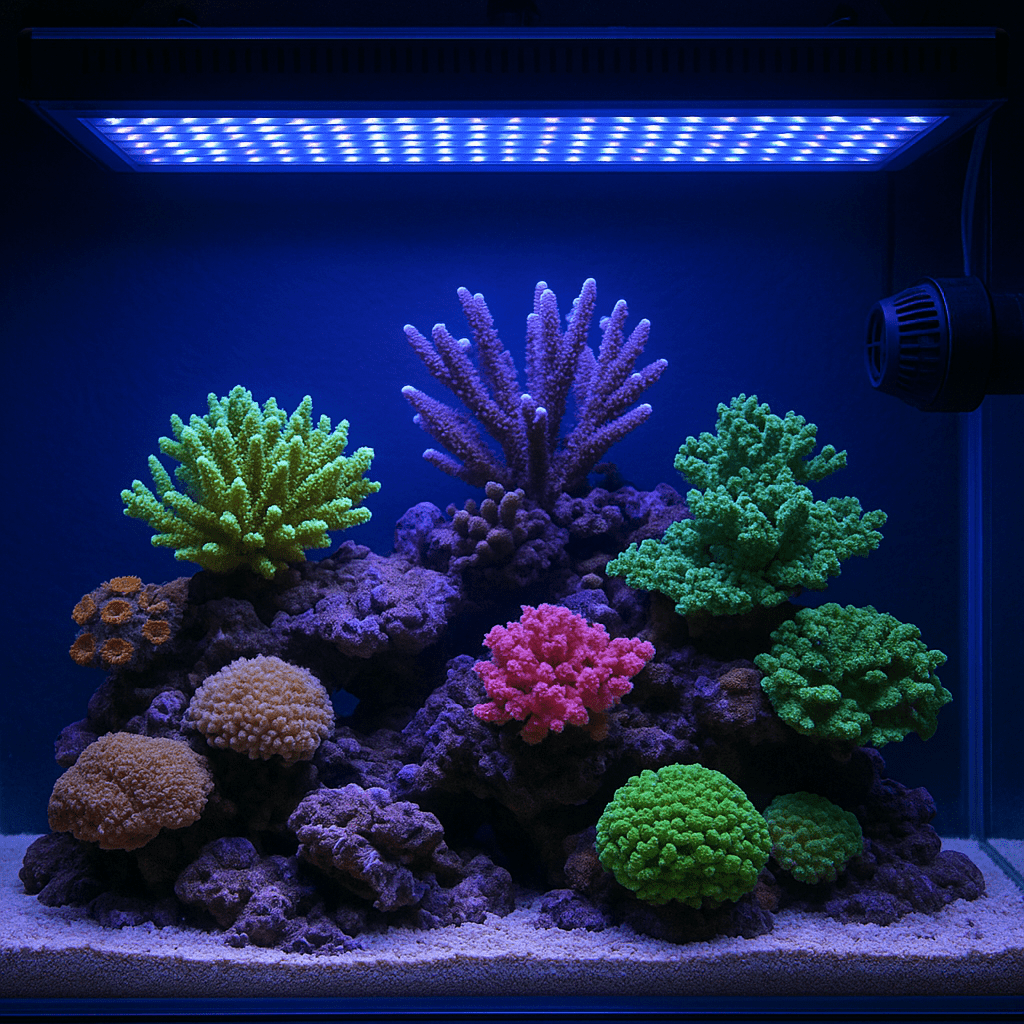
Reef tank lighting for beginners can feel overwhelming at first, but it becomes much easier once you understand what your corals actually need. In this guide, you will learn how to choose the right light, set a practical schedule, and avoid common mistakes that lead to pale corals, nuisance algae, or stalled growth. If you are still building your system, start with [reef tank setup basics](/reef-tank-setup-basics) and [reef aquarium water parameters](/reef-aquarium-water-parameters) so your lighting plan works with the rest of the tank.
Quick Care Table
| Topic | Beginner Recommendation |
| Best light type | Modern reef LED with controllable intensity and spectrum |
| Photoperiod | 8 to 10 hours full lighting, plus ramp up and ramp down |
| PAR for soft corals | 50 to 100 PAR |
| PAR for LPS corals | 75 to 150 PAR |
| PAR for easy SPS | 150 to 250 PAR |
| Color spectrum | Blue-heavy reef spectrum with balanced white |
| Mounting height | Usually 8 to 12 inches above the water, depending on fixture |
| Biggest beginner mistake | Running lights too strong too soon |
| Helpful tools | Timer, acclimation mode, PAR map from manufacturer or meter |
Introduction to Reef Tank Lighting for Beginners
Light is one of the most important pieces of reef husbandry because most corals rely on photosynthetic algae called zooxanthellae for a large part of their energy. In practical reef keeping terms, that means your lighting affects coral color, growth, polyp extension, and even how much algae shows up on the glass and rocks. Reef tank lighting for beginners is not about buying the most expensive fixture. It is about matching the light output to the animals you keep, then keeping that output stable. A simple, well-tuned light over a mixed reef usually performs better than a powerful fixture run inconsistently. If you are choosing livestock too, read [best beginner corals](/best-beginner-corals) before you buy.
Natural Habitat
Corals come from a wide range of reef zones, and that matters when setting up aquarium lighting. Shallow reef crest corals often receive intense tropical sunlight, strong water movement, and very stable chemistry. Deeper or more sheltered reef corals usually experience lower light and gentler flow. This is why some corals thrive under moderate LEDs while others need much stronger PAR to maintain color and growth.
For beginners, the key lesson is that not all corals want the same intensity. Mushrooms, zoanthids, and many soft corals often prefer lower to moderate light. Many LPS corals do well in moderate light. SPS corals, especially Acropora, generally demand stronger and more consistent lighting. Understanding this natural variation helps you place corals properly and prevents the common mistake of putting low-light corals directly under the brightest part of the fixture.
Tank Requirements
Your tank dimensions, aquascape, and coral selection all influence the right lighting choice. A shallow nano reef is easier to light evenly than a deep tank. A long tank may need two fixtures or a bar-style light to prevent dark zones. Rockwork also creates shadows, which can be useful for low-light corals but frustrating if you are trying to grow SPS on lower shelves.
- Nano tanks: One compact LED is often enough, but intensity can become too high quickly.
- Standard mixed reefs: Broad, even coverage matters more than peak output.
- SPS-dominant tanks: Prioritize strong PAR, spread, and stability.
- Deep tanks: Need more punch and careful placement to reach lower areas.
As a rule, choose a fixture that provides even coverage across the tank rather than a narrow spotlight effect. Corals respond better to stable, usable light over time than to extreme hotspots. If your aquascape has arches and overhangs, use those shaded areas intentionally for lower-light species.
Water Parameters
Lighting does not work in isolation. Stronger light increases photosynthetic demand, which means corals need stable alkalinity, calcium, magnesium, and nutrients to actually use that light well. Many beginner problems blamed on lighting are really a chemistry-and-light mismatch. Review [reef aquarium water parameters](/reef-aquarium-water-parameters) if your corals look stressed after a lighting change.
| Parameter | Recommended Range |
| Temperature | 76 to 79°F |
| Salinity | 1.025 to 1.026 specific gravity |
| pH | 7.9 to 8.3 |
| Alkalinity | 8 to 9 dKH |
| Calcium | 400 to 450 ppm |
| Magnesium | 1250 to 1400 ppm |
| Nitrate | 2 to 15 ppm for many mixed reefs |
| Phosphate | 0.03 to 0.10 ppm |
Very low nutrients combined with strong light often lead to pale corals or slow tissue loss. On the other hand, high nutrients with excessive white light can encourage nuisance algae. Balance is more important than chasing extreme numbers.
Lighting Requirements
For most beginners, a controllable reef LED is the easiest and most practical option. LEDs run cool, offer good color control, and usually include timers, acclimation modes, and programmable schedules. T5 and hybrid systems are still excellent, especially for even coverage, but they are less common for entry-level hobbyists due to bulb replacement and fixture size.
Focus on three things:
- Intensity: Usually measured as PAR.
- Spectrum: Blue-heavy reef spectrum supports coral fluorescence and photosynthesis.
- Coverage: Even spread prevents hotspots and shadowing.
Useful beginner PAR targets:
- Soft corals and mushrooms: 50 to 100 PAR
- Zoanthids and many LPS: 75 to 150 PAR
- Montipora and easier SPS: 150 to 250 PAR
- Demanding SPS: often 250+ PAR with excellent stability
These are not hard rules, but they are dependable starting points. In real tanks, consistency matters as much as the exact number. Corals adapt to stable light better than frequent intensity changes. If your fixture has an acclimation mode, use it whenever adding new corals or upgrading lights.
A practical beginner schedule is 1 to 2 hours of ramp up, 6 to 8 hours of peak lighting, and 1 to 2 hours of ramp down. Long photoperiods do not automatically equal faster growth. More often, they increase algae pressure and stress corals if intensity is already high.
Water Flow
Lighting and flow work together. Stronger light increases photosynthesis, which means corals benefit from water movement that brings in oxygen and nutrients while carrying away waste. In low flow, brightly lit corals can struggle because the tissue surface is not being refreshed efficiently.
For a beginner mixed reef, aim for varied, indirect flow rather than a constant blast. Soft corals and many LPS prefer moderate, turbulent movement. SPS generally need stronger, more chaotic flow. If a coral is receiving more light than before, make sure flow is adequate or you may see retracted polyps and tissue irritation.
Feeding
Even photosynthetic corals benefit from feeding. Good lighting supports the coral’s symbiotic algae, but many species also capture fine foods from the water column. In a beginner reef, feeding helps especially with LPS corals and can improve color and tissue fullness when done moderately.
- Feed fish consistently so corals receive some dissolved nutrients
- Use coral foods sparingly to avoid nutrient spikes
- Target feed fleshy LPS if appropriate
- Do not try to compensate for poor lighting with excessive feeding
One common mistake is running very strong lights while also keeping nutrients near zero. Corals often look washed out under that combination. Moderate feeding and stable nutrients usually produce better long-term results.
Compatibility
Lighting compatibility is really about matching coral species to the zones available in your tank. A beginner mixed reef often works best when you place low-light corals on the sand bed or in partial shade, moderate-light corals in the middle, and higher-light corals near the top. This zoning approach is much easier than trying to force every coral to adapt to one intensity level.
Fish and invertebrates are not usually affected by reef lighting in the same way corals are, but sudden changes can still stress the whole tank. Bright, abrupt schedules may make some fish skittish. Gradual ramping looks better and is gentler on livestock. If you are planning a beginner community, [best beginner corals](/best-beginner-corals) can help you choose species with similar lighting needs.
Common Problems
Why are my corals turning brown under reef lights?
Brown corals often indicate increased zooxanthellae density, usually from light that is too weak, nutrients that are too high, or both. This is common when a fixture is mounted too high, set too blue but too dim overall, or spread across a tank that is too large for one unit.
- Check whether the coral is getting enough PAR for its species
- Review nitrate and phosphate levels
- Increase intensity slowly, not all at once
- Improve flow if the coral sits in a stagnant area
Why is my coral losing color after a lighting change?
Color loss after a new fixture or schedule change is often a sign of light shock. Corals can bleach or fade when intensity rises too quickly, even if the final PAR is technically appropriate. This happens a lot when hobbyists copy someone else’s settings without considering tank depth, mounting height, and water clarity.
- Reduce intensity and use acclimation mode
- Shorten the peak period temporarily
- Keep alkalinity stable during recovery
- Do not move the coral repeatedly unless necessary
Why is my coral not growing even though the light looks bright?
Human eyes are a poor judge of coral-useful light. A tank can look very bright but still provide poor PAR distribution or an unbalanced spectrum. Growth can also stall when alkalinity, calcium, magnesium, or nutrients are unstable. In many real-world tanks, the issue is not lack of light but inconsistency.
- Verify coral placement for its light demand
- Check alkalinity stability over several weeks
- Make sure nitrate and phosphate are not bottomed out
- Confirm the fixture covers the whole coral, not just part of it
Why are the polyps closed after I increased the light intensity?
Closed polyps after a lighting increase usually point to stress from excess intensity, inadequate acclimation, or a mismatch between stronger light and weak flow. Corals often retract first before showing obvious tissue damage, so this is an early warning sign worth taking seriously.
- Lower intensity by 10 to 20 percent and observe
- Increase flow gently if the area is too still
- Check for temperature swings caused by new equipment
- Avoid making more than one major change at a time
Why am I getting more algae after upgrading my reef light?
More powerful lighting often reveals a nutrient imbalance that was already present. Longer photoperiods, excess white channels, and dirty rockwork can all fuel algae growth. In beginner systems, the answer is usually reducing excess light and tightening up nutrient control, not blacking out the tank completely.
- Shorten the peak photo period
- Reduce white channels if they are excessive
- Test nitrate and phosphate
- Improve export with water changes, skimming, or manual removal
- Review [reef tank setup basics](/reef-tank-setup-basics) if the tank is still maturing
Propagation or Fragging
Lighting plays a major role in coral propagation because healthy, growing corals are much easier to frag successfully. Soft corals, zoanthids, and many LPS can be propagated by hobbyists once they are established. For branching SPS and plating corals, stable light and consistent chemistry are especially important before fragging.
After fragging, place new frags under slightly reduced light compared to the parent colony, then acclimate them upward if needed. Fresh cuts are more sensitive to stress, and many hobbyists lose frags by placing them immediately into high PAR. If you are interested in coral growth and placement strategies, [montipora coral care](/montipora-coral-care) is a good example of how light affects fragging success.
FAQ
What is the best reef tank lighting for beginners?
A controllable reef LED is usually the best choice for beginners because it offers adjustable intensity, programmable schedules, and lower heat output.
How many hours should reef lights be on?
Most beginner reef tanks do well with 8 to 10 hours of total lighting, including ramp periods, with about 6 to 8 hours at peak intensity.
Do beginner corals need strong light?
No. Many beginner-friendly corals such as mushrooms, zoanthids, and several LPS species thrive in low to moderate light.
Can too much light hurt corals?
Yes. Too much light can cause bleaching, faded color, retracted polyps, and stress, especially if intensity is increased too quickly.
Do I need a PAR meter for a beginner reef tank?
Not always, but it helps a lot. If you do not have one, use manufacturer guidance, coral placement, and slow acclimation to avoid over-lighting.
Was this helpful?
Related Posts
Reef Tank Plumbing Basics
Learn reef tank plumbing basics, including drains, return pumps, sump flow, noise control, and flood prevention for a…
 By
ByOur Reef Emergency Plan
A reef emergency plan helps you act fast during outages, leaks, and water quality crashes. Here is the…
[favorite_button]
My Bookmarks:
To see full list click here
[user_favorites user_id="" include_links="true" site_id="" post_types="" include_thumbnails="true" thumbnail_size="thumbnail" include_excerpt="false"]