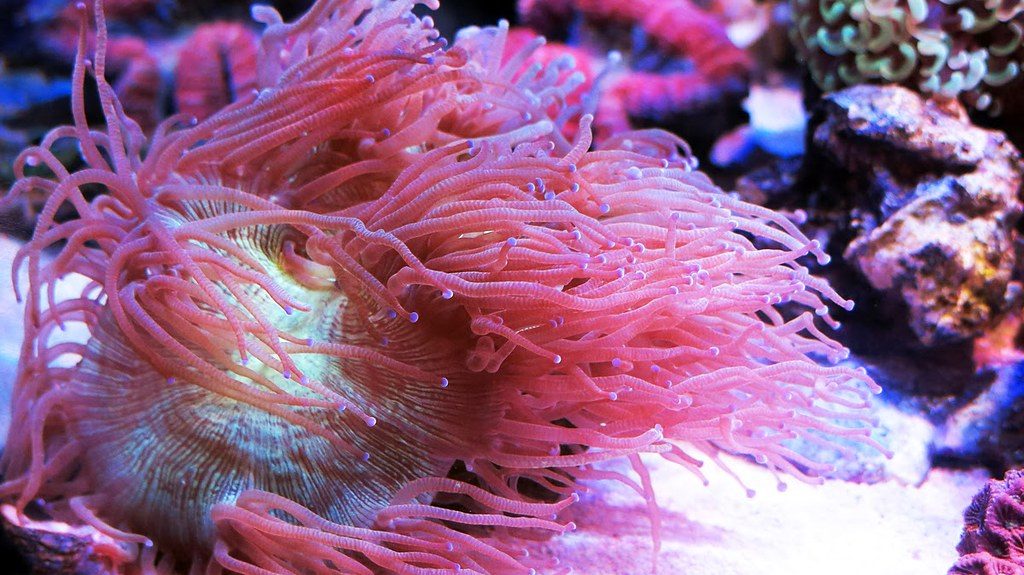
Elegance corals are eye-catching LPS with long, flowing tentacles. They can thrive in home reefs, but they need stable conditions. Good placement and gentle handling make the biggest difference.
Tank setup and placement
Start with a stable, mature tank. Aim for at least 6 months old. A 40-gallon breeder can work for one coral. A 75-gallon tank gives more stability and space.
Place elegance corals on sand in most systems. Their tissue can tear on sharp rock. Leave space for sweepers and drift. Plan at least 6 to 10 inches of clearance.
Use moderate light for best extension. Target 80 to 150 PAR at the coral. Ramp up slowly over 2 to 3 weeks. Sudden light jumps often cause shrinking and bleaching.
Flow should be gentle and indirect. Tentacles should sway, not whip. Strong jets can split tissue near the skeleton. If you need help, review your reef tank flow guide.
- Sandbed placement reduces tissue damage from rough rock.
- Keep 6–10 inches from other corals to avoid stings.
- Acclimate to light with a 10–20% weekly increase.
Water parameters and stability
Elegance corals reward stability more than chasing numbers. Keep salinity at 1.025 to 1.026. Hold temperature at 77 to 79°F. Avoid swings over 1°F per day.
Maintain alkalinity at 8.0 to 9.0 dKH. Keep calcium at 420 to 460 ppm. Keep magnesium at 1280 to 1400 ppm. Test twice weekly until consumption is predictable.
Nutrients should not be stripped to zero. Aim nitrate at 5 to 15 ppm. Keep phosphate at 0.03 to 0.10 ppm. Very low nutrients can cause pale tissue and poor inflation.
Use regular water changes for trace balance. A 10% weekly change is a solid baseline. If alkalinity swings, dose daily in small amounts. See our alkalinity stability basics for dosing routines.
- Match new saltwater to 1.026 and 78°F before changes.
- Calibrate your refractometer monthly with 35 ppt fluid.
- Stop adjusting multiple parameters on the same day.
Feeding, acclimation, and troubleshooting
Elegance corals can photosynthesize, but feeding helps growth. Feed 1 to 2 times per week. Offer small meaty foods like mysis or chopped shrimp. Pieces should be 1/4 inch or smaller.
Turn off pumps for 10 to 15 minutes during feeding. Use a pipette to place food on tentacles. Watch for a slow fold and mouth response. If food blows off, reduce flow or target feed closer.
Acclimate new specimens carefully. Float to match temperature for 15 minutes. Drip acclimate for 30 to 45 minutes. Avoid exposing the coral to air if possible.
Common issues include deflation, brown jelly, and torn tissue. Deflation often follows light or flow stress. Brown jelly needs fast action and isolation. Move the coral to low flow and siphon debris. Consider an iodine dip per product label. Then improve stability and spacing.
- Do not place elegance corals near aggressive euphyllia or torches.
- Quarantine new corals for 2 to 4 weeks when possible.
- If tissue recedes, check alkalinity swings and direct flow first.
Elegance corals can be hardy when their needs are met. Focus on gentle flow, moderate light, and steady chemistry. With patience and careful placement, they often become a centerpiece coral.
Sources: Borneman, E. (2001) Aquarium Corals; Sprung, J. (2005) Corals: A Quick Reference Guide; Delbeek & Sprung (1994–1997) The Reef Aquarium Vol. 1–3.
Was this helpful?
Related Posts
Reef Safe Fish for Beginners
Discover the best reef safe fish for beginners, plus tank size, feeding, and compatibility tips for a peaceful…
 By
By
Dragonets Fish Care
Dragonets are beautiful reef fish, but they need mature tanks and steady food sources. Learn how to keep…