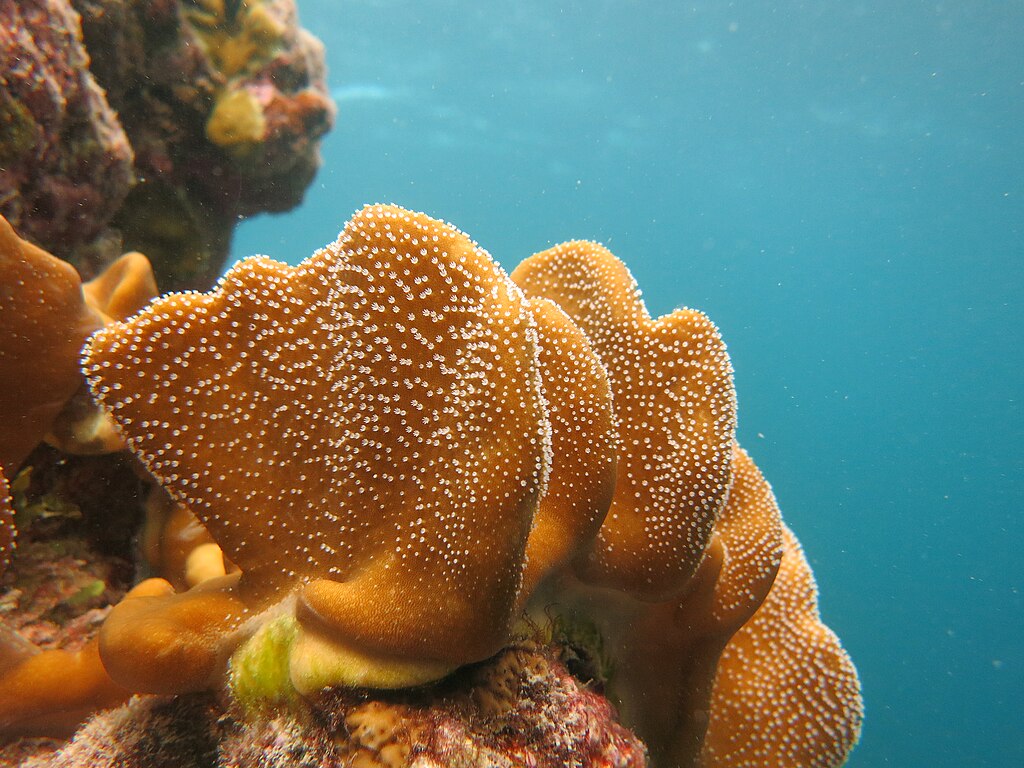
Lobophytum leather corals are tough, forgiving soft corals. They suit new reef keepers and busy tanks. Good flow and stable chemistry matter most.
These “devil’s hand” leathers can look closed for days. That is often normal. Learn their rhythms and you will avoid bad fixes.
Tank setup, placement, and flow
Start with a stable tank that is at least 6 months old. Aim for 20 gallons or more. Bigger water volume swings less each day.
Give Lobophytum moderate to strong, random flow. The surface should sway, not whip. Good flow lifts mucus during shedding and prevents detritus buildup.
Place it on rock, not on sand. Sand can trap debris against the base. Leave 3 to 6 inches of space for growth and chemical reach.
Use carbon if you keep many soft corals. Lobophytum can release terpenes into the water. Run fresh carbon 1 to 2 weeks per month for control.
- Flow test: sprinkle a pinch of reef food and watch the swirl pattern.
- Safe spacing: keep it away from LPS sweepers and SPS tips.
- Stability tip: top off daily or use an ATO to hold salinity.
For more on coral placement strategy, see reef aquarium flow guide. If you are mixing softies and stony corals, review chemical warfare in reef tanks.
Lighting, water parameters, and feeding
Lobophytum prefers moderate light. Target 80 to 150 PAR at the top surface. Too much light can cause tight polyps and pale tissue.
Keep salinity at 1.025 to 1.026 specific gravity. Hold temperature at 25 to 26 C (77 to 79 F). Avoid daily swings over 1 F.
Maintain alkalinity at 8 to 9 dKH and calcium at 400 to 450 ppm. Keep magnesium at 1250 to 1400 ppm. Nitrate at 5 to 15 ppm often works well.
Feeding is optional but helpful in lean systems. Offer fine foods 1 to 2 times per week. Try reef roids, powdered plankton, or thawed mysis “juice.”
- Light acclimation: increase intensity 5% each week after moving it.
- Parameter checks: test alkalinity twice weekly in new tanks.
- Feeding method: turn off pumps for 10 minutes during target feeding.
If you struggle with stable alkalinity, read reef alkalinity stability. It helps prevent slow tissue decline in soft corals.
Shedding, troubleshooting, and common mistakes
Lobophytum often “sheds” a waxy film every few weeks. It may look glossy and closed. Strong, varied flow usually clears the film within 1 to 3 days.
Do not panic and move it right away. Moving can restart the stress cycle. Instead, check for detritus on the surface and increase flow slightly.
If it stays closed over 5 to 7 days, check basics. Confirm salinity with a calibrated refractometer. Look for alkalinity drops over 1 dKH in 24 hours.
Watch for pests and irritation. Some clownfish rub leathers too hard. Nearby euphyllia can sting at night. A simple “space buffer” solves many issues.
- Closed polyps: verify salinity, then alkalinity, then temperature stability.
- Brown film: increase random flow and siphon detritus from the base.
- Sudden slumping: check for low pH under 7.9 and poor gas exchange.
A real example helps. A 40-gallon breeder had 0 nitrate and 0.00 phosphate. The leather stayed tight for two weeks. Raising nitrate to 10 ppm and adding carbon restored full extension.
Quarantine can be simple for soft corals. Dip new frags and inspect for hitchhikers. Give them 2 weeks in a small tank with stable salinity and flow.
Sources: Borneman, E. (2001) Aquarium Corals; Delbeek, J. & Sprung, J. (1994–2005) The Reef Aquarium series; Fenner, R. (2008) The Conscientious Marine Aquarist.
Was this helpful?
Related Posts
Reef Safe Fish for Beginners
Discover the best reef safe fish for beginners, plus tank size, feeding, and compatibility tips for a peaceful…
 By
By
Dragonets Fish Care
Dragonets are beautiful reef fish, but they need mature tanks and steady food sources. Learn how to keep…