Reef lighting spectrum shapes coral color, growth, and long-term health. Blue-heavy reef lighting usually gives the best balance for photosynthesis and visual pop. The right spectrum also depends on coral type, tank depth, and your fixture’s overall intensity.
Many reef keepers focus on wattage or brand first. Spectrum often matters more. It affects how corals use light, how algae responds, and how your tank looks each day. In this guide, you will learn what reef lighting spectrum means, which color channels matter most, and how to build a practical schedule that supports healthy corals without overcomplicating your setup.
Quick Reference Table
| Lighting Factor | Best Practice | Why It Matters |
|---|---|---|
| Primary spectrum | Blue and royal blue dominant | Supports coral photosynthesis and fluorescence |
| White channel | Use moderately | Adds balance and natural daytime appearance |
| Red and green | Use sparingly | Too much can encourage nuisance algae and wash out color |
| Photoperiod | 8 to 10 hours peak light | Provides stability without excessive stress |
| PAR target for soft corals | 50 to 150 | Matches lower light coral needs |
| PAR target for LPS corals | 75 to 200 | Supports growth with moderate light |
| PAR target for SPS corals | 200 to 350+ | Needed for many high light species |
| Acclimation | Increase slowly over 2 to 4 weeks | Prevents bleaching and light shock |
This table gives the short version. The details below will help you apply it correctly to your own reef.
What Reef Lighting Spectrum Actually Means
Spectrum describes the mix of light wavelengths your fixture produces. In simple terms, it is the color makeup of the light. Corals do not respond to all colors equally. Their symbiotic algae, called zooxanthellae, use some wavelengths better than others for photosynthesis.
Most reef tanks perform best under a blue-heavy spectrum. That usually means strong output in the violet, royal blue, and blue range. These wavelengths penetrate water well in nature. They also match the light environment many corals evolved under.
White light is not bad. It can be useful. It broadens the spectrum and makes fish and rockwork look more natural. The problem comes when hobbyists push white too high and reduce blue too much. That often leads to flatter coral color and a less efficient spectrum for many reef animals.
Spectrum is also different from intensity. A light can have a great spectrum but still be too weak. It can also have enough power but poor color balance. Successful reef lighting needs both the right spectrum and the right PAR.
Why Blue Light Dominates Reef Aquariums
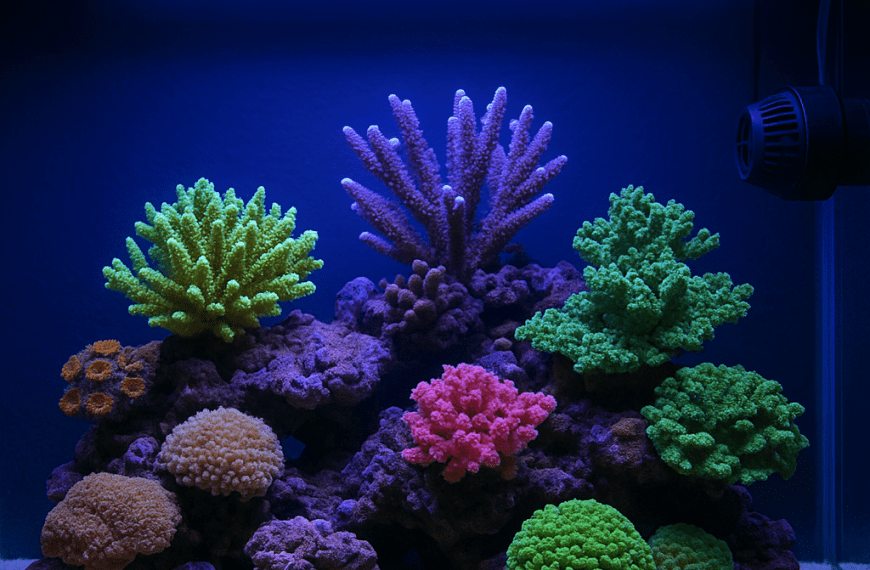
Blue light is the foundation of modern reef lighting. There are two big reasons. First, corals use blue wavelengths very efficiently. Second, blue light makes coral pigments glow. That is why tanks often look more colorful under actinic or blue-heavy settings.
In the ocean, red and yellow wavelengths fade quickly with depth. Blue light travels farther. Many popular reef corals come from areas where blue light is naturally dominant. Your aquarium does not need to copy the ocean perfectly. Still, it should respect that basic pattern.
Royal blue and violet are especially useful. They help drive photosynthesis and bring out fluorescent proteins in coral tissue. This is why many successful LED programs run blue channels much higher than white channels.
That said, an all-blue tank is not always ideal. Corals still benefit from a balanced spectrum. You also want a look that you enjoy. The goal is not maximum blue at all costs. The goal is a coral-friendly spectrum with enough visual balance for daily viewing.
Understanding Each Color Channel
Most LED reef fixtures let you adjust several channels. Knowing what each one does helps you avoid random settings.
Violet and UV range: These channels are valuable for coral fluorescence and photosynthesis. They should be used carefully but confidently. Quality fixtures tune this range safely.
Royal blue and blue: These are usually your main channels. They form the core of a proven reef spectrum. Many successful tanks run them high.
Cool white: White fills out the spectrum and improves visual clarity. Moderate use works well. Too much can make the tank look harsh and reduce that rich reef glow.
Red and green: These are accent channels. Small amounts can improve color rendering. Heavy use is rarely needed. It can make the tank look unnatural and may favor nuisance algae in nutrient-rich systems.
If you are unsure, keep it simple. Run violet, royal blue, and blue as your primary channels. Add white moderately. Keep red and green low.
Best Reef Lighting Spectrum by Coral Type
Different corals tolerate different light levels. Spectrum needs stay fairly similar, but intensity changes a lot.
Soft corals usually prefer lower to moderate PAR. Many thrive under a blue-heavy spectrum with gentle intensity. Mushrooms, zoanthids, and leathers often color up well without extreme output.
LPS corals often like moderate light and stable placement. Euphyllia, acans, blastos, and favias usually respond well to strong blue channels with moderate white support. Too much intensity can bleach them quickly.
SPS corals usually demand the most light. Acropora and montipora often thrive under high PAR and a spectrum dominated by blue and violet. Stability matters more than chasing tiny spectrum changes every week.
Mixed reefs are the most common challenge. In those tanks, spectrum can stay broadly blue-heavy across the whole aquarium. You then place low-light corals lower and high-light corals higher. Coral placement is often more important than making separate spectrum zones.
Lighting Requirements and PAR Targets
Spectrum tells you the type of light. PAR tells you how much usable light reaches the coral. Both matter. A perfect spectrum cannot fix weak PAR. High PAR also cannot rescue a poor spectrum.
Use these ranges as a practical starting point. Soft corals often do well at 50 to 150 PAR. Most LPS corals fit well between 75 and 200 PAR. SPS corals commonly need 200 to 350 PAR or more, depending on species and nutrient levels.
Tank depth changes everything. A shallow frag tank can hit high PAR easily. A deep display may need stronger fixtures, tighter mounting height, or multiple lights for even spread.
If possible, use a PAR meter. It removes guesswork. If you cannot, start conservatively. Watch coral response closely. Pale tissue, retracted polyps, and sudden color loss often mean too much light. Browning and slow growth can suggest too little light, though nutrients also play a role.
How to Set a Reef Lighting Schedule
A good reef lighting schedule is simple and consistent. Corals like stability. Constant tweaking usually causes more problems than it solves.
- Start with an 8 to 10 hour peak photoperiod.
- Use a ramp-up period of 1 to 2 hours.
- Use a ramp-down period of 1 to 2 hours.
- Keep blue channels dominant during peak hours.
- Run white channels lower than blue channels.
- Limit red and green to low accent levels.
A common beginner mistake is running lights too long. More hours do not always mean more growth. Long photoperiods can fuel algae and stress corals. Another mistake is changing the program every few days. Corals need time to adapt.
Moonlight is optional. It looks nice, but it should stay very dim. Bright blue moonlights all night can disrupt natural rest cycles. If you use them, keep them subtle and limited.
Aquarium Setup and Light Spread
Good spectrum only works if the tank is lit evenly. Poor spread creates hot spots and shadows. Corals in one area bleach while others struggle in dim light.
Mounting height affects both spread and intensity. Higher mounting improves coverage but reduces PAR. Lower mounting increases PAR but can create harsh hotspots. Many fixtures perform well around 8 to 12 inches above the water, though every model differs.
Aquascape also changes light distribution. Tall rock towers shade lower corals. Overhangs reduce direct light. Branching SPS colonies can shadow their own bases over time. Plan your coral placement with future growth in mind.
For mixed reefs, place high-light corals near the top and center. Put lower-light corals along the edges, lower rockwork, or partially shaded zones. This approach often works better than trying to force one intensity level across the entire tank.
Water Flow and Spectrum Work Together
Lighting and flow should always be considered together. High light with weak flow often causes trouble. Corals need water movement to exchange gases, remove waste, and deliver nutrients.
Under stronger lighting, many corals benefit from stronger, more varied flow. This is especially true for SPS corals. Good flow helps them handle intense light more effectively. It also reduces detritus buildup and supports healthier tissue.
LPS corals need more caution. They still need flow, but not direct blasting. Pair moderate light with gentle, indirect movement for fleshy species. If a coral stays tightly retracted, check both light and flow before changing only one variable.
When a coral looks unhappy, hobbyists often blame spectrum first. Sometimes the real issue is poor flow, unstable alkalinity, or nutrient imbalance. Reef success comes from balancing all these factors together.
Common Problems
Why are my corals bleaching under LED lights?
Bleaching usually means too much light, too fast. It can also happen after a fixture upgrade or a major schedule change. Reduce intensity by 10 to 20 percent. Shorten the peak period if needed. Raise the fixture or use an acclimation mode. Then hold settings steady for two weeks.
Why do my corals look brown?
Brown corals often point to excess nutrients, low light, or both. Check nitrate and phosphate first. If nutrients are high, improve export slowly. If nutrients are reasonable, your PAR may be too low. Increase intensity gradually. Do not make large jumps.
Why does my tank grow algae after changing spectrum?
Algae blooms often follow longer photoperiods, stronger whites, or rising nutrients. Reduce white, red, and green channels first. Keep the schedule tighter. Test nitrate and phosphate. Spectrum can influence algae, but nutrient control still matters most.
Why are my corals colorful but not growing?
Very blue lighting can make corals look amazing while growth stays slow. Check PAR, alkalinity, and nutrient availability. Some tanks need a bit more overall intensity or a slightly broader spectrum. Stable chemistry often unlocks growth more than spectrum tweaks alone.
Frequently Asked Questions
What is the best spectrum for reef tank lights?
A blue-heavy spectrum is the best starting point for most reef tanks. Use strong violet, royal blue, and blue channels. Add moderate white. Keep red and green low.
Do corals need white light?
Corals do not need high white output to thrive. Moderate white can still be useful. It improves color rendering and broadens the spectrum. Too much white is usually unnecessary.
Can I run only blue lights on my reef tank?
You can run a very blue spectrum successfully. Many reef tanks do. Still, a small amount of white often creates a more balanced look and fuller spectrum.
How long should reef lights stay on each day?
Most reef tanks do well with 8 to 10 hours of peak lighting. Add gentle ramp-up and ramp-down periods. Avoid very long photoperiods unless you have a clear reason.
Is spectrum more important than PAR?
Neither is more important on its own. Spectrum and PAR work together. Good coral growth needs the right wavelengths and the right intensity delivered consistently.
Final Tips for Choosing Your Reef Spectrum
Keep your reef lighting simple. Start with a proven blue-heavy spectrum. Match intensity to your coral mix. Use a steady schedule. Change settings slowly. Most lighting failures come from chasing perfection too often.
If your corals have good color, normal polyp extension, and steady growth, resist the urge to keep adjusting. Stability wins. A good spectrum supports coral health, but it works best alongside strong husbandry, stable chemistry, and smart coral placement.
For more help, read our guides on reef tank lighting schedule, PAR for coral guide, reef tank water parameters, and best coral for beginners.
Was this helpful?
Related Posts
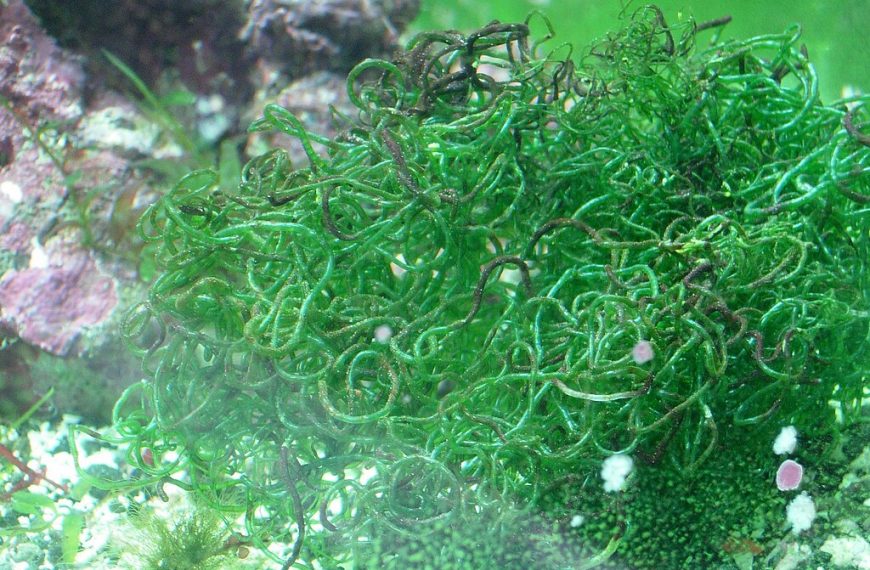
What is a Chaeto Reactor, and How Does it Help Control Nutrients?
A chaeto reactor grows macroalgae in a sealed chamber to remove nitrate and phosphate, helping reef tanks control…
 By
By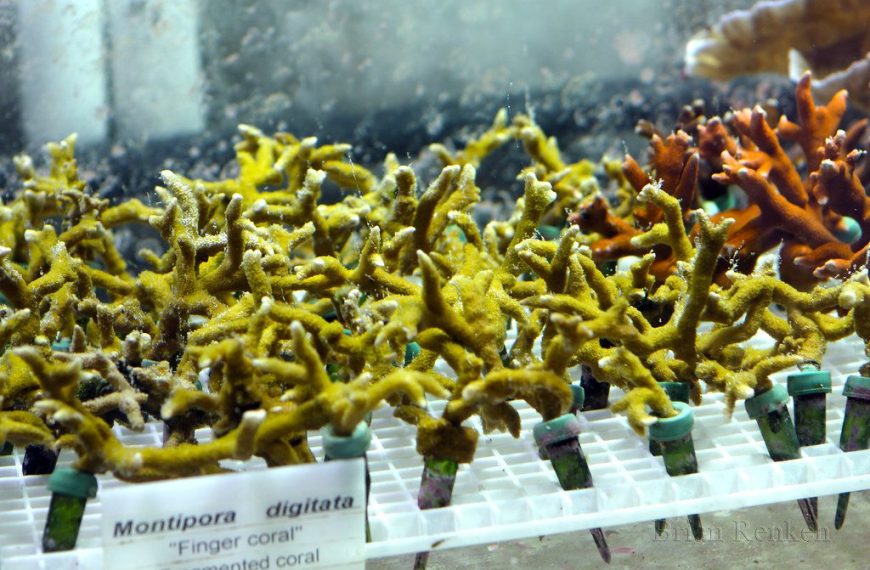
What is a Propagation Tank, and How Do Reef Hobbyists Use it to Grow Coral Frags?
A propagation tank is a dedicated coral grow-out system. It helps reef hobbyists heal, organize, and multiply coral…