

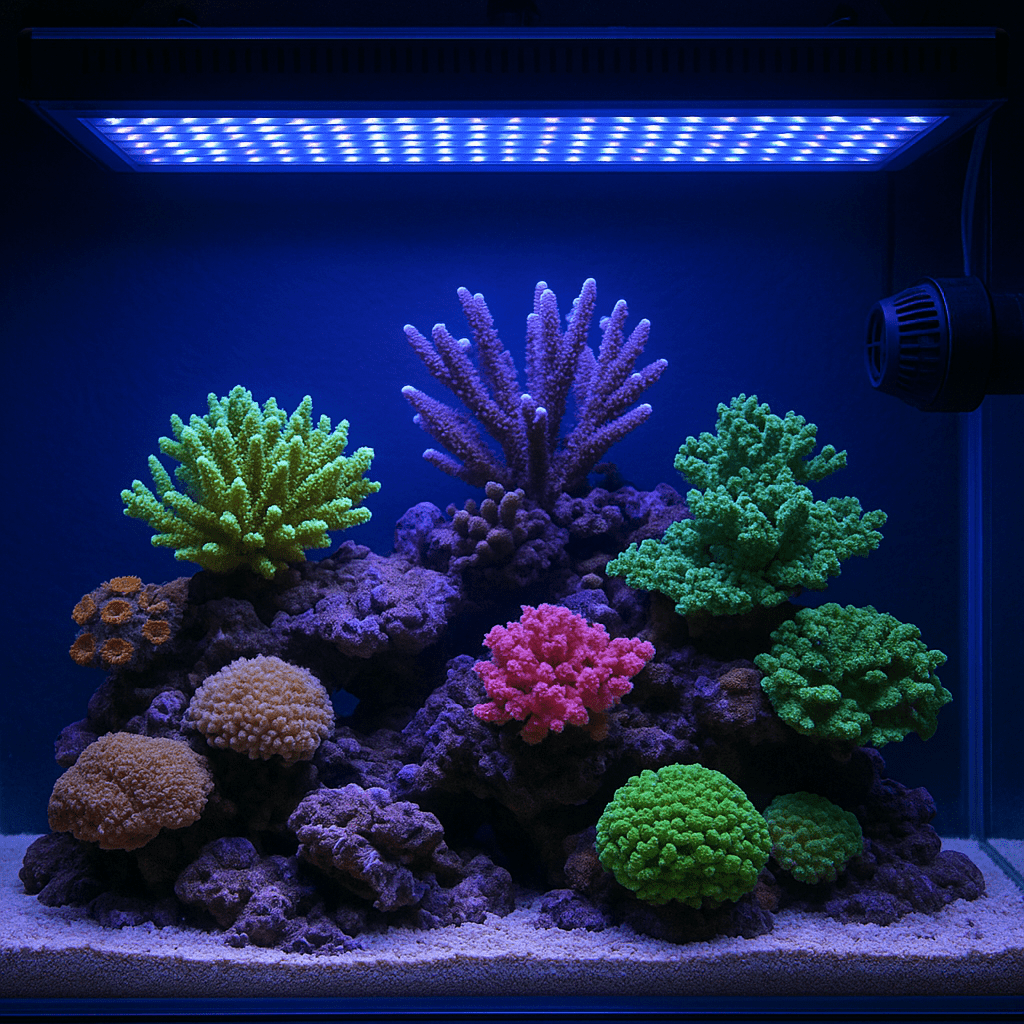
Rapid Tissue Necrosis (RTN) is one of the most alarming events in reefkeeping: a healthy-looking stony coral, usually an SPS like Acropora, starts losing tissue and can go from “fine” to bare white skeleton in hours to a couple of days. RTN is not a single disease with one cause. It is a syndrome where coral tissue sloughs off rapidly after a major stressor, sometimes with bacterial involvement. The good news is that quick, methodical action can often save part of the colony and prevent the same trigger from hitting other corals.
This guide explains what coral RTN is, how to tell it apart from STN (slow tissue necrosis) and bleaching, the most common causes in home aquariums, and a practical step-by-step plan to stop it or at least contain it.
What is coral RTN?
Coral RTN (Rapid Tissue Necrosis) is a fast loss of living coral tissue, typically starting at the base or a damaged area and progressing quickly across the colony. Underneath, the skeleton is exposed and appears bright white at first. In many cases, you will see a sharp “tissue recession line” where healthy tissue meets bare skeleton.
RTN is most commonly reported in:
- Acropora (especially newly introduced frags/colonies)
- Montipora (can also show rapid recession)
- Pocillopora and other SPS
LPS can suffer rapid tissue loss too, but the classic “RTN” pattern is most often discussed with SPS.
RTN vs STN vs bleaching: how to tell the difference
Correct identification matters because the response is different.
| Issue | What it looks like | Typical speed | Common triggers |
|---|---|---|---|
| RTN | Tissue peels/sloughs off, sharp recession line, white skeleton exposed | Hours to 1–3 days | Major parameter swing, alkalinity shock, temperature spike, handling damage, infection after stress |
| STN | Slow recession, often from base upward, less dramatic edge | Days to weeks | Chronic instability, low nutrients, pests, low flow at base, long-term stress |
| Bleaching | Coral turns pale/white but tissue is still present (polyps may still be out) | Days to weeks (sometimes faster) | Light shock, heat stress, starvation, chemical stress |
A quick check: if you can still see tissue and polyp structure on the “white” area, it may be bleaching. If it is hard, chalky skeleton with no tissue, it is necrosis/recession.
Why RTN happens in reef aquariums (most common causes)
RTN is usually the result of acute stress that overwhelms the coral’s ability to maintain tissue and immune function. Often there is more than one factor at play. These are the big ones to investigate first.
1) Alkalinity swings (the #1 repeat offender)
Fast changes in alkalinity (dKH) are strongly associated with SPS recession events. Common scenarios include:
- Overdosing alkalinity supplements after a low test result
- Changing salt brands (different dKH) and doing a large water change
- Dosing pump malfunction
- Switching from manual dosing to automated dosing without recalibration
Even if the “number” is acceptable, a rapid change can trigger RTN. Stability beats chasing a target.
2) Temperature spikes or rapid swings
Heater failures, stuck relays, summer heat, or a return pump shutting off can cause temperature to rise quickly. SPS are especially sensitive to sudden shifts. A swing of a few degrees over a short period can be enough to start a cascade.
3) Salinity changes (top-off problems)
Auto top-off failures, dumping too much freshwater, or topping off with saltwater can change salinity quickly. Corals regulate internal osmotic balance poorly compared to fish, so fast salinity changes can cause tissue stress and recession.
4) Light shock (especially after new LEDs or a frag move)
Sudden increases in PAR or spectrum shifts can stress SPS. RTN is not the most common outcome of light shock (bleaching is), but severe stress can contribute, especially when paired with alkalinity shifts or low nutrients.
5) Physical damage and infection after stress
Fragging, shipping, aggressive dipping, a fall from the rockwork, or a fish/invert repeatedly nipping can create an entry point for opportunistic bacteria. In these cases, RTN may appear to start at the damaged area and race outward.
6) Low nutrients or sudden nutrient drops
Ultra-low nitrate and phosphate can make SPS more fragile, especially under strong light. Large changes in nutrient levels can also destabilize the microbiome on the coral’s surface. Common triggers include:
- Overuse of GFO or aggressive phosphate removers
- Carbon dosing changes (vodka, vinegar, NOPOX)
- Sudden improvement in skimming or filtration
- Big refugium growth surge
7) Chemical contamination
Household sprays, aerosols, rusting magnets, contaminated RO/DI water, or certain medications can irritate corals. If multiple SPS show rapid decline at once, contamination moves up the suspect list.
8) Pests and predators (less common for true RTN, but important)
Acropora-eating flatworms (AEFW), red bugs, and some crabs can cause tissue loss that may be mistaken for RTN. Pests often leave clues: bite marks, reduced polyp extension, patchy damage, or eggs on the underside of branches.
How to stop RTN: an emergency action plan
When RTN starts, time matters. Your goal is to (1) stabilize the system, (2) reduce further stress, and (3) physically save healthy tissue if the colony is actively receding.
Step 1: Confirm it is active RTN
Look for a moving recession line. Take a photo, then compare 2 to 4 hours later. If the line is advancing noticeably, treat it as RTN.
Step 2: Immediately test the “big stability” parameters
Do not guess. Test with reliable kits or probes:
- Temperature (verify with a second thermometer if possible)
- Salinity (calibrated refractometer or conductivity probe)
- Alkalinity (dKH)
- pH (helpful context, not always the cause)
- Nitrate and phosphate
If something is far off, correct it gradually. Rapid corrections can make RTN worse.
Step 3: Stabilize first, then intervene
Stability actions that are usually safe and helpful:
- Stop “chasing numbers”: pause non-essential dosing changes for 24 hours.
- Increase gas exchange: point a powerhead at the surface, ensure skimmer is running normally.
- Check equipment: heaters, dosing pumps, ATO, return pump, and controller logs.
- Run fresh activated carbon if contamination is possible (use a high-quality reef carbon, rinse well).
A water change can help if contamination is suspected or parameters are clearly out of range, but avoid massive swings. Many reefers do better with one or two moderate water changes rather than a single huge one.
Step 4: Frag to save healthy tissue (often the most effective “stop”)
If RTN is actively progressing, the most reliable way to save the coral is to cut well into healthy tissue and remount the healthy pieces.
Practical fragging guidelines for RTN:
- Use bone cutters, a coral saw, or a Dremel with a clean cutting wheel.
- Cut at least 5 to 10 mm into healthy-looking tissue above the recession line. More is often better.
- Make multiple small frags rather than trying to save one big piece.
- Dip the rescued frags (see next step) and place them in stable, moderate flow and moderate light.
- Discard the necrotic base. Leaving dying tissue in the tank can foul water and may spread issues.
Fragging is stressful, but with true RTN, doing nothing is often worse.
Step 5: Consider a coral dip (supportive, not magic)
Dips can reduce bacterial load and help with pests, but they do not fix the underlying instability that triggered RTN. Common options reefers use include iodine-based dips and commercial coral dips. Follow the product instructions carefully and match temperature and salinity to avoid additional shock.
Important cautions:
- Do not extend dip times “just in case.” Overdipping can worsen tissue loss.
- Rinse frags in clean tank water before placing back into the display or frag rack.
- If pests are suspected (AEFW/red bugs), a targeted pest protocol is needed, not just a single dip.
Step 6: Adjust light and flow gently
During RTN events, corals are stressed. A common mistake is blasting them with more light “for energy” or moving them repeatedly.
- Lighting: If the coral was recently moved higher or lights were recently increased, consider reducing intensity 10 to 20% for a few days. Avoid dramatic changes.
- Flow: Ensure strong, chaotic flow around SPS, but avoid a direct jet hitting exposed skeleton or freshly cut tissue.
Step 7: Watch the rest of the tank
If another SPS starts receding, treat it as a system-wide problem, not “a bad frag.” Re-check alkalinity stability, temperature stability, and salinity calibration. Look for patterns: did this start after a water change, a dosing tweak, or a new piece of equipment?
Best-practice parameter targets (for RTN prevention)
There is no single perfect set of numbers, but SPS thrive on consistency. Use these as reasonable ranges for mixed reefs and SPS-focused systems, then keep them stable.
| Parameter | Recommended range | Stability tip |
|---|---|---|
| Temperature | 25–26.5°C (77–80°F) | Avoid swings > 0.5–1°F/day when possible |
| Salinity | 1.025–1.026 SG (35 ppt) | Calibrate refractometer with 35 ppt solution |
| Alkalinity | 7.5–9.0 dKH | Keep daily swing small (ideally < 0.3 dKH) |
| Calcium | 400–450 ppm | Correct slowly; match salt mix to your target |
| Magnesium | 1250–1400 ppm | Helps buffer Ca/alk stability |
| Nitrate | 2–15 ppm | Prevent bottoming out, especially under high PAR |
| Phosphate | 0.03–0.10 ppm | Avoid rapid drops from aggressive media |
Common RTN scenarios (and what to do)
RTN after a big water change
Most often this is an alkalinity, salinity, or temperature mismatch between new saltwater and the display.
- Test dKH of your new mix before water changes.
- Match salinity and temperature closely.
- Consider smaller, more frequent changes if your salt mix is far from your tank’s dKH.
RTN on a new Acropora frag (within 24–72 hours)
This is commonly shipping stress plus parameter mismatch plus light shock. New frags are not “settled” and can crash quickly.
- Acclimate to light (start lower PAR and ramp over 1–2 weeks).
- Keep alkalinity stable and avoid large corrections right after adding new SPS.
- Dip and inspect for pests, but do not over-handle the coral.
RTN starts at the base while tips look fine
This can be low flow at the base, detritus buildup, shading, or chronic instability that finally crosses a threshold.
- Improve random flow around the base.
- Check for sand or detritus collecting on the plug/rock.
- Consider fragging healthy tips if recession is advancing.
Multiple SPS RTN at the same time
Think system-wide: temperature event, dosing error, contamination, or a major parameter swing.
- Verify heaters and controller setpoints.
- Check dosing containers and pump programming.
- Run carbon and increase aeration.
- Confirm RO/DI quality and check for TDS creep.
Can RTN spread to other corals?
RTN itself is not always “contagious” in a simple way, but the cause often affects the whole tank. Also, dying tissue can degrade water quality and opportunistic bacteria can increase in the system during an event. That is why removing necrotic pieces, maintaining strong filtration, and stabilizing parameters quickly can protect other corals.
Long-term prevention: how to make RTN less likely
Most RTN prevention is boring, and that is the point. Focus on repeatable routines and stability.
- Automate carefully: Dosing pumps and ATOs reduce swings, but only when calibrated and maintained.
- Log alkalinity: Test daily during growth spurts or after changes, then reduce frequency once stable.
- Match new saltwater: Temperature, salinity, and alkalinity should be close before water changes.
- Quarantine and dip: Prevent pests that can mimic or complicate RTN.
- Avoid sudden nutrient stripping: Make phosphate and nitrate changes slowly.
- Use redundancy for heat: Two smaller heaters, a controller, and a high-temp alarm reduce catastrophic spikes.
FAQ: Coral RTN (Rapid Tissue Necrosis)
How fast does RTN kill a coral?
RTN can strip a small frag in hours and a colony within 1 to 3 days. If the recession line is moving, assume you have a short window to stabilize conditions and frag healthy tissue.
Should I do a water change when RTN starts?
A moderate water change can help if you suspect contamination or a parameter is clearly out of range. The key is to avoid creating a new swing. Match temperature, salinity, and alkalinity as closely as possible.
Is RTN caused by low alkalinity or high alkalinity?
Either can be involved, but the most common trigger is a rapid change in alkalinity rather than a specific number. SPS generally handle a stable 7.5–9 dKH better than a tank that swings between values.
Can iodine dips stop RTN?
Dips may help as supportive care, especially if tissue loss began after damage, but they rarely solve the root cause by themselves. If RTN is progressing, fragging into healthy tissue plus system stabilization is usually more effective.
Will RTN stop on its own?
Sometimes it slows if the trigger was a one-time event and the system returns to stability. However, active RTN often continues until the coral is gone. Taking action early, especially fragging healthy sections, gives you the best chance of saving it.
Was this helpful?
Related Posts
Reef Lighting For Soft Corals
Learn the ideal PAR, spectrum, and photoperiod for reef lighting for soft corals, plus placement and troubleshooting tips.
 By
ByCoral Care Troubleshooting
Learn how to diagnose coral stress, match symptoms to causes, and fix common reef tank problems before they…
[favorite_button]
My Bookmarks:
To see full list click here
[user_favorites user_id="" include_links="true" site_id="" post_types="" include_thumbnails="true" thumbnail_size="thumbnail" include_excerpt="false"]