

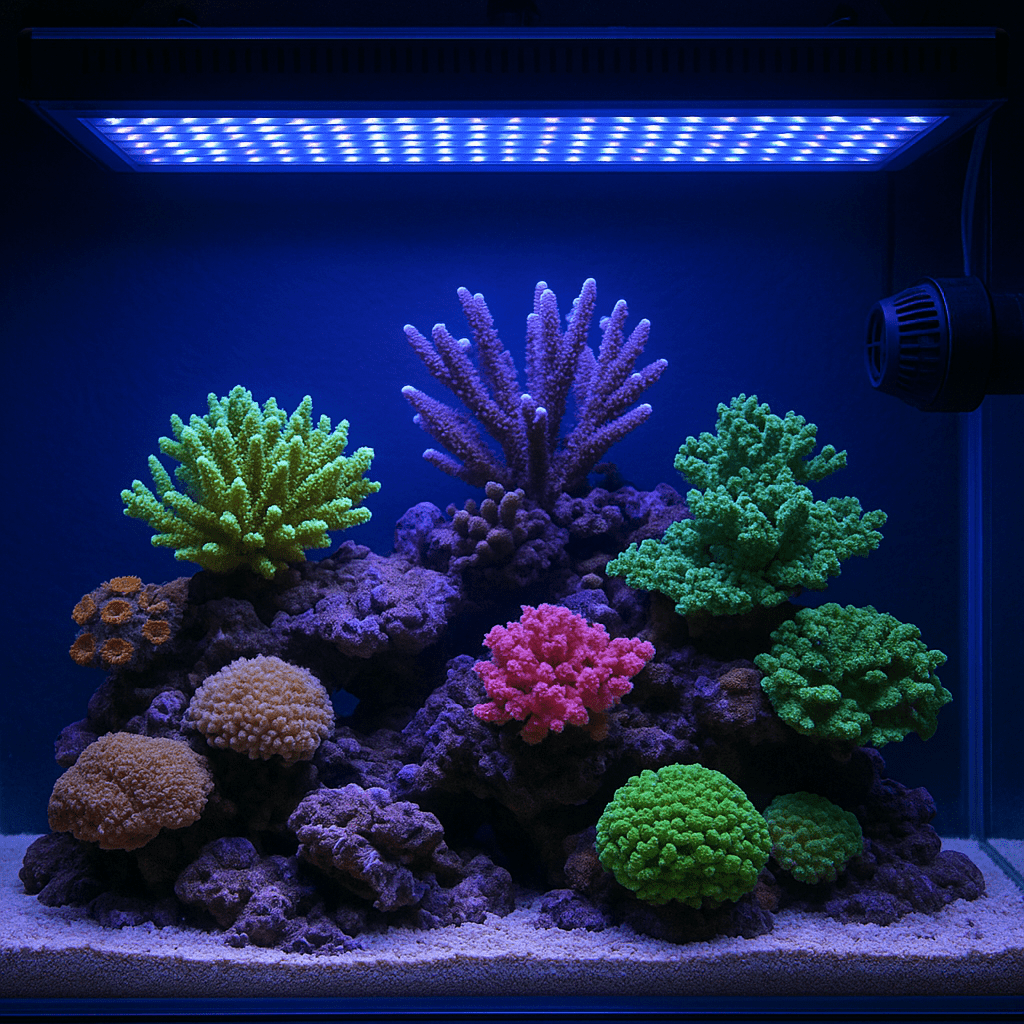
Photoperiod is the length of time lights are on and off in a 24-hour day. In nature, it is controlled by sunrise, sunset, seasons, clouds, and water clarity. In an aquarium, you control photoperiod with timers or your light’s app, and it becomes one of the biggest levers you have for coral health, algae control, and fish behavior.
For reef keepers, photoperiod is not just “how long the lights run.” It includes how long your tank spends at low light (sunrise ramp), peak intensity (midday), and dim light (sunset ramp and moonlights). Getting the timing right helps you balance coral energy needs with nutrient levels and the tank’s ability to process waste.
Why photoperiod matters in a reef aquarium
Light drives photosynthesis in zooxanthellae (the symbiotic algae living in most reef-building corals). During the “lights on” portion of the day, corals and other photosynthetic organisms produce energy. During the “lights off” period, they shift metabolic processes and recover. Both phases matter.
- Coral growth and color: Too little usable light time can limit growth. Too much can cause paling or stress, especially if intensity is high.
- Algae control: Long photoperiods can fuel nuisance algae if nutrients are available. Shorter or better-structured schedules can help.
- Fish and invertebrate behavior: Many reef fish feed and interact based on light cues. Consistent day/night cycles reduce stress.
- pH stability: Photosynthesis consumes CO2 during the day, often raising pH. At night, CO2 rises and pH drops. Photoperiod affects the swing.
Photoperiod vs. intensity (and why both matter)
Photoperiod is time. Intensity is how strong the light is. Corals respond to the total daily light dose, not just one setting. Reef lighting discussions often use two related concepts:
- PAR (Photosynthetically Active Radiation): A measurement of light available for photosynthesis at a given moment and location.
- DLI (Daily Light Integral): The total amount of usable light delivered over the whole day (PAR integrated over time).
You can reach a similar DLI with a shorter, brighter schedule or a longer, dimmer schedule, but corals do not always respond the same way. Many reef tanks do best with a moderate peak period and reasonable total time rather than an extremely long day.
Typical reef tank photoperiods (practical ranges)
There is no single “perfect” photoperiod, but these are common starting points for mixed reefs using modern LEDs. Adjust based on coral response, algae pressure, nutrient levels, and your viewing schedule.
| Lighting phase | Common duration | Notes |
|---|---|---|
| Sunrise ramp (low to moderate) | 1–2 hours | Helps fish transition and reduces sudden light shock |
| Peak period (highest intensity) | 4–6 hours | Main photosynthesis window for corals |
| Sunset ramp (moderate to low) | 1–2 hours | Gradual dimming can reduce stress and jumping |
| Total “daylight” (any meaningful output) | 8–10 hours | Most reefs succeed in this range |
| Moonlights (very dim blue) | 0–2 hours (optional) | Keep extremely low; bright moonlights can disrupt night behavior |
If you are battling algae, a common mistake is to cut intensity drastically but keep the lights on for 12–14 hours. Often, a better approach is to keep a stable schedule and reduce peak intensity slightly, shorten the peak window, or improve nutrient export.
How to set photoperiod for different reef styles
Soft coral and LPS-dominant tanks
Soft corals and many LPS can thrive with moderate PAR and a moderate photoperiod. They often show best extension with stable timing and gentle ramps.
- Total daylight: ~8–10 hours
- Peak: ~4–5 hours
- Tip: If LPS are receding or staying tightly closed, check for too much intensity or too much direct flow before changing photoperiod.
SPS-dominant tanks
SPS typically want higher PAR and stable conditions. Photoperiod is still important, but stability and appropriate intensity at the coral’s location matter most.
- Total daylight: ~8–10 hours
- Peak: ~5–6 hours
- Tip: If SPS are paling, consider reducing peak intensity or shortening peak by 30–60 minutes rather than changing everything at once.
FOWLR (fish-only with live rock)
Without photosynthetic corals, photoperiod is mainly for fish comfort and aesthetics. A shorter day can also reduce algae growth.
- Total daylight: ~6–9 hours
- Tip: Use enough light to enjoy the tank and support coralline algae if desired, but avoid long days that fuel nuisance algae.
Signs your photoperiod is too long (or too short)
Photoperiod problems can look like nutrient problems, flow problems, or even pest issues. Use trends over 1–2 weeks, not one-day changes.
When the photoperiod is likely too long
- Rapid algae growth despite reasonable nutrient control
- Corals look “washed out” or pale, especially near the top
- Corals stay retracted late in the day
- Large pH swing from day to night (not always photoperiod, but it can contribute)
When the photoperiod is likely too short
- Slow coral growth with otherwise stable alkalinity, calcium, and nutrients
- Corals appear darker or browner (can also be nutrient-related)
- Corals only show strong polyp extension briefly during peak light
Important: browning is often caused by elevated nutrients or low flow, not just photoperiod. Likewise, paling can be high light, low nutrients, or instability. Change one variable at a time.
How to adjust photoperiod safely
Corals can adapt to changes, but sudden schedule shifts can cause stress. If you want to change photoperiod, do it gradually and watch your livestock.
- Change in small steps: Adjust total daylight or peak length by 15–30 minutes every 4–7 days.
- Keep a stable “peak” window: Many tanks do best with a consistent peak time each day.
- Use ramps, but don’t overdo them: Long ramps can make your total day much longer than you think.
- Re-check coral placement: A coral too high can be over-lit even with a reasonable photoperiod.
Photoperiod, algae, and nutrients: the balancing act
Algae needs light plus nutrients. If nitrate and phosphate are available, a long photoperiod can accelerate algae growth. But cutting light too much can also weaken corals and reduce their ability to compete. The goal is a schedule that supports coral health while you manage nutrients through feeding control, filtration, and export.
In practice, many reef keepers find success with:
- A consistent 8–10 hour daylight schedule
- A defined 4–6 hour peak period
- Reasonable nutrient targets (not zero) and steady alkalinity
Do corals need darkness?
Yes. Corals benefit from a true night period. Darkness supports natural day-night rhythms in fish and invertebrates and gives the tank a predictable cycle. It also helps prevent “always on” lighting that can stress livestock over time.
If you like moonlights for viewing, keep them very dim and consider limiting them to an hour or two, or using them only occasionally. Bright blue lights all night can disrupt nocturnal behavior, feeding patterns, and rest.
Simple example photoperiod schedules
Use these as templates and adapt to your tank and your light fixture. Times are examples, not rules.
Balanced mixed reef schedule (8.5 hours total)
- 12:00–13:30 ramp up
- 13:30–18:30 peak
- 18:30–20:30 ramp down
- 20:30–12:00 lights off
Algae-control leaning schedule (7.5–8 hours total)
- 13:00–14:00 ramp up
- 14:00–18:00 peak
- 18:00–20:00 ramp down
- 20:00–13:00 lights off
When making changes, keep notes. Track coral color, polyp extension, algae growth on the glass, and nutrient tests weekly. Photoperiod tuning is easier when you can see what changed and when.
Was this helpful?
Related Posts
Sohal Tang (Acanthurus Sohal)
Sohal Tang care centers on space, heavy feeding, and aggression control. Learn tank size, diet, compatibility, and common…
 By
By
Half Black Angelfish (Centropyge Vrolikii)
Half Black Angelfish care is straightforward in mature tanks, but reef safety is never guaranteed. Learn feeding, tank…
[favorite_button]
My Bookmarks:
To see full list click here
[user_favorites user_id="" include_links="true" site_id="" post_types="" include_thumbnails="true" thumbnail_size="thumbnail" include_excerpt="false"]