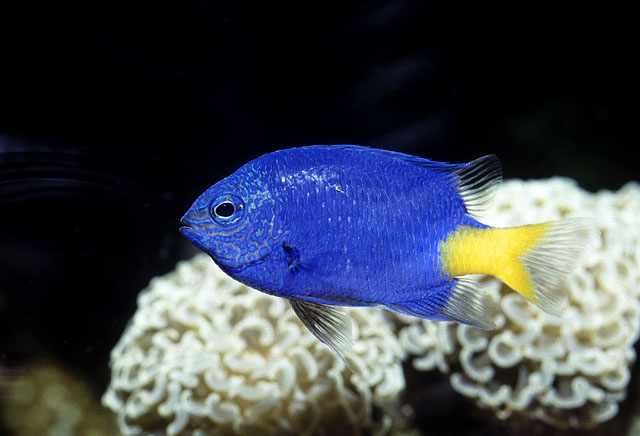
Yellowtail damselfish are small, bold reef fish with bright color. They suit many beginner saltwater tanks. They can also test your patience with attitude.
This guide covers tank size, water targets, feeding, and behavior. You will also get practical steps to avoid common stocking problems.
Tank setup and water parameters
Chrysiptera parasema stays near 2.5–3 inches as an adult. A 20-gallon tank works for one fish. A 30-gallon tank is safer for a pair. Use 40 gallons or more for a small group.
Build a rockscape with many breaks in line of sight. Add at least two caves per fish. Use branching rock or small bommies. This reduces chasing and stress.
Aim for stable reef parameters. Keep salinity at 1.025–1.026 specific gravity. Hold temperature at 25–26°C (77–79°F). Keep pH at 8.1–8.4 and alkalinity at 8–9 dKH.
Control nutrients to limit algae and keep oxygen high. Keep ammonia and nitrite at 0 ppm always. Keep nitrate at 5–20 ppm for mixed reefs. Keep phosphate near 0.03–0.10 ppm.
- Use a tight lid or mesh top to reduce jumping risk.
- Add moderate flow near rock faces for oxygen and waste lift.
- Do 10% weekly water changes to keep parameters steady.
If you need a refresher on stability, review reef tank water parameters. For cycling basics, see how to cycle a saltwater tank.
Feeding and daily care
Yellowtail damselfish are eager eaters. Feed small portions twice per day. Use pellets or flakes as a base. Add frozen foods for variety and color.
Offer a simple weekly rotation. Feed quality marine pellets in the morning. Feed frozen mysis or brine at night. Add finely chopped seafood once per week. Include spirulina flakes twice weekly for plant matter.
Watch body shape during feeding. A healthy fish has a full belly after meals. It should not look pinched behind the head. If it spits food, try smaller pellets. Soak dry food for 30 seconds.
Keep the tank clean by matching food to filtration. Rinse frozen foods in RO water. Use a filter sock or floss after heavy feeding. Empty it within 48 hours to avoid nitrate spikes.
- Target 30–60 seconds of feeding time per meal.
- Use a feeding ring to keep food from entering the overflow.
- Skip one feeding per week if nitrate climbs above 25 ppm.
For more on nutrition planning, check reef fish feeding schedule. A consistent routine helps reduce aggression too.
Temperament, tank mates, and troubleshooting
This species is calmer than many damsels. It can still claim a rock as its turf. Aggression rises in small tanks. It also rises when you add timid fish later.
Choose tank mates with care. Good options include clownfish, gobies, blennies, and many wrasses. Avoid mixing with very shy fish in a 20-gallon tank. Avoid adding it with other Chrysiptera in tight spaces.
Add the yellowtail near the end of stocking. This prevents it from owning the whole tank. If you must add it early, rearrange rock before new fish arrive. This resets territory claims.
Quarantine reduces disease and drama. Use a 10-gallon bare tank with PVC shelters. Observe for 14–21 days when possible. Watch for ich spots, frayed fins, and heavy breathing. Match salinity during transfers to prevent shock.
- If it bullies a new fish, add a mirror for two days.
- If chasing persists, use an acclimation box for 3–5 days.
- If fins tear, improve hiding spots and reduce light intensity.
Common mistake: keeping a “pair” without a plan. Two fish may fight in small tanks. A bonded pair is not guaranteed. In a 30–40 gallon tank, add two at once. Provide separate caves at opposite ends.
Another mistake is underestimating their appetite and waste. Overfeeding can push nitrate fast. If algae blooms, reduce feeding by 20%. Increase water changes to 15% weekly for one month.
Sources: FishBase (Chrysiptera parasema species profile); Scott W. Michael, Marine Fishes (behavior and care notes); Borneman, Aquarium Corals (reef husbandry principles)
Yellowtail damselfish reward good planning with constant motion and color. Give them stable water, smart rockwork, and a careful stocking order. You will get a hardy reef fish that stays active for years.
Was this helpful?
Related Posts
Protein Skimmer Reef Tank Guide
Learn how a protein skimmer works, how to size one, and how to tune it for a cleaner,…
 By
By
Reef Aquarium Water Parameters
Learn the ideal reef aquarium water parameters, safe ranges, and how to keep salinity, alkalinity, nutrients, and pH…