
Brown film in a reef tank can mean two very different problems. Dinoflagellates and cyanobacteria look similar at first. Correct identification saves time and livestock.
Fast visual clues: strings, bubbles, and where it grows
Start with where the growth appears each day. Dinos often coat sand first. They can also cover rock tips and coral bases. Cyano often forms sheets on sand and low flow rock.
Look for texture and structure under white light. Many dinos form snotty strings. The strings trap air bubbles by afternoon. Cyano tends to look like a smooth mat. It can still bubble, but strings are less common.
Track the day and night pattern for two days. Dinos often “disappear” after lights out. They return fast after lights come on. Cyano usually stays put overnight. It may thin, but mats remain visible.
Use flow as a clue, not a rule. Dinos can thrive in high flow areas. Cyano loves dead spots and dirty sand. If a turkey baster lifts a slimy cloud, note the smell. Cyano can smell earthy or swampy.
- Likely dinos: snot strings, many bubbles, daily vanish and return
- Likely cyano: red or purple sheets, peels off in mats, stays overnight
- Mixed case: cyano on rocks, dinos on sand, both present
Simple tests at home: microscope, peroxide, and nutrient context
A cheap microscope gives the clearest answer. Aim for 100x to 400x. Collect a small sample in a cup. Use a pipette to place it on a slide. Dinos look like single cells that move. Many spin or dart in place.
Cyano looks different under magnification. It shows long filaments or chains. Movement is slow, if present. It may glide, but it will not spin like many dinos. If you already own one, see our reef tank microscope guide.
Use nutrient numbers to support your ID. Dinos often show up in “too clean” systems. Common readings are nitrate 0–2 ppm and phosphate 0.00–0.03 ppm. Cyano often appears with higher organics. It can happen at any nitrate level. It often spikes after heavy feeding or clogged filters.
Try a controlled peroxide spot test on a removed sample. Put a small clump in a clear cup. Add 3% hydrogen peroxide at 1 mL per 100 mL tank water. Swirl and watch for 10 minutes. Cyano often breaks apart and fades. Some dinos resist and stay stringy. This is not a cure test.
- Microscope result beats all other clues
- Record nitrate and phosphate for seven days
- Do not chase “zero” nutrients during an outbreak
What to do next: first-response plans and common mistakes
If you confirm cyano, fix the cause first. Increase random flow on the sand. Siphon mats during water changes. Clean mechanical filters every two to three days. Aim for nitrate 5–15 ppm and phosphate 0.05–0.15 ppm. Stable numbers reduce rebounds.
If you confirm dinos, avoid large “clean up” swings. Many outbreaks worsen after big water changes. They also worsen after aggressive carbon dosing. Focus on stability and competition. Raise nutrients slowly if they are near zero. Target nitrate 5–10 ppm and phosphate 0.05–0.10 ppm.
Use UV correctly when dinos are in the water column. Many species go planktonic at night. Run UV 24/7 for two weeks. Size it for parasites, not just clarity. A common target is 1–2x display volume per hour through the UV. For setup help, see our UV sterilizer reef tank setup.
Do not treat blind. Antibiotics can crash beneficial bacteria. Algaecides can harm inverts and corals. If you see both pests, treat the worst first. Many tanks need a balanced approach. Our reef tank nutrient balance article can guide dosing.
- Common mistake: running phosphate remover to “starve” cyano
- Common mistake: daily large water changes during a dino bloom
- Best habit: log light schedule, feeding, and test results
Dinos and cyano can look alike, but they behave differently. Use day-night changes, texture, and a microscope to confirm. Then pick a steady plan and avoid sudden swings.
Sources: Borneman, E. (2001) Aquarium Corals; Delbeek, J.C. & Sprung, J. (1994–2005) The Reef Aquarium Vol. 1–3; Tullock, J.H. (2001) Natural Reef Aquariums.
Was this helpful?
Related Posts
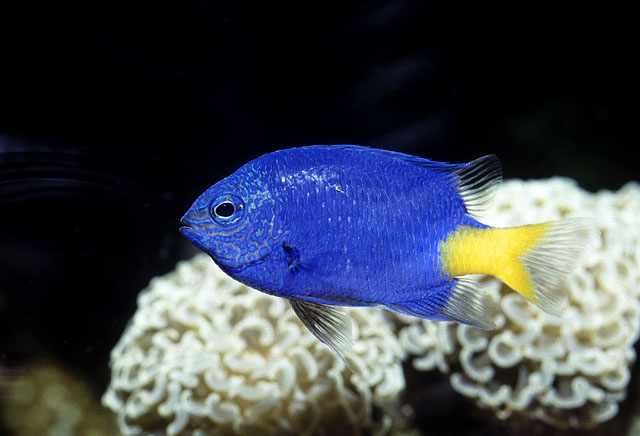
Yellowtail Damselfish (Chrysiptera Parasema)
Yellowtail Damselfish are hardy, colorful, and reef safe, but they can be territorial. Learn their care, feeding, tank…
 By
ByWater Chemistry Basics
Water chemistry basics are the foundation of reef success. Learn the key parameters, target ranges, and simple ways…
[favorite_button]
My Bookmarks:
To see full list click here
[user_favorites user_id="" include_links="true" site_id="" post_types="" include_thumbnails="true" thumbnail_size="thumbnail" include_excerpt="false"]