Reef tanks run on chemistry, not luck. Alkalinity, calcium, and magnesium drive coral growth and stability. When one drifts, the others often follow.
What these three parameters do (and ideal ranges)
Alkalinity is your tank’s buffering capacity. It helps keep pH steady all day. It also supplies carbonate for skeleton growth.
For most mixed reefs, target 7.5–9.0 dKH. Keep daily swing under 0.3 dKH. Stability matters more than chasing a single number.
Calcium is the main building block for stony corals and coralline algae. A solid target is 400–450 ppm. Avoid changes over 20 ppm per day.
Magnesium supports the system by limiting unwanted calcium carbonate precipitation. Aim for 1250–1400 ppm. Many hobbyists match their salt mix, often near 1350 ppm.
- Quick targets: Alk 8.0 dKH, Ca 430 ppm, Mg 1350 ppm.
- Testing cadence: Alk daily in new tanks, then 2–3 times weekly.
- Red flags: Burnt tips, stalled growth, and rapid pH swings.
If you are still learning baseline tank stability, start with reef tank water parameters. It helps you set a consistent testing routine. Then track how these three numbers move together.
How to test and interpret results without chasing numbers
Use reliable kits and repeatable technique. Test alkalinity at the same time each day. Evening readings can be slightly higher in some systems.
Write results in a log with date and time. Look for trends over 7–10 days. A slow decline usually means coral and coralline uptake.
Example: a 75-gallon reef drops from 8.3 to 7.7 dKH in three days. That is a 0.6 dKH drop. Your daily consumption is about 0.2 dKH.
Do not “fix” calcium before alkalinity is stable. Alk swings stress corals faster than calcium shifts. Magnesium is the slowest to change, so adjust it last.
- Rinse test vials with tank water before each test.
- Use consistent sample volume, like 10 ml or 5 ml.
- Retest any surprising result before dosing anything.
For help planning a testing schedule, see our reef tank testing schedule. It pairs frequency with tank maturity. It also reduces over-correction.
Dosing strategy, common mistakes, and troubleshooting
Start with water changes to reset imbalances. A 10–15% weekly change often maintains calcium and magnesium in light-demand tanks. Heavier SPS systems usually need dosing.
Two-part dosing adds alkalinity and calcium separately. Dose alkalinity in a high-flow area of the sump. Wait 5–10 minutes before dosing calcium in a different spot.
Use your measured consumption to set a daily dose. Split the total into 2–4 smaller doses. This reduces pH spikes and local precipitation.
Common mistake: raising alkalinity too fast to “match” a salt mix. Increase no more than 0.5 dKH per day. Another mistake is dosing with high pH additives during lights-on only.
- Cloudy water after dosing: You likely caused precipitation. Stop dosing for 24 hours. Recheck Alk, Ca, and Mg.
- Alk will not rise: Test kit error or heavy precipitation. Check magnesium and verify salinity at 1.025–1.026.
- High calcium, low alkalinity: Dose alkalinity only until stable. Then resume balanced dosing.
If you want a deeper dosing setup, read our two-part dosing guide. It covers pump calibration and safe mixing. It also explains when kalkwasser or a calcium reactor makes sense.
Sources: Holmes-Farley, R. “Reef Aquarium Water Parameters” (Advanced Aquarist); Borneman, E. “Aquarium Corals”; Sprung, J. “The Reef Aquarium” Vol. 1–3.
Was this helpful?
Related Posts
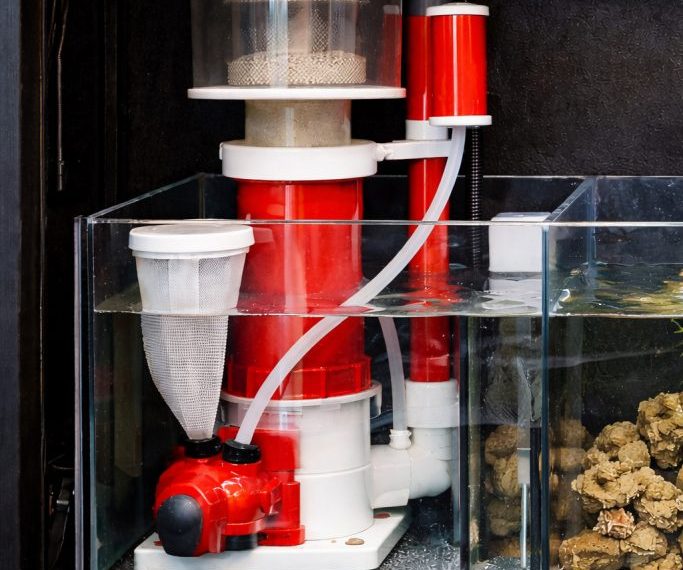
Protein Skimmer Reef Tank Guide
Learn how a protein skimmer works, how to size one, and how to tune it for a cleaner,…
 By
By
Reef Aquarium Water Parameters
Learn the ideal reef aquarium water parameters, safe ranges, and how to keep salinity, alkalinity, nutrients, and pH…