

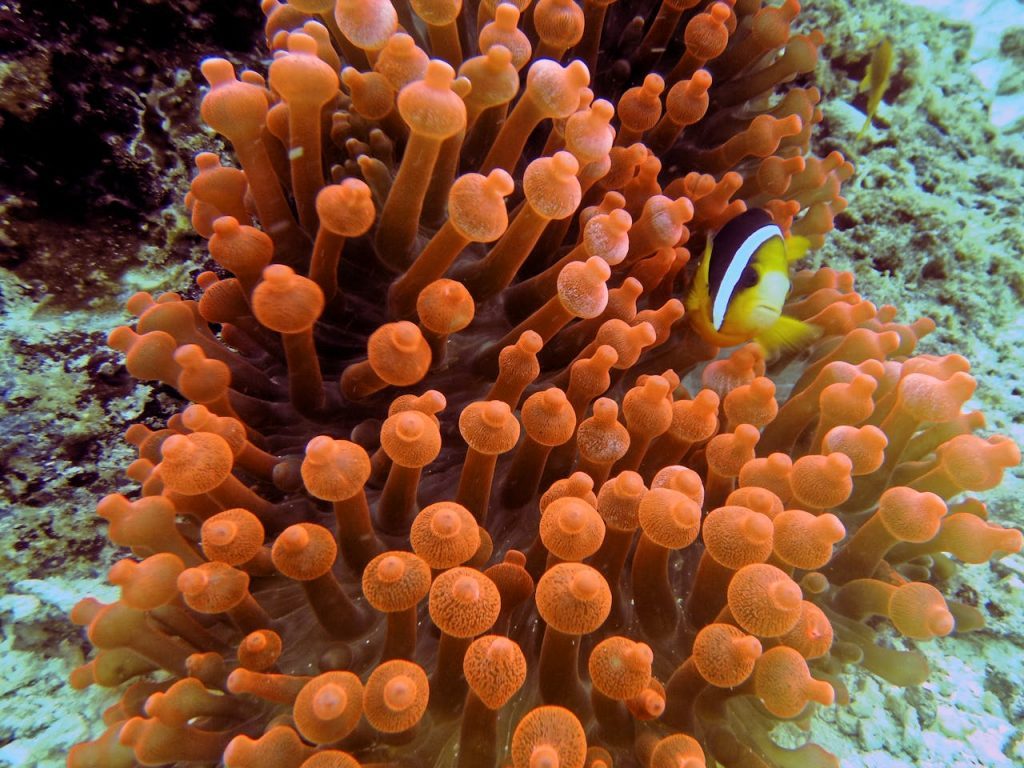
Bubble Tip Anemones (Entacmaea quadricolor) are one of the most iconic reef aquarium anemones for good reason: they can be hardy once established, they come in stunning color morphs, and they are one of the most reliable hosts for clownfish in captivity. They are also misunderstood. Many losses come from unstable parameters, poor placement, or adding one to a “new” tank that is still cycling through chemistry swings.
This guide focuses on practical, repeatable husbandry: how to choose a healthy specimen, set up the right environment, dial in lighting and flow, feed correctly, and prevent the two classic disasters: wandering anemones and powerhead accidents. If you do the basics well, a Bubble Tip Anemone can become a long-term centerpiece that may even split and form a small colony over time.
Quick Care Snapshot
| Difficulty | Moderate (easy once stable) |
| Recommended tank age | 6+ months (stable, mature reef) |
| Minimum tank size | 20–30 gallons (more stable is better) |
| Lighting | Moderate to high (PAR ~150–250 typical) |
| Flow | Moderate, indirect, random |
| Feeding | 1–2× weekly (optional but helps growth) |
| Placement | Rock crevice with protected foot |
| Reef safe? | Yes, but can sting corals if it wanders |
Species Overview: Entacmaea quadricolor
The Bubble Tip Anemone (BTA) is a symbiotic anemone found across the Indo-Pacific. In the wild, it lives anchored deep in rock crevices with its oral disc and tentacles extended into the water column. That “anchored foot” behavior is the key to keeping BTAs successfully in aquariums. When the foot feels secure and the animal is happy with light and flow, it typically stays put.
BTAs contain symbiotic zooxanthellae (photosynthetic algae) that provide much of their energy under proper lighting. They can also capture and ingest meaty foods. In aquariums, they may host clownfish, though hosting is not guaranteed and depends on the clown species and the individual anemone.
Choosing a Healthy Bubble Tip Anemone
Start with a healthy specimen and you eliminate most of the “mystery” failures. Look for these signs at the store or from a hobbyist:
- Sticky tentacles that grab lightly when touched (do not handle directly if you can avoid it).
- Mouth closed or only slightly relaxed. A gaping mouth is a red flag.
- Foot intact with no tears. Foot damage is one of the hardest injuries to recover from.
- Good inflation/deflation rhythm. Occasional deflation is normal. Constant collapse is not.
- Color that looks “full,” not bleached. Very pale anemones can recover, but it is a longer, riskier process.
Tip: Many of the brightest “designer” BTAs are clones that have been propagated in captivity. Captive-propagated anemones often adapt better to aquarium life than freshly imported wild specimens.
Tank Requirements (Stability First)
The most important “equipment” for a Bubble Tip Anemone is a stable reef tank. BTAs can tolerate a range of conditions, but they do poorly with swings, especially in salinity, temperature, and alkalinity.
Tank size and maturity
A 20–30 gallon tank can work, but larger systems are more forgiving. More important than volume is maturity. A tank that is 6+ months old with stable nutrients, stable alkalinity, and predictable daily pH is a much better home than a brand-new “clean” system.
Aquascape for a secure foot
BTAs want to plant their foot deep in a hole or crevice and then expand into light. Build or identify a few “anemone pockets” before you add one:
- Rockwork with deep fissures or caves where the foot can disappear.
- A stable rock that will not shift if the anemone wedges in tightly.
- Space around the anemone for expansion and potential splitting.
- Distance from high-value corals in case it decides to move.
Avoid placing BTAs on the sand bed unless you have a rock island or a protected crevice at the base. Many will eventually climb to find better light and flow, and that is when they can sting corals along the way.
Water Parameters for Bubble Tip Anemones
BTAs respond best to reef-stable parameters rather than chasing a single “perfect” number. Keep salinity and alkalinity steady, maintain reasonable nutrients, and avoid rapid corrections.
| Parameter | Recommended Range | Notes |
|---|---|---|
| Temperature | 76–79°F (24.5–26°C) | Stability matters more than exact value |
| Salinity | 1.025–1.026 SG | Use an ATO to prevent daily swings |
| pH | 8.0–8.3 | Avoid big day/night swings |
| Alkalinity | 8–9 dKH | Keep stable; avoid rapid dosing changes |
| Calcium | 400–450 ppm | Not as critical as Alk stability |
| Magnesium | 1250–1400 ppm | Supports overall chemistry stability |
| Nitrate | 2–15 ppm | Ultra-low nutrients can lead to pale BTAs |
| Phosphate | 0.03–0.10 ppm | Keep detectable; avoid stripping to zero |
Lighting Requirements (PAR and Placement)
Bubble Tip Anemones are photosynthetic and typically do best under moderate to high reef lighting. In many mixed reefs, a target of roughly PAR 150–250 at the oral disc is a solid starting point. Some BTAs will thrive higher, but pushing intense light too quickly can cause bleaching or repeated shrinking.
Practical lighting tips:
- Acclimate to light using a ramp-up schedule or reduced photoperiod for the first 1–2 weeks.
- Expect the anemone to move to self-select its preferred intensity. This is normal, but you should plan for it.
- Blue-heavy reef spectra are fine. Avoid sudden spectrum changes that shock the animal.
- If your BTA stretches upward with long, thin tentacles and looks “reaching,” it may want more light (or different flow).
“Bubble” tips are not a guaranteed sign of health. Many healthy BTAs display long, stringy tentacles depending on flow, lighting, feeding, and genetics.
Water Flow: Keep It Moderate and Indirect
Flow is where many reef keepers accidentally create problems. BTAs want moderate, indirect, random flow that keeps tentacles gently moving and helps carry food and waste away, without blasting the oral disc.
How to dial it in:
- Aim for tentacles that sway, not whip violently.
- Use crossflow or alternating pumps to avoid a constant jet.
- Make sure the anemone’s chosen crevice is not a dead spot where detritus collects.
- Cover powerheads with foam guards or anemone shields. This is non-negotiable in many tanks.
If a BTA keeps walking, one of the most common reasons is that it is trying to escape an uncomfortable flow pattern or find a better combination of light and flow.
Feeding Bubble Tip Anemones
BTAs can survive on light and dissolved nutrients in a healthy reef, but targeted feeding often improves growth, coloration, and the likelihood of splitting. Overfeeding, however, can foul water and cause regurgitation.
Best foods
- Thawed mysis shrimp
- Chopped raw shrimp, scallop, or clam
- Small pieces of silversides (sparingly, and only appropriately sized)
- Quality frozen reef blends with marine proteins
How often to feed
For most tanks, 1–2 times per week is plenty. If nutrients are already high, reduce feeding frequency. If you are trying to recover a pale anemone, small frequent meals can help, but only if water quality stays stable.
Feeding technique
- Turn off or reduce flow for 10–15 minutes.
- Use feeding tongs or a turkey baster to place food on the tentacles near the mouth.
- Feed pieces about the size of the anemone’s mouth or smaller. Oversized chunks often get spit out later.
- If clownfish steal food, feed the fish first, then offer the anemone.
Clownfish Hosting and Behavior
BTAs are a natural host for several clownfish species, including Amphiprion ocellaris and A. percula in many aquariums. Some clowns take to a BTA immediately, while others never do. Hosting is influenced by species, size, prior hosting experience, and even the individual anemone.
One caution: large, enthusiastic clownfish can irritate a newly introduced or stressed anemone. If the BTA stays deflated and the clowns are constantly diving into it, consider using a temporary fish acclimation box or divider until the anemone settles and attaches firmly.
Compatibility in Reef Tanks
With corals
Bubble Tip Anemones are “reef safe” in the sense that they do not eat corals, but they can and will sting corals they touch. The biggest risk is wandering. Plan a buffer zone and avoid placing BTAs in tight SPS gardens.
- Keep distance from Euphyllia (torches, hammers) and other long-sweeper corals.
- Expect chemical competition in small tanks. Activated carbon can help.
- Consider an anemone island rock structure to limit contact with corals.
With fish
Most reef fish are fine. Avoid fish that pick at invertebrates or are known anemone nippers (some butterflyfish, some angels). Also be cautious with very small fish that may blunder into tentacles, though BTAs in home aquariums rarely capture healthy fish.
With invertebrates
Shrimp, snails, and hermits are generally compatible. Peppermint shrimp may steal food during feeding. Some crabs can irritate anemones. Keep an eye on interactions, especially at night.
Placement: How to Keep Your BTA From Wandering
Most wandering is the anemone telling you something is off. Your goal is to give it a spot that meets its needs from day one.
Best practice placement method:
- Choose a rock with a deep crevice and moderate light.
- Turn pumps down temporarily so it can grab hold.
- Gently set the anemone near the crevice and let it attach on its own. Do not force the foot into a hole.
- Once attached, slowly restore normal flow over several hours.
If it moves anyway, check the basics in this order: salinity stability (ATO functioning), temperature stability, alkalinity swings, and then light and flow.
Common Problems and Troubleshooting
Why is my Bubble Tip Anemone shrinking or deflating?
Periodic deflation is normal. BTAs expel water to clear waste and reset internal pressure. Concern starts when it stays deflated for long periods or repeats the cycle multiple times daily.
- Check salinity with a calibrated refractometer. Top-off swings are a common cause.
- Check alkalinity stability over several days. Rapid dosing changes can stress anemones.
- Look for irritation from clownfish, crabs, or direct flow.
- Test nutrients. Ultra-low nitrate/phosphate can lead to pale, unhappy BTAs.
What does a gaping mouth mean?
A mildly relaxed mouth can happen after feeding or during a normal deflation cycle. A persistently gaping mouth, especially combined with limp tentacles and repeated deflation, is a serious stress sign.
Immediate steps:
- Stop feeding for a few days.
- Confirm temperature and salinity are stable.
- Check for ammonia and nitrite (both should be zero).
- Increase oxygenation and gentle flow (not blasting).
My anemone is bleached. Can it recover?
Yes, many bleached BTAs recover, but it takes time. Bleaching means the anemone has lost much of its zooxanthellae. Provide stable parameters, avoid intense lighting spikes, and offer small meaty meals once or twice a week if it will accept them. Focus on consistency, not rapid fixes.
Why did my BTA get sucked into a powerhead?
This happens when an anemone wanders at night or during a parameter swing. Prevention is far easier than treatment.
- Use anemone guards or foam covers on all intakes.
- Keep a safe zone around pump intakes and overflow teeth.
- If it wanders, look for the underlying cause (light, flow, stability) rather than trying to “pin” it in place.
If an injury occurs, remove any shredded tissue you can access, run fresh carbon, and keep water quality pristine. Some BTAs recover from minor damage, but severe injuries are often fatal and can pollute small tanks quickly.
My Bubble Tip Anemone split. Is that good or bad?
Splitting is often a sign of growth and stability, but it can also occur after stress (such as a major parameter change). If both halves have intact mouths and remain inflated within a day or two, it is usually fine. Keep hands off, keep parameters stable, and avoid heavy feeding until they settle.
Propagation and “Fragging” Bubble Tip Anemones
In reef aquariums, Bubble Tip Anemones most commonly propagate by natural fission (splitting). This is how many captive “designer” lines are produced. Intentional cutting is possible but risky and not recommended for beginners.
If your BTA splits naturally:
- Give both clones room. They may expand more than you expect.
- Do not try to pull them off the rock. Let them detach naturally if they decide to move.
- Maintain stable alkalinity and salinity. Avoid big water changes “just because it split.”
- Feed lightly after a few days if mouths are closed and they are sticky.
If you plan to trade or sell clones, wait until each anemone is stable, attached, and has been eating normally for several weeks.
FAQ: Bubble Tip Anemone (Entacmaea quadricolor)
How long do Bubble Tip Anemones live in captivity?
With stable conditions, BTAs can live for many years in reef aquariums. Long-term success is strongly tied to stability, safe flow (guarded pumps), and consistent salinity.
Do Bubble Tip Anemones need to be fed?
They do not strictly need frequent feeding if lighting and nutrients are appropriate, but feeding 1–2 times per week often improves growth, coloration, and splitting potential.
What PAR does a Bubble Tip Anemone need?
Many BTAs thrive around PAR 150–250, though they can adapt outside that range. Acclimate slowly and let the anemone choose its final spot.
Why won’t my clownfish host the anemone?
Hosting is not guaranteed. Some clowns prefer other corals or corners of the tank, and some take weeks or months. Focus on anemone health first, and avoid “forcing” hosting behaviors.
Can I keep a Bubble Tip Anemone in a new tank?
It is not recommended. Wait until your tank is mature (often 6+ months) with stable salinity, alkalinity, and consistent nutrient levels. New tanks tend to swing too much for anemones.
Was this helpful?
Related Posts
Best Filtration Systems
Best Filtration Systems for a Healthy Saltwater Aquarium Choosing the best filtration system for your saltwater aquarium is…
 By
By
Clown Triggerfish (Balistoides Conspicillum)
Clown triggerfish are stunning but aggressive marine fish that need very large tanks, strong filtration, and careful tankmate…
[favorite_button]
My Bookmarks:
To see full list click here
[user_favorites user_id="" include_links="true" site_id="" post_types="" include_thumbnails="true" thumbnail_size="thumbnail" include_excerpt="false"]