
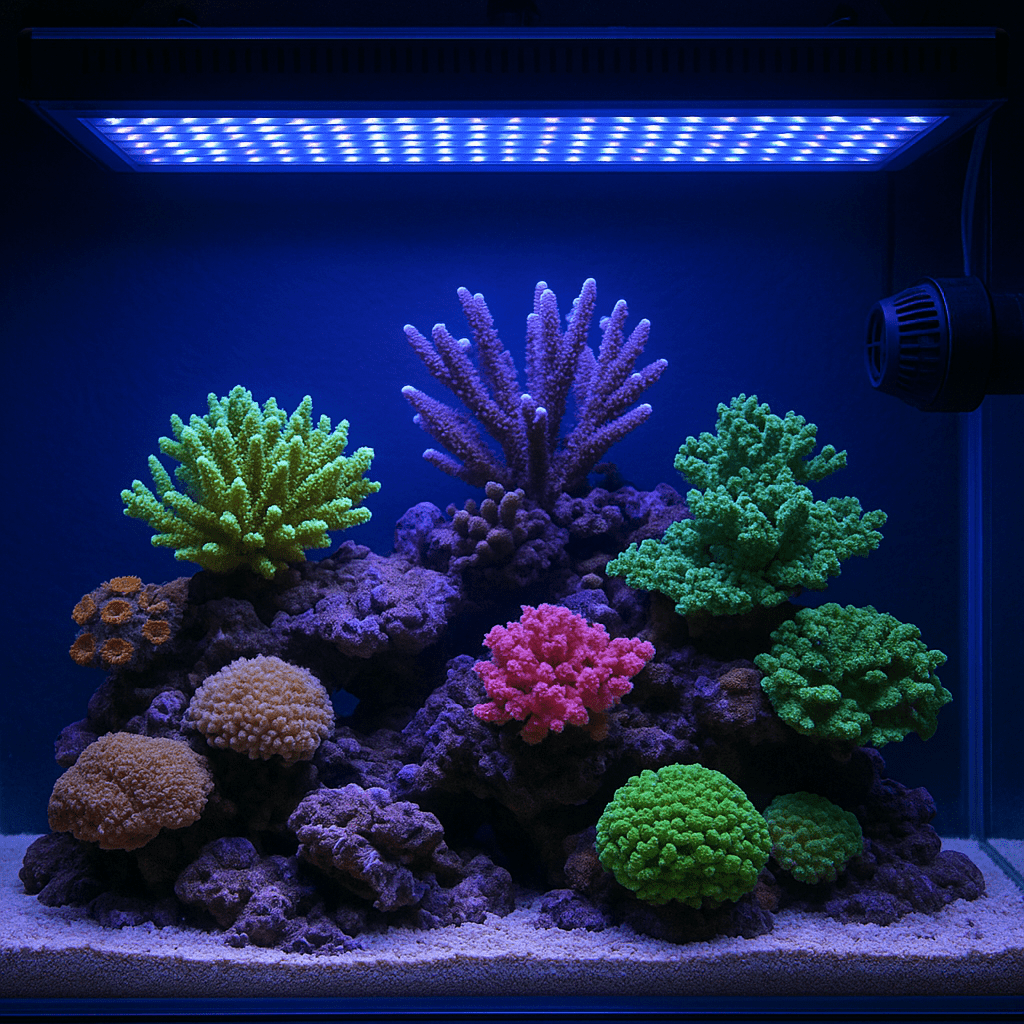
Intermediate corals are ideal for reef keepers who have mastered the basics and want better color, growth, and variety. These corals need more stable conditions than beginner species, but they remain very achievable in a well-run mixed reef.
As reef tanks mature, many hobbyists outgrow soft coral starter pieces and hardy beginner LPS. The next step is choosing corals that reward stability, patience, and improving husbandry. In this guide, you will learn which intermediate corals fit growing reef tanks, what they need to thrive, and how to avoid the common mistakes that cause slow decline. We will cover lighting, flow, placement, feeding, compatibility, and troubleshooting. The goal is simple. Help you move beyond survival and into steady coral growth.
Quick Reference Table
| Coral | Difficulty | Light | Flow | Best Placement | Main Watchout |
|---|---|---|---|---|---|
| Hammer Coral | Intermediate | Moderate | Moderate, indirect | Mid to lower rockwork | Aggression and tissue damage |
| Frogspawn Coral | Intermediate | Moderate | Moderate, indirect | Mid level | Sweeper tentacles |
| Birdsnest Coral | Intermediate | Moderate to high | Moderate to high | Upper rockwork | Parameter swings |
| Montipora | Intermediate | Moderate to high | Moderate to strong | Mid to upper rockwork | Low alkalinity stability |
| Candy Cane Coral | Intermediate | Moderate | Low to moderate | Lower to mid level | Overly strong flow |
| Leptastrea | Intermediate | Low to moderate | Low to moderate | Lower rockwork | Too much light too fast |
This table gives you a fast starting point. Exact placement still depends on your tank, your lights, and your flow pattern.
What Makes a Coral Intermediate?
Intermediate corals sit between beginner forgiving species and demanding SPS showpieces. They usually need stable alkalinity, calcium, and magnesium. They also react faster to poor placement or changing nutrients. That does not mean they are fragile. It means they reward consistency.
Most growing reef tanks reach this stage around the six to twelve month mark. By then, the tank has more stable biology. The reefer also has better testing habits. You should already understand salinity control, water changes, and basic nutrient management. If your tank still has frequent swings, wait a bit longer.
Good intermediate coral choices add movement, texture, and stronger skeletal growth. They also teach placement strategy. Some need room from neighbors. Some need stronger random flow. Others need lower light than new hobbyists expect. Learning those differences is what helps you progress.
Best Intermediate Corals for Growing Reef Tanks
Several coral groups fit this category very well. Euphyllia corals are a classic choice. Hammer, frogspawn, and torch corals bring motion and color. They need stable chemistry and enough space from nearby corals. Their sweeper tentacles can sting neighbors.
Montipora is often the first SPS many hobbyists keep successfully. Plating and encrusting forms grow fast in healthy tanks. They show clear responses to light, alkalinity, and nutrients. Birdsnest coral is another good bridge into SPS. It likes stronger flow and stable parameters, but it is less intimidating than many Acropora.
Candy cane corals and leptastrea are excellent for reef keepers who want more structure without jumping into high-demand species. They tolerate moderate conditions but still benefit from careful placement and stable alkalinity. If you want a mixed reef, these corals offer variety without making the tank too risky.
Natural Habitat and Why It Matters
Many intermediate corals come from reef slopes, lagoons, and protected outer reef areas. In nature, they experience stable salinity and temperature. They also receive constant water movement. That flow brings oxygen, removes waste, and delivers food.
Euphyllia often occur in areas with moderate movement rather than direct surge. This explains why they dislike being blasted by a powerhead. Montipora and birdsnest usually come from brighter, more turbulent zones. That is why they often color up better under stronger light and random flow.
Understanding habitat helps with placement. Corals are not random decorations. They are animals adapted to specific reef zones. Matching those conditions in your aquarium improves expansion, growth, and long-term health. It also prevents the common mistake of treating every coral the same.
Aquarium Setup for Intermediate Corals
A stable tank matters more than a large tank, but size still helps. A reef of 40 gallons or more gives you better room for placement and spacing. Larger systems also resist sudden chemistry swings. That makes them friendlier for intermediate coral care.
Aquascaping should create zones. Build lower light shelves, moderate flow ledges, and brighter upper sections. This lets you place each coral based on its needs. Leave room between aggressive LPS. Also plan for future growth. A tiny frag can become a large colony faster than expected.
Use quality rockwork with secure mounting points. Corals that wobble often fail to settle in. Keep enough open space for fish movement and water circulation. Dead spots trap detritus and raise nutrients around coral tissue. Good reef structure supports both coral health and easier maintenance. For broader planning, see reef tank aquascaping ideas, beginner reef tank setup, and reef tank maintenance schedule.
Lighting Requirements
Intermediate corals need matched lighting, not maximum lighting. Many hobbyists lose corals by placing them too high too soon. Start lower when possible. Then move upward after watching tissue response and color.
Euphyllia usually do well under moderate PAR. Many thrive around 80 to 150 PAR. Candy cane corals often prefer similar levels. Leptastrea usually prefers lower to moderate light. Montipora and birdsnest often perform best in moderate to higher PAR, commonly around 150 to 250, depending on the strain and system.
Acclimate all new corals to your lights. Reduce intensity or use lower placement at first. Watch for bleaching, retraction, or faded tissue. Those signs often mean too much light too fast. For more detail, read reef aquarium lighting guide.
Water Flow
Flow is one of the biggest differences between success and frustration. Intermediate corals often need more thoughtful flow than beginner species. The goal is random, indirect movement. You want tissue to sway or pulse gently, not whip violently.
Euphyllia prefer moderate indirect flow. Their tentacles should move smoothly. If the flesh folds sharply or stays retracted, the flow may be too strong. Candy canes and leptastrea usually prefer gentler movement. Montipora and birdsnest need stronger flow to keep surfaces clean and oxygenated.
Adjust pumps based on coral behavior. One tank’s moderate flow can be another tank’s harsh flow. Rock placement changes everything. Observe each coral for several days before making another adjustment. Constant moving creates stress and slows adaptation.
Feeding and Nutrition
Most intermediate corals get much of their energy from light, but feeding still helps. LPS corals often benefit from occasional target feeding. Offer small meaty foods like mysis, reef roids, or finely chopped seafood once or twice weekly.
Do not overfeed the tank. Extra food quickly raises phosphate and nitrate if export is weak. That can hurt SPS color and encourage nuisance algae. Feed small amounts and watch how the system responds. A healthy skimmer and regular maintenance make feeding safer.
SPS like montipora and birdsnest usually rely more on dissolved nutrients and strong photosynthesis than direct feeding. They still benefit from a balanced system with some available nutrients. Ultra-clean water can be just as problematic as dirty water. Coral health usually improves when nitrate and phosphate remain detectable and stable.
Compatibility in a Mixed Reef
Compatibility matters more as coral variety increases. Many intermediate corals can live together, but spacing is critical. Euphyllia can sting nearby corals at night. Keep enough room around them. Plating montipora can also shade slower growers below.
Fish compatibility matters too. Most reef-safe fish are fine, but some angels, butterflies, and larger wrasses may irritate coral tissue. Certain crabs can also cause problems if they pick at polyps. Watch new livestock closely during the first week.
Invertebrates are usually safe, though some shrimp may steal food from fleshy LPS during feeding. If you keep a mixed reef, place aggressive corals lower or on isolated islands. Keep peaceful encrusters away from fast growers. For stocking strategy, see reef safe fish list.
Step-by-Step Guide to Adding Intermediate Corals
First, test your water before buying coral. Salinity, alkalinity, calcium, magnesium, nitrate, and phosphate should be stable. Stability matters more than chasing one perfect number.
Second, dip every new coral. This reduces the risk of pests and hitchhikers. Inspect the plug, skeleton, and tissue closely. Remove algae or eggs if you see them.
Third, place the coral in lower light for acclimation. Start with moderate flow. Let it settle for several days. Then adjust placement slowly based on extension and color.
Fourth, monitor alkalinity closely during the first month. Growing corals increase demand over time. Many reef keepers succeed early, then struggle when consumption rises unnoticed. Test often and dose only when needed.
Finally, be patient. Do not move corals every day. Most need time to adapt before showing their true response.
Propagation and Fragging
Fragging Euphyllia and Candy Cane Corals
Branching LPS corals are often the easiest intermediate corals to frag. Use bone cutters or a coral saw. Cut cleanly through dead skeleton between heads. Avoid crushing tissue. Dip the fresh frag and place it in moderate flow while it heals.
Fragging Montipora and Birdsnest
These SPS corals are usually simple to propagate. Break a healthy branch or cut a small section. Glue it to a clean plug or rock. Keep alkalinity stable during healing. Good flow helps prevent detritus buildup on the new frag.
Common Problems
Why is my coral not opening?
Check flow first. Too much direct flow often keeps LPS retracted. Then check salinity and temperature. Sudden swings can also cause closure. Pests, stings from neighbors, and rough handling are other common causes.
Why is the coral turning brown?
Brown tissue often points to excess nutrients or insufficient light. It can also happen after stress. Test nitrate and phosphate. Review recent lighting changes. Improve export slowly rather than making abrupt corrections.
Why is the coral bleaching?
Bleaching usually means too much light, heat stress, or a sudden chemistry swing. Lower the coral, reduce intensity, and confirm temperature stability. Do not make several big changes at once.
Why is tissue receding from the skeleton?
Tissue recession often follows alkalinity swings, poor flow balance, or aggression from nearby corals. Inspect for brown jelly on LPS. Remove damaged tissue if needed. Improve stability and space around the colony.
Frequently Asked Questions
When should I start keeping intermediate corals?
Start when your tank is stable for several months. You should already manage salinity and alkalinity confidently.
Are intermediate corals good for mixed reefs?
Yes. Many are excellent in mixed reefs. You just need smart placement, spacing, and balanced flow zones.
Do I need dosing for intermediate corals?
Maybe. A few frags may do fine with water changes alone. Growing colonies often need alkalinity and calcium supplementation.
Which intermediate coral is best for first-time SPS keepers?
Montipora is often the best first SPS. It grows well in stable tanks and gives clear feedback.
Can I keep euphyllia near other corals?
Yes, but leave generous space. Their sweeper tentacles can sting nearby corals, especially at night.
Intermediate corals are the perfect next step for a maturing reef. They challenge you in useful ways. They teach placement, chemistry control, and patience. If your tank is stable and your habits are solid, these corals can transform a basic reef into a thriving display with real depth and movement.
Was this helpful?
Related Posts
Half Black Angelfish (Centropyge Vrolikii)
Half Black Angelfish care is straightforward in mature tanks, but reef safety is never guaranteed. Learn feeding, tank…
 By
By
Kenya Tree Corals
Kenya Tree corals are hardy soft corals with easy care, moderate light needs, and fast growth. Learn placement,…
[favorite_button]
My Bookmarks:
To see full list click here
[user_favorites user_id="" include_links="true" site_id="" post_types="" include_thumbnails="true" thumbnail_size="thumbnail" include_excerpt="false"]