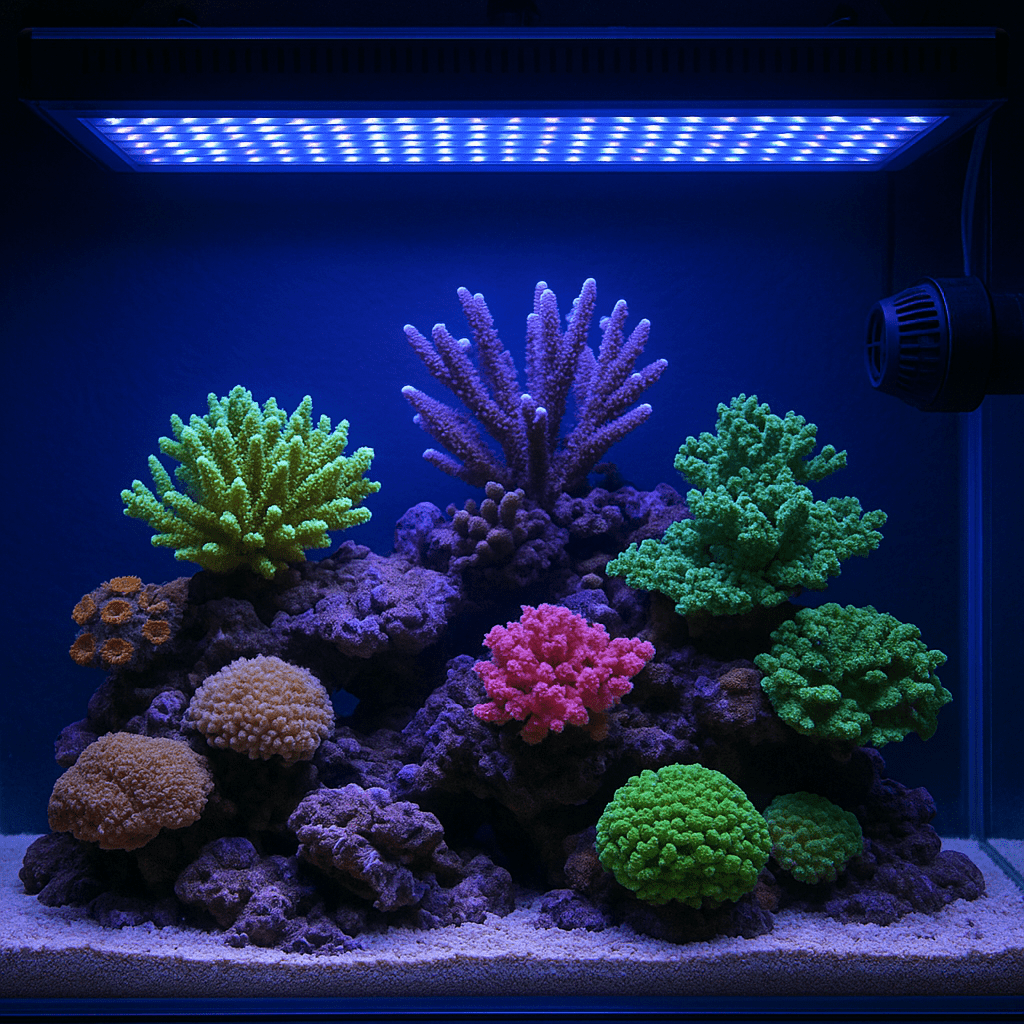
Dialing in the right reef LED intensity settings can feel intimidating, but it doesn’t have to be. With a basic understanding of PAR, coral needs, and a methodical approach to ramping up light, you can create a stable, colorful reef without frying your corals or battling endless algae.
Understanding Reef LED Intensity and PAR
LED intensity is usually expressed as a percentage in your light’s app, but what your corals actually “see” is PAR (Photosynthetically Active Radiation). Different corals thrive in different PAR ranges:
- Soft corals & most LPS: ~75–150 PAR
- Higher-light LPS & easy SPS (like Montipora): ~150–250 PAR
- Demanding SPS (Acropora, some Millepora): ~250–350+ PAR
Because every tank and fixture is different, a 40% intensity on one light might equal 80% on another. If possible, use or borrow a PAR meter to map your tank. If not, start conservative and watch coral response over several weeks.
For more background on how light affects coral coloration and health, see our guide on Coral Lighting Basics.
Practical Starting Points for Reef LED Intensity
Most modern reef LEDs are powerful enough to bleach corals at full power over shallow tanks. A safer approach is to begin with lower intensity and slowly increase.
General Starting Recommendations
- Softie/LPS tanks: Start around 25–35% overall intensity on blue channels, 5–15% on white, then adjust.
- Mixed reefs: 35–50% blue, 10–20% white, with SPS placed high and LPS/softies lower.
- SPS-dominant: 50–70% blue, 15–25% white, but verify with PAR if possible.
These ranges assume a common scenario: a single or pair of modern LED fixtures over a 18–24 inch deep tank. If you’re running multiple fixtures or a shallow tank, you may need to reduce intensity.
Tips for Safe Adjustments
- Increase slowly: Change intensity by no more than 5% per week.
- Use acclimation modes: Many lights offer an “acclimation” feature that automatically ramps intensity over 2–4 weeks.
- Prioritize blues: Keep blue/violet channels higher than whites; they’re more useful to corals and less likely to fuel nuisance algae when balanced correctly.
- Watch for stress: Bleaching, receding tissue, or corals staying tightly closed can signal too much light.
Rule of thumb: If you’re unsure, it’s safer to run slightly lower intensity with good stability than to chase maximum PAR and risk bleaching.
Daily Schedules and Long-Term Stability
Intensity is only part of the picture; your photoperiod and ramping schedule matter too. Many reefers have success with:
- 10–12 hour total photoperiod (including ramps)
- 6–8 hour peak intensity window in the middle of the day
- 1–2 hour sunrise and sunset ramps to reduce light shock
For example, you might run blues at 40% and whites at 10% from noon to 6 p.m., with gentle ramps from 10 a.m.–noon and 6–8 p.m. This approach keeps corals happy while still letting you enjoy the tank under more natural-looking light.
If you’re also tuning nutrients and flow, check out our article on Balanced Reef Tank Parameters to keep your lighting changes in sync with the rest of your system.
Above all, consistency is key. Once you find reef LED intensity settings that your corals respond to with good polyp extension, steady growth, and solid coloration, resist the urge to keep tinkering. Stable light, stable parameters, and patient observation will reward you far more than chasing the latest “magic” settings. For additional fine-tuning tips, see our post on Acclimating Corals to New Lighting.
Sources
- B. Delbeek & J. Sprung, The Reef Aquarium series – lighting and PAR guidelines.
- Bulk Reef Supply Investigates – YouTube series on LED intensity, spectrum, and coral response.
- Manufacturer documentation from common reef LED brands (AI, Ecotech, Kessil) for baseline intensity and PAR maps.
Was this helpful?
Related Posts
Protein Skimmer Reef Tank Guide
Learn how a protein skimmer works, how to size one, and how to tune it for a cleaner,…
 By
By
Reef Aquarium Water Parameters
Learn the ideal reef aquarium water parameters, safe ranges, and how to keep salinity, alkalinity, nutrients, and pH…