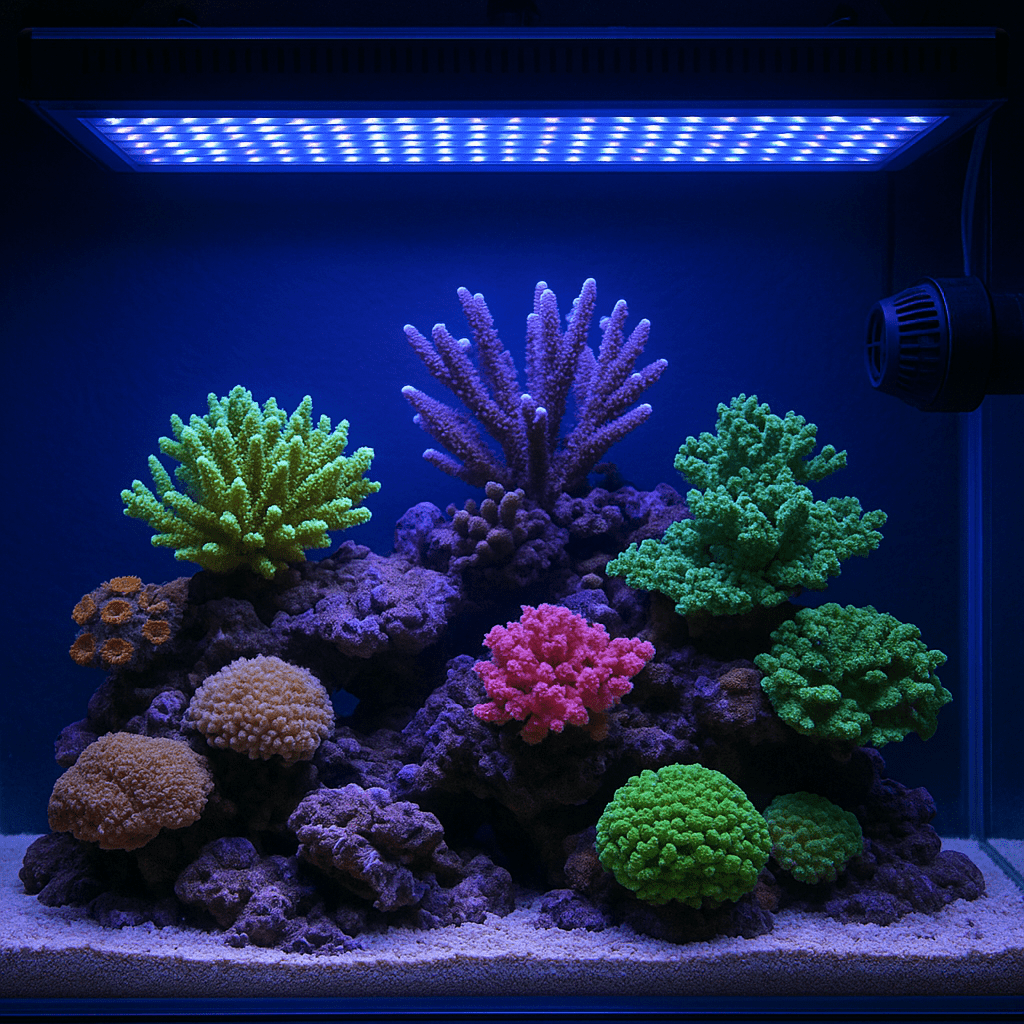
PAR measures the usable light that reaches your corals. It helps you place corals correctly, avoid bleaching, and tune your reef lights with confidence. This guide explains practical PAR ranges, how to measure them, and how to use them in real reef tanks.
Reef lighting causes confusion for many hobbyists. Wattage alone does not tell you enough. Brand settings also vary between fixtures. PAR gives you a better way to judge light intensity inside the tank. That matters because soft corals, LPS corals, SPS corals, and clams all use light differently. In this guide, you will learn what PAR means, what ranges work for common reef animals, how rockwork and water depth affect readings, and how to avoid common mistakes when adjusting lights. You will also learn why stability matters more than chasing a perfect number.
Quick Reference PAR Table
| Reef Animal | Typical PAR Range | Notes |
|---|---|---|
| Mushrooms | 50–100 | Many prefer lower light and can shrink under strong intensity. |
| Zoanthids | 75–150 | Most adapt well, but color and growth vary by strain. |
| Soft corals | 75–150 | Leathers and similar corals usually enjoy moderate light. |
| LPS corals | 75–200 | Acans and scolys often prefer lower ranges. Euphyllia likes moderate light. |
| Montipora | 150–250 | Usually does well in moderate to moderately high light. |
| Acropora | 200–350 | Many thrive here if nutrients and flow are stable. |
| Maxima and Crocea clams | 250–400 | Need strong, stable light and excellent water quality. |
| Fish-only areas | 30–100 | Enough for viewing and low-light invertebrates. |
Use these ranges as a starting point. They are not strict rules. Coral species, nutrient levels, spectrum, and flow all affect how a coral responds. A healthy coral at 180 PAR may struggle at 260 PAR if the change happens too quickly.
What PAR Means in a Reef Tank
PAR stands for Photosynthetically Active Radiation. In simple terms, it measures light useful for photosynthesis. Corals rely on symbiotic algae called zooxanthellae. These algae use light to produce energy. That energy supports coral growth, color, and health.
PAR is usually measured in micromoles per square meter per second. You will often see it written as µmol/m²/s. Reef hobbyists shorten this to just PAR. A PAR reading tells you how much usable light reaches a specific point in the tank. It does not tell you everything about spectrum or fixture quality. Still, it is one of the most useful reef lighting tools available.
This is why two tanks with similar lights can perform very differently. Mounting height, water depth, rock placement, dirty lenses, and surface agitation all change PAR. So does the age of bulbs in T5 systems. LED settings also change readings fast. A small increase on one channel can have a big effect.
Why PAR Matters More Than Wattage
Many beginners still ask how many watts they need. That question made more sense years ago. Today, it is less useful. A 100-watt fixture from one brand may deliver very different PAR than another. Lens design, diode mix, spread, and mounting height all matter.
PAR helps you move from guessing to measuring. That means fewer lighting mistakes. It also helps when adding new corals. Instead of placing a coral randomly, you can match it to a known light zone. This improves survival and reduces stress.
PAR also helps with troubleshooting. If an Acropora turns pale, the problem could be too much light, not too little. If zoanthids stretch upward, they may want more light. If mushrooms stay closed, they may be getting blasted. A PAR map gives context for those signs. It lets you respond with more confidence.
Ideal PAR Ranges for Common Corals
Soft corals usually do well in low to moderate PAR. Mushrooms, ricordea, and many leathers can thrive between 50 and 150 PAR. Some mushrooms prefer even less. Too much light can make them shrink, detach, or fade.
LPS corals often prefer moderate light. Many acans, blastos, and scolys look best around 75 to 125 PAR. Euphyllia, favia, and some chalices often enjoy 100 to 200 PAR. Stronger light can work, but only with careful acclimation.
SPS corals usually need more light. Montipora often grows well between 150 and 250 PAR. Acropora commonly performs best between 200 and 350 PAR. Some high-energy systems push higher numbers. That approach works best for experienced reefers with stable nutrients and strong flow.
Clams also need strong light. Maxima and Crocea clams often prefer 250 PAR or more. Derasa clams can be comfortable at lower levels. Always research the exact animal you keep. General ranges help, but species details still matter.
How Tank Depth and Aquascape Change PAR
PAR drops as light travels through water. The deeper the tank, the lower the reading at the bottom. This is why a coral that thrives near the top may struggle on the sand. Rock structures also create shadows and hot spots. Overhangs can reduce PAR sharply.
Water clarity matters too. Yellow water from dissolved organics can reduce light penetration. Dirty glass and salt spray also block light. So can dusty covers and old T5 reflectors. Even strong surface agitation can scatter light and shift readings slightly.
This is why one average PAR number for the whole tank is not enough. You need a map. Measure several points from top to bottom. Check the center, front, back, and shaded zones. That map helps you create clear coral zones. It also reveals weak spread near tank edges.
How to Measure PAR Correctly
The best way to measure PAR is with a PAR meter. Many local reef clubs and stores rent them. Some hobbyists share meters within their community. This is often worth the effort. A single session can prevent months of poor coral placement.
- Clean the glass, lenses, and light covers first.
- Set your lights to the normal daily peak settings.
- Turn off strong wave pulses if readings jump too much.
- Measure at the top, middle, and bottom of the tank.
- Check readings in open areas and shaded areas.
- Write down each number with location notes.
- Repeat after major lighting or aquascape changes.
Keep the sensor level during each reading. Move slowly. Avoid casting shadows with your arm. If your fixture ramps through the day, measure during the period of highest intensity. That gives the most useful reference for coral placement.
Lighting Requirements and Spectrum Basics
PAR measures intensity, not full spectrum quality. Corals generally respond well to blue-heavy reef lighting. Violet and royal blue wavelengths are especially useful. White channels can increase brightness to your eyes, but they do not always improve coral results. In some tanks, too much white light encourages nuisance algae or washes out color.
Most successful reef tanks use a blue-dominant spectrum with enough balance for viewing. T5, LED, metal halide, or hybrid systems can all grow coral well. The key is consistency and coverage. A fixture with great peak PAR but poor spread can leave corals shaded and uneven.
If you run LEDs, avoid making large jumps in intensity. Corals react to total light over time, not just a single setting. Raising output by 10 percent can be a major change. Increase slowly and watch coral response for at least one to two weeks.
Step-by-Step Guide to Setting PAR in a New Reef Tank
New reef tanks should not start with maximum light. Corals need time to adjust. So do the tank’s nutrients and biology. Use a gradual plan.
- Choose your target coral types first. Soft coral and SPS tanks need different PAR zones.
- Mount the fixture at the manufacturer’s recommended height.
- Start with moderate intensity, not full power.
- Measure PAR across the tank if possible.
- Create low, medium, and high light zones with your rockwork.
- Place corals based on known PAR needs.
- Acclimate new corals with lower light at first.
- Increase intensity slowly over several weeks if needed.
- Watch for bleaching, stretching, or poor extension.
- Adjust one variable at a time.
This slow approach prevents many problems. It also helps you learn how your tank responds. Fast changes create confusion. If you change intensity, spectrum, and flow together, you will not know what caused the result.
Water Flow and Its Relationship to PAR
Light and flow work together. Higher PAR often requires stronger, more chaotic flow. This is especially true for SPS corals. Strong light increases metabolic demand. Corals need good gas exchange and waste removal to keep up.
LPS corals usually prefer gentler flow than SPS. They can still handle moderate PAR, but heavy direct flow may keep them retracted. Soft corals often tolerate a wide range, though many dislike being blasted constantly.
If a coral receives strong PAR but weak flow, tissue stress may appear. You might see dull color, poor polyp extension, or algae settling on the colony. Before changing light, check circulation. Good reef husbandry always looks at the full environment.
Common Problems
Why are my corals bleaching under new lights?
Bleaching often happens when PAR rises too fast. This is common after upgrading LEDs, lowering the fixture, or increasing white channels. Corals can expel zooxanthellae when stressed by excess light. Reduce intensity, shorten the peak photoperiod, or move the coral lower. Then acclimate slowly. Also check nutrients. Very low nitrate and phosphate can make strong light harder to tolerate.
Why are my zoanthids or soft corals stretching?
Stretching usually suggests low light. Polyps extend upward to capture more energy. First, confirm PAR in that area. Then check for shading from rock or larger corals. Increase light gradually or move the colony higher. Do not make a sudden jump. Some zoanthids naturally grow taller, so compare with the coral’s normal form too.
Why do my SPS look pale even with high PAR?
Pale SPS can result from too much light, low nutrients, unstable alkalinity, or poor flow. High PAR alone does not guarantee good color. Many Acropora lose color when nitrate and phosphate are too low. Check alkalinity stability as well. If PAR is above 350, consider reducing it slightly while improving flow and nutrient balance.
Why is coral growth slow despite strong lighting?
Corals need more than light. Growth also depends on alkalinity, calcium, magnesium, nutrients, and flow. If PAR is already in range, look at chemistry next. Slow growth often points to low alkalinity consumption, unstable parameters, or insufficient feeding. Dirty pumps and old bulbs can also reduce performance over time.
Propagation and Fragging Considerations
Frag placement after cutting
Fresh frags usually do better under slightly lower PAR than established colonies. Cutting causes stress. Lower light helps reduce shock while tissue heals. Start frags in moderate, stable light with good flow. Then move them upward over time if needed.
Acclimating frags from different systems
A frag from a dim system can bleach quickly in a bright tank. A frag from a bright system may brown out in lower light. Ask the seller about previous PAR if possible. If not, begin conservatively. Light acclimation screens or reduced intensity can help during the first one to two weeks.
Frequently Asked Questions
What PAR is best for a mixed reef?
A mixed reef usually works well with zones. Aim for about 75 to 125 PAR on the sand, 125 to 200 in mid-level areas, and 200 to 300 near the top. This gives you flexibility for soft corals, LPS, and SPS.
Can corals get too much PAR?
Yes. Excess PAR can cause bleaching, tissue recession, faded color, and poor polyp extension. This is especially common after sudden lighting changes. Acclimation is critical.
How long should reef lights stay on?
Most reef tanks do well with an 8 to 10 hour main photoperiod. Peak intensity often lasts 4 to 6 hours within that window. Longer is not always better.
Do I need a PAR meter?
You can keep corals without one, but a PAR meter removes guesswork. It is especially useful for SPS tanks, deep tanks, and fixture upgrades. Renting one is often enough.
Is PUR more important than PAR?
PUR refers to light wavelengths most useful to photosynthetic organisms. It matters, but hobbyists usually rely on PAR because it is easier to measure. Use PAR with a proven reef spectrum for the best practical results.
For more reef lighting and coral placement help, see best LED reef lights, reef tank lighting schedule, Acropora care guide, and zoanthid care.
Was this helpful?
Related Posts
Our Reef Fish Medication Guide
Learn when to medicate reef fish, which treatments target common diseases, and why quarantine is the safest way…
Reef Tank Water Change Guide
Why Water Changes Matter in a Reef Tank Regular water changes are one of the simplest and most…