


Reef tank equipment does not need to feel overwhelming. You need a few core tools, a plan for stability, and gear that fits your tank size. This guide explains what each piece of reef aquarium equipment does, what beginners should buy first, and how to avoid costly mistakes.
Many new reef keepers focus on corals and fish first. That is understandable. Livestock is the exciting part. Still, long-term success usually comes from the equipment working behind the scenes. Good reef tank equipment keeps temperature stable, moves water, exports waste, and supports coral growth. It also makes daily maintenance easier. In this guide, you will learn the basic equipment every reef tank needs, which upgrades matter most, and how to choose reliable gear without overspending. The goal is simple. Build a system that stays stable and gives your corals the best chance to thrive.
Quick Reference Table
| Equipment | Purpose | Beginner Priority | Key Tip |
|---|---|---|---|
| Tank and stand | Houses the system safely | Essential | Choose the biggest tank your space allows |
| Heater | Maintains stable temperature | Essential | Use a reliable controller if possible |
| Return pump | Moves water from sump to display | Essential if using a sump | Match flow to overflow capacity |
| Powerheads | Create internal flow | Essential | Aim for varied, indirect movement |
| Protein skimmer | Removes dissolved waste | Very useful | Oversize slightly, not drastically |
| Lighting | Supports coral photosynthesis | Essential for corals | Buy for your future coral goals |
| RO/DI unit | Produces purified water | Highly recommended | Start with clean source water |
| ATO system | Replaces evaporated water | Highly recommended | Helps keep salinity stable |
| Test kits | Tracks water chemistry | Essential | Test consistently and log results |
| Refractometer | Measures salinity | Essential | Calibrate regularly |
What Equipment Does a Reef Tank Really Need?
A reef tank needs stable heat, strong circulation, clean water, and proper lighting. Everything else supports those basics. That is why simple systems often do better than cluttered ones. Each device should solve a clear problem. Avoid buying equipment only because it looks advanced.
The true essentials for most reef tanks are the aquarium, stand, heater, thermometer, powerheads, quality light, salt mix, test kits, and a way to use purified water. Many tanks also benefit from a sump, return pump, protein skimmer, and auto top off system. These are not always mandatory, but they make reef keeping easier and more forgiving. Stability matters more than chasing every gadget. A well-maintained tank with basic, dependable equipment usually outperforms a poorly managed tank full of expensive gear.
If you are planning your first system, start with equipment that protects water quality and reduces daily swings. Corals tolerate less instability than many fish. Good equipment buys you consistency. Consistency builds success.
Tank, Stand, and Sump Basics
Your tank and stand are the foundation of the whole system. Bigger tanks usually stay more stable. They dilute mistakes better. A 20-gallon nano can be beautiful, but it changes fast. A 40-gallon breeder or 75-gallon tank gives beginners more room for error.
Choose a stand that supports the full weight of the aquarium. Saltwater systems are heavy. Water, rock, sand, and equipment add up quickly. If you plan to use a sump, make sure the stand has enough interior space. A sump increases water volume and hides equipment. It also gives you a place for filter socks, heaters, skimmers, and media reactors.
All-in-one reef tanks are another strong option. They include rear filtration chambers and save space. They work well for beginners who want a clean look. A drilled tank with an overflow and sump offers more flexibility. Either can work. Pick the setup that matches your budget, maintenance style, and available room.
Heating and Temperature Control
Temperature swings stress fish and corals quickly. Most reef tanks do well between 77 and 79 degrees Fahrenheit. The exact number matters less than stability. A quality heater is essential. Cheap heaters fail more often and can cook a tank or stop heating without warning.
Many hobbyists use two smaller heaters instead of one large heater. That adds safety. If one sticks on, it has less power to overheat the tank. A temperature controller adds another layer of protection. It shuts heaters off if they run too hot. This is one of the smartest upgrades for any reef system.
Keep a separate thermometer in the tank. Do not rely only on the heater display. Room temperature changes, cabinet airflow, and return pump heat all affect the system. In warm climates, you may also need a fan or aquarium chiller. Heat is often a bigger issue than cold, especially under strong lights and in closed cabinets.
Water Movement: Return Pumps and Powerheads
Reef tanks need constant water movement. Flow delivers oxygen, carries food to corals, and prevents waste from settling. It also helps corals shed mucus and stay clean. Without enough flow, dead spots form. Detritus collects there and nutrients rise.
If you use a sump, the return pump sends water back to the display tank. It is important, but it should not be your only source of flow. Internal flow comes from powerheads or wavemakers. These create the random movement corals prefer. Soft corals usually like moderate, varied flow. SPS corals often need stronger, more chaotic movement. LPS corals usually prefer moderate flow that does not blast their tissue.
A common beginner mistake is aiming powerheads directly at corals. That can cause tissue damage. Instead, create broad, indirect flow that moves around rockwork. Watch how food particles and coral polyps react. The tank will show you where flow needs adjusting.
Lighting Requirements for a Reef Tank
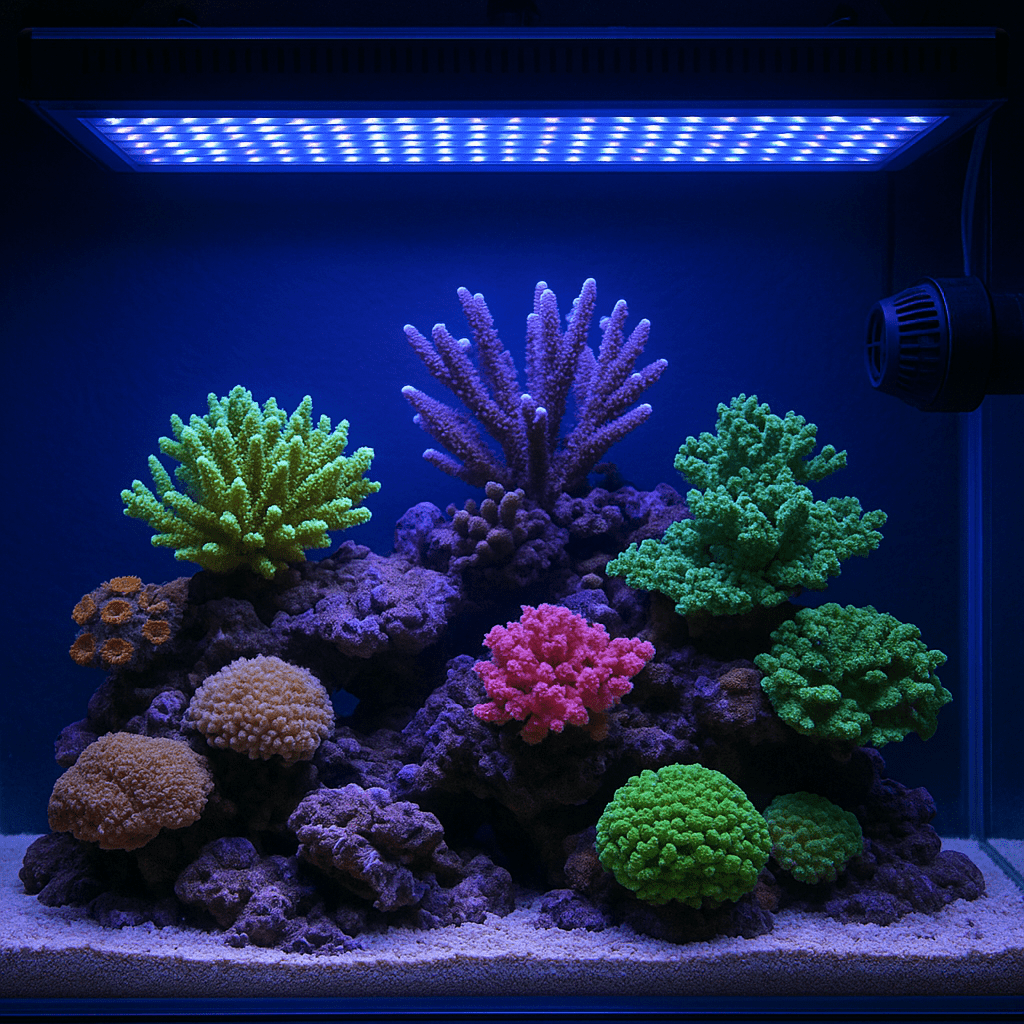
Lighting is one of the most important reef tank equipment choices. Corals depend on light because their zooxanthellae use it for energy. Different corals need different intensity levels, but nearly all photosynthetic corals need stable, appropriate lighting.
Modern reef tanks usually use LED fixtures. They run cool, save energy, and offer good control. T5 and hybrid systems still perform very well, especially for even spread. For beginners, LED lighting is usually the easiest path. Look for fixtures with proven reef results, not just bright marketing. Spread matters as much as raw power. A strong hotspot can bleach corals while shaded areas struggle.
Choose your light based on the corals you want to keep. Soft coral and many LPS tanks can succeed under moderate lighting. SPS tanks usually need stronger, more even PAR. Avoid changing intensity too fast. Corals need time to adapt. Use a ramp schedule and acclimation mode if your light offers one. Stable lighting wins over constant tweaking.
Filtration Equipment and Nutrient Control
Filtration in a reef tank is more than one device. It is a system. Live rock handles much of the biological filtration. It houses bacteria that process ammonia and nitrite. Mechanical filtration removes particles from the water. Chemical filtration targets specific impurities. Protein skimmers export dissolved organic waste before it breaks down.
A protein skimmer is not mandatory for every small reef, but it is very useful. It adds oxygen and helps control nutrient buildup. Filter socks and filter floss trap debris, but they need regular cleaning. If left dirty, they become nutrient factories. Activated carbon helps polish water and remove toxins. GFO can lower phosphate when needed, but use it carefully. Stripping nutrients too fast can stress corals.
Refugiums are another helpful option. They grow macroalgae that consume nitrate and phosphate. They also support pods and increase biodiversity. The best filtration approach is balanced. Export waste steadily. Do not chase zero nutrients. Most corals do better with low, stable nutrients than with sudden swings.
RO/DI Water, Salinity, and Auto Top Off Systems
Good source water prevents many reef problems. Tap water often contains phosphate, nitrate, silicate, copper, or chloramine. Those contaminants feed algae and can harm invertebrates. An RO/DI unit removes them. This is one of the best long-term investments in reef keeping.
Salinity must stay stable. Corals and invertebrates react poorly to swings. Use a refractometer or a high-quality digital salinity meter. Calibrate it regularly. Evaporation raises salinity because only pure water leaves the tank. Salt stays behind. That is why an auto top off system is so helpful. It replaces evaporated water with fresh RO/DI water. This keeps salinity steady and reduces daily work.
Mix saltwater in a separate container before water changes. Heat and circulate it first. Match salinity and temperature closely to the display tank. Sudden changes create avoidable stress. Stable salinity is one of the quiet secrets behind healthy reef tanks.
Testing Equipment and Monitoring Tools
You cannot manage what you do not measure. Test kits are core reef tank equipment. Beginners should monitor salinity, temperature, ammonia during cycling, nitrate, phosphate, alkalinity, calcium, and magnesium. These numbers tell you how stable the system is and what corals are consuming.
Alkalinity is especially important in coral tanks. It affects coral growth and overall stability. If you keep stony corals, test alkalinity often. Calcium and magnesium become more important as coral demand increases. Nitrate and phosphate should stay low but detectable in many mature reef tanks. Zero is not always the goal.
Keep a simple log. Write down test results, water changes, dosing changes, and new livestock additions. Patterns become easier to spot. You may notice that alkalinity falls after adding new frags or that phosphate rises when filter socks go unchanged. Monitoring tools do not just produce numbers. They help you make better decisions.
Step-by-Step: How to Prioritize Reef Tank Equipment
- Pick the largest practical tank for your space and budget.
- Choose a safe stand and decide on sump or all-in-one filtration.
- Buy a reliable heater and thermometer first.
- Add a quality return pump if your system uses a sump.
- Install powerheads for varied internal flow.
- Choose lighting based on your future coral plans.
- Set up RO/DI water production or a trusted source for purified water.
- Add a protein skimmer if your bioload or nutrient goals justify it.
- Install an auto top off system for salinity stability.
- Buy accurate test kits and use them consistently.
- Upgrade slowly after the tank proves stable.
This order helps beginners avoid wasting money. It also builds a stable foundation before adding complex extras. Fancy controllers, dosers, and reactors can wait. First, make the tank stable with the basics.
Common Problems
Why is my reef tank temperature unstable?
The heater may be undersized or unreliable. Room temperature may swing too much. Pumps and lights can also add heat. Use a controller, confirm heater wattage, and improve airflow around the tank. Check the thermometer against a second reading.
Why do I have dead spots and detritus buildup?
Your flow pattern likely needs adjustment. Add another powerhead or change the angle of existing ones. Blow debris from rockwork during maintenance. Watch where food settles. That usually reveals weak circulation zones.
Why are my corals fading under new lights?
New lights may be too intense or too focused. Reduce intensity and lengthen acclimation. Check placement. Corals moved from lower PAR to higher PAR can bleach quickly. Stability matters more than chasing a perfect color program.
Why is salinity drifting every day?
Evaporation changes salinity fast, especially in small tanks. An auto top off system helps. Also verify your refractometer calibration. Manual top offs work, but they require strict consistency.
Frequently Asked Questions
What is the most important reef tank equipment for beginners?
A reliable heater, good flow, proper lighting, purified water, and accurate test kits matter most. These support stability every day.
Do I need a protein skimmer on a reef tank?
Not always, but it helps many systems. It improves oxygenation and waste export. Heavier bioloads benefit the most.
Can I use tap water in a reef tank?
It is risky. Tap water often carries nutrients and contaminants. RO/DI water is the safer choice for long-term success.
How many powerheads does a reef tank need?
That depends on tank size and coral type. Most reef tanks need at least one or two dedicated flow pumps beyond the return pump.
Should I buy cheap equipment to save money?
It depends on the item. Cheap heaters, pumps, and lights often cost more later through failure or poor performance. Buy dependable core gear first.
Final Thoughts
The best reef tank equipment supports stability, not complexity. Start with reliable basics. Match gear to your tank size and coral goals. Upgrade only when a clear need appears. That approach saves money and reduces frustration. A stable reef grows better, looks better, and is far easier to enjoy.
Related reading: how to cycle a reef tank, reef tank water parameters, best beginner corals, reef tank maintenance schedule, protein skimmer basics
Was this helpful?
Related Posts
Best Filtration Systems
Best Filtration Systems for a Healthy Saltwater Aquarium Choosing the best filtration system for your saltwater aquarium is…
 By
By
Clown Triggerfish (Balistoides Conspicillum)
Clown triggerfish are stunning but aggressive marine fish that need very large tanks, strong filtration, and careful tankmate…
[favorite_button]
My Bookmarks:
To see full list click here
[user_favorites user_id="" include_links="true" site_id="" post_types="" include_thumbnails="true" thumbnail_size="thumbnail" include_excerpt="false"]