

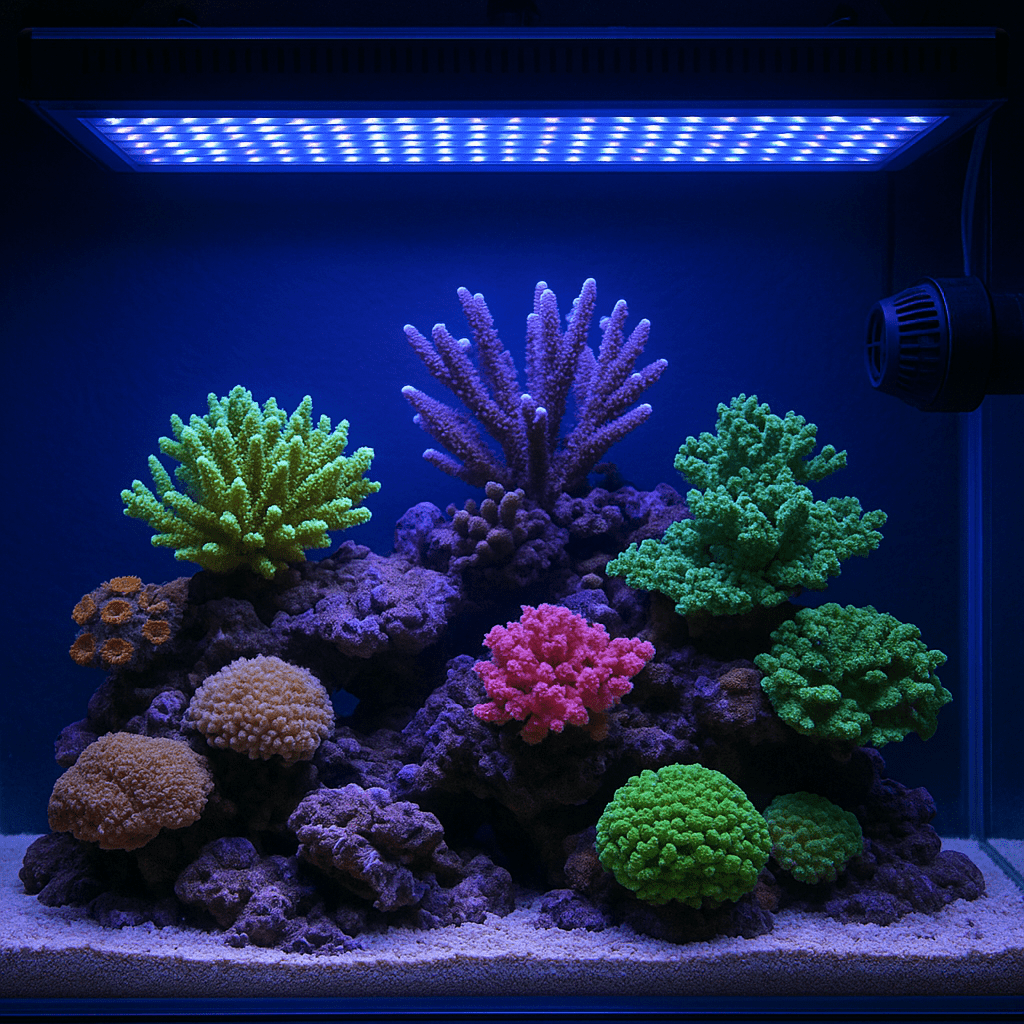
Saltwater aquarium lighting affects coral growth, fish color, and algae control. The right setup depends on your tank, your livestock, and your goals. This guide explains reef lighting in simple terms. You will learn how to choose fixtures, set intensity, build a schedule, and avoid common mistakes.
Lighting is one of the most confusing parts of reef keeping. New hobbyists often focus on brand names first. That is rarely the best approach. Good reef lighting starts with understanding what your animals need. Soft corals, LPS corals, SPS corals, fish-only tanks, and macroalgae systems all use light differently. Spectrum, PAR, spread, mounting height, and photoperiod all matter. So does tank depth. In this FancyReef guide, I will break down each part in practical language. You will learn how reef lights work, how to match them to your aquarium, and how to troubleshoot weak growth, bleaching, and nuisance algae.
Quick Reference Table
| Tank Type | Typical PAR Range | Best Spectrum | Photoperiod | Notes |
|---|---|---|---|---|
| Fish-only | 20-80 | Balanced white-blue | 8-10 hours | Prioritize appearance and algae control |
| Soft coral tank | 50-150 | Blue-heavy reef spectrum | 8-10 hours | Most soft corals prefer moderate light |
| LPS reef | 75-175 | Blue-heavy reef spectrum | 8-10 hours | Avoid sudden intensity jumps |
| Mixed reef | 75-250 | Blue-heavy with some white | 9-11 hours | Use zones for different corals |
| SPS dominant reef | 200-350+ | Strong blue-violet reef spectrum | 9-11 hours | Needs stable nutrients and flow too |
| Refugium | 50-150 | Red and plant-biased spectrum | Reverse daylight cycle | Supports macroalgae growth |
Use these ranges as starting points. Coral placement, water clarity, and rock shadows can change the actual light each coral receives.
Why Lighting Matters in a Saltwater Aquarium
Light does more than make a reef tank look nice. In coral systems, light fuels photosynthesis. Most reef corals host zooxanthellae. These symbiotic algae convert light into energy. That energy helps the coral grow and build skeleton. If light is too weak, corals may brown out or stop growing. If light is too strong, corals can bleach or recede.
Fish-only tanks have different needs. Fish do not require high PAR. They still benefit from a stable day and night cycle. Proper lighting helps reduce stress and supports normal behavior. It also improves viewing and color. In reef tanks, lighting must work with flow and water chemistry. Strong light cannot fix poor alkalinity stability. It also cannot overcome low nutrient balance. Think of lighting as one part of a complete reef system.
Understanding Spectrum, PAR, and PUR
Spectrum describes the color output of the fixture. Reef tanks usually perform best under blue-heavy lighting. Violet and royal blue wavelengths are especially important. These wavelengths support photosynthesis and make coral fluorescence pop. White channels add visual balance. Too much white can encourage nuisance algae and wash out coral color.
PAR stands for Photosynthetically Active Radiation. It measures usable light between 400 and 700 nanometers. Reef keepers use PAR to estimate intensity at coral level. PUR means Photosynthetically Usable Radiation. It focuses on wavelengths corals use most effectively. Most hobbyists track PAR because it is easier to measure. A PAR meter is one of the best tools for dialing in a reef light. Without one, start low and adjust slowly. Coral response matters more than chasing a single number.
Types of Saltwater Aquarium Lighting
LED lighting is now the most common choice. It runs cool, uses less power, and allows full control. Many LED fixtures let you adjust blue, white, violet, red, and green channels. Good LEDs also offer ramping and acclimation modes. The downside is uneven spread on some models. Hot spots and shadows can happen in tanks with complex rockwork.
T5 fluorescent lighting still has a loyal following. T5 fixtures provide even coverage and fewer shadows. They are excellent for mixed reefs and SPS systems. Bulb replacement is the main drawback. Hybrid systems combine LED shimmer with T5 fill. Metal halide is less common today. It still grows coral well. It produces heat and uses more electricity. For most hobbyists, a quality LED or LED-T5 hybrid is the best balance of performance and control.
How to Choose the Right Light for Your Tank
Start with tank dimensions. Length, width, and depth matter more than gallon rating alone. A shallow frag tank needs different lighting than a deep peninsula reef. Next, list your livestock goals. A soft coral tank needs less intensity than an Acropora system. Mixed reefs need flexibility because different corals prefer different PAR zones.
Check spread before buying. One powerful fixture may not cover a four-foot tank evenly. Two smaller fixtures often work better. Mounting height matters too. Higher mounting improves spread but lowers peak intensity. Budget also matters. Do not buy a weak light now and upgrade later if you already know you want SPS. Buy for your future plan when possible. Look for proven reef fixtures, easy programming, and strong manufacturer support. Fancy features are nice. Reliable output and coverage matter more.
Aquarium Setup and Light Placement
Fixture placement affects both coral health and visual appearance. Most reef LEDs perform best when mounted high enough for even spread. That often means 8 to 12 inches above the water. Follow the manufacturer range first. Then fine tune based on PAR and coral response. If you mount too low, you may create bright centers and dim edges.
Aquascaping should match your light plan. Build higher shelves for SPS and lower areas for LPS and soft corals. Leave open sand zones for lower-light species. Avoid stacking rock so tightly that lower corals sit in permanent shade. Surface agitation also changes light penetration. Salt creep and dirty lenses reduce output over time. Clean your fixture and splash guard often. If you use a mesh lid, expect some light loss. Glass lids can reduce gas exchange and trap heat, so plan carefully.
Lighting Requirements by Tank Type
Fish-only tanks need a simple and stable schedule. Eight to ten hours is usually enough. Use a balanced blue-white look that flatters fish color. You do not need extreme intensity. In fact, lower light often helps reduce algae pressure.
Soft corals usually prefer moderate light. Zoanthids, mushrooms, and leathers often thrive in the 50 to 150 PAR range. LPS corals like hammers, acans, and brains usually do well between 75 and 175 PAR. Many can tolerate more, but sudden increases cause stress. SPS corals often need 200 to 350 PAR or higher, depending on species. Stability matters as much as intensity. Clams also need strong, consistent light. Always research each species. Coral type is a guide, not a guarantee.
How to Set a Reef Lighting Schedule
Most reef tanks do well with a total photoperiod of 8 to 11 hours. That does not mean full intensity all day. A simple schedule uses ramp-up, peak, and ramp-down periods. For example, lights can ramp up over two hours, hold peak intensity for five to six hours, and ramp down over two hours. This looks natural and reduces stress.
Do not run intense white channels for long periods just because the tank looks brighter. Corals often respond better to a blue-heavy peak. Moonlights are optional. Very dim moonlights are fine. Bright moonlights all night can disrupt fish and invertebrate behavior. Consistency matters. Avoid changing your schedule every week. Corals adapt slowly. If you need to increase intensity, raise it in small steps. Five percent per week is a safe rule for many systems.
Step-by-Step: Acclimating Corals to New Lighting
New lighting shocks more corals than weak lighting. Many losses happen because hobbyists install a strong fixture and run it too high on day one. Follow a simple acclimation process instead.
- Measure or estimate your target PAR for the coral type.
- Start the fixture at 40 to 60 percent of the planned intensity.
- Reduce the peak period to four or five hours at first.
- Place sensitive corals lower in the tank.
- Increase intensity by 5 percent each week.
- Watch for bleaching, retraction, or faded tissue.
- Pause increases if corals look stressed.
- Move high-light corals upward only after they adjust.
This slow approach works well for LEDs. It is especially important when switching from older lights to modern fixtures with stronger blue and violet output.
Compatibility With Corals, Fish, and Invertebrates
Lighting affects every animal in the tank, even when corals are the main focus. Some fish prefer dimmer areas to rest. Strong light across the whole tank can make shy fish hide more. Overhangs and caves help. Cleaner shrimp, snails, and most common reef invertebrates adapt well to standard reef lighting. Photosynthetic invertebrates, such as giant clams, need stronger placement and stable conditions.
Coral compatibility also links to light zones. High-light SPS can shade lower-light LPS as colonies grow. Fast-growing soft corals may overrun prime ledges. Plan your aquascape with mature colony size in mind. Keep aggressive LPS away from neighbors, even if the light is ideal. Good placement solves many future problems. For more livestock planning, see reef tank compatibility guide, best coral for beginners, reef tank water parameters, and how to cycle a saltwater aquarium.
Common Problems
Why are my corals turning brown?
Brown corals often point to low light, elevated nutrients, or both. Corals may increase zooxanthellae density under weak lighting. That makes them look darker. Check nitrate and phosphate first. Then review PAR at the coral location. Dirty lenses and old bulbs can also reduce output. Improve intensity slowly. Do not make a large jump in one day.
Why are my corals bleaching?
Bleaching usually happens after sudden stress. Excess light is a common trigger. So are temperature swings and unstable alkalinity. If a coral pales after a lighting change, reduce intensity and shorten the peak period. Move the coral lower if needed. Check temperature, salinity, and alkalinity the same day.
Why is algae growing faster after I upgraded my lights?
More light can fuel algae if nutrients are available. New fixtures often increase usable energy far beyond the old setup. Reduce white channels first. Keep the photoperiod reasonable. Test nitrate and phosphate. Improve export through skimming, water changes, and manual removal. Lighting is often the trigger, but nutrients are the fuel.
Why do some corals thrive while others struggle?
Uneven spread is a common cause. LED hot spots create bright peaks and dark corners. Two corals in the same tank may receive very different PAR. Flow also changes coral response to light. Measure several spots if possible. Reposition corals based on actual conditions, not guesswork.
Frequently Asked Questions
How many hours should reef lights stay on?
Most reef tanks do well with 8 to 11 total hours. Peak intensity usually lasts 5 to 6 hours.
What color light is best for corals?
A blue-heavy spectrum usually works best. Violet and royal blue are especially useful for coral growth and color.
Do saltwater fish need blue light?
Fish do not need blue light specifically. They need a stable day and night cycle. Blue-heavy lighting is mainly for coral systems.
Can reef lights be too strong?
Yes. Too much intensity can bleach corals, especially after sudden changes. Acclimation is essential.
Should I leave moonlights on all night?
Very dim moonlights are fine. Bright moonlights all night are unnecessary and may stress some animals.
Final Thoughts
The best saltwater aquarium lighting is not always the most expensive fixture. It is the one that matches your tank, your coral goals, and your husbandry style. Focus on spread, spectrum, and stable intensity. Acclimate slowly. Keep your schedule consistent. Measure PAR when possible. Most lighting problems become easier once you stop chasing hype and start matching light to livestock. If you build sensible zones and avoid sudden changes, your reef will reward you with better growth, stronger color, and fewer setbacks.
Was this helpful?
Related Posts
Our Reef Emergency Plan
A reef emergency plan helps you act fast during outages, leaks, and water quality crashes. Here is the…
 By
ByReef Alkalinity and Calcium Guide
Learn the ideal reef alkalinity and calcium ranges, how they interact, and how to test, dose, and troubleshoot…
[favorite_button]
My Bookmarks:
To see full list click here
[user_favorites user_id="" include_links="true" site_id="" post_types="" include_thumbnails="true" thumbnail_size="thumbnail" include_excerpt="false"]