

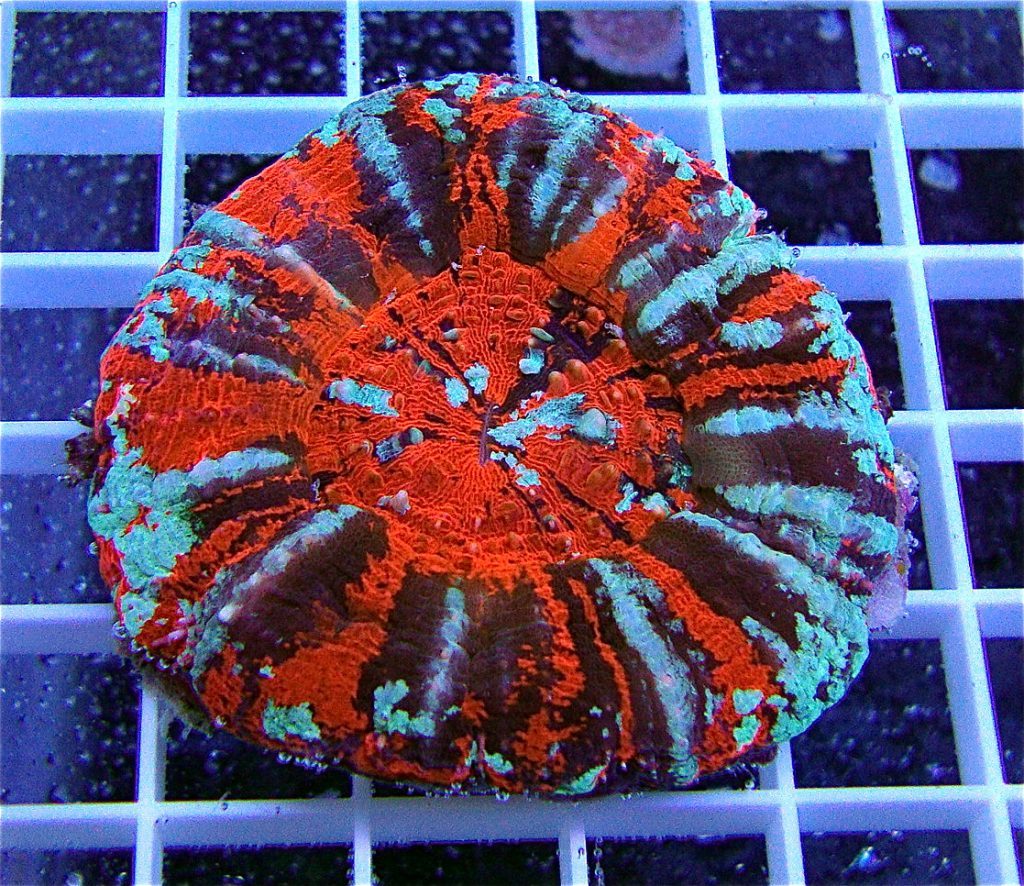
Scolymia corals are prized for their bold colors, round shape, and fleshy appearance. They are also one of the easier large polyp stony corals to keep when you provide stable water, moderate light, gentle flow, and careful placement. This guide covers feeding, placement, compatibility, fragging limits, and the most common problems reef keepers face.
Scolymia corals have long been favorites in display reefs. Their single large polyp creates a strong focal point. Many hobbyists know them for bright red, orange, green, and rainbow patterns. They look dramatic under blue lighting, but they also reward good husbandry with steady inflation and strong feeding responses. While they are often sold as beginner-friendly LPS corals, they still need thoughtful care. In this article, you will learn how to place a Scolymia correctly, what lighting and flow it prefers, how to feed it without causing stress, and how to prevent common issues like tissue recession, bleaching, and nighttime aggression from nearby corals.
Quick Reference Table
| Common name | Scolymia coral |
| Scientific group | Scolymia and related meat coral types in trade |
| Care level | Easy to moderate |
| Temperament | Semi-aggressive |
| Lighting | Low to moderate |
| Water flow | Low to moderate, indirect |
| Placement | Sand bed or low rock ledge |
| Feeding | Mysis, brine, reef roids, small meaty foods |
| Ideal temperature | 76–79°F |
| Salinity | 1.025–1.026 |
| Alkalinity | 8–9 dKH |
| Calcium | 420–460 ppm |
| Magnesium | 1300–1450 ppm |
| Nitrate | 5–15 ppm |
| Phosphate | 0.03–0.10 ppm |
Use these values as a starting point, not a rigid rule. Stability matters more than chasing exact numbers. Sudden swings in alkalinity, salinity, or temperature often cause more damage than slightly imperfect levels.
Natural Habitat
Scolymia corals come from reef environments with stable conditions and moderate nutrient availability. In nature, they are often found in lower light zones than many SPS corals. They usually sit on sandy bottoms, rubble areas, or lower reef slopes. This matters in the home aquarium. It explains why they often struggle under intense light or direct blasting flow.
These corals are built to inflate their fleshy tissue and collect food from the water. They rely on both photosynthesis and feeding. Their thick tissue helps them store energy, but it also makes them vulnerable to damage. Sharp rock edges, falling frags, and aggressive neighbors can tear the flesh. Once tissue is damaged, infection and recession can follow quickly. Replicating their natural setting means lower placement, moderate nutrients, and enough room around the coral. Think calm lagoon edge rather than high-energy SPS shelf. That simple mindset helps many reef keepers avoid early losses.
Aquarium Setup
Scolymia corals do best in mature reef tanks. A nano reef can work, but stability is harder in small volumes. For most hobbyists, a tank of 20 gallons or more is a practical minimum. Larger systems offer steadier chemistry and more placement options. That lowers stress.
Place the coral on the sand bed or a smooth, low rock shelf. Avoid jagged rock. The coral expands well beyond its skeleton. If the tissue rubs against hard surfaces, it can tear. Many hobbyists use a small flat disk or shallow sand depression to keep the coral stable. Make sure snails, hermits, and burrowing fish cannot flip it over. An upside-down Scolymia can suffer tissue damage fast.
Leave space around the coral. Scolymia can send out feeder tentacles at night. Nearby Euphyllia, chalices, acans, and sweepers from other LPS can also sting it. Give several inches of clearance at minimum. More is better in mixed reefs. If you are building a new system, review reef tank setup guide and reef aquascaping tips before final placement.
Lighting Requirements
Scolymia corals prefer low to moderate lighting. In many tanks, a PAR range of 50 to 120 works well. Some specimens tolerate more, but intense lighting often causes stress. Signs of too much light include fading color, failure to inflate, and tissue pulling tight against the skeleton. New hobbyists often place them too high because they are expensive and eye-catching. That is a common mistake.
Start low in the tank. Acclimate slowly if your lights are strong. Reduce intensity or use shading if the coral was previously kept under dimmer conditions. Color can shift after import and after moving between systems. Do not chase ultra-bright coloration by blasting the coral with blue-heavy intensity. Healthy tissue inflation is a better sign than exaggerated fluorescence.
If you are unsure about your reef lighting, use a PAR meter if possible. If not, observe the coral over two weeks. A happy Scolymia expands during the day, shows full tissue, and responds to food. For broader planning, see reef lighting guide.
Water Flow
Water flow should be low to moderate and indirect. Scolymia corals dislike strong, direct current. Their fleshy tissue can whip around, stay retracted, or rub against the skeleton under excessive flow. That stress often leads to recession over time. If food blows off the coral instantly, flow is likely too strong.
The goal is gentle movement. You want enough flow to carry oxygen, prevent detritus buildup, and deliver suspended food. You do not want a powerhead pointed at the coral. Random flow patterns work better than a constant stream. In mixed reefs, this usually means placing the coral in a sheltered lower area. Watch how the tissue moves. Slight rippling is fine. Heavy folding or flattening is not.
If debris settles on the coral, use a turkey baster gently. Do not blast it. A little maintenance goes a long way. Stable flow is just as important as stable light for long-term success.
Feeding
Scolymia corals can survive on light and dissolved nutrients, but they usually do better with direct feeding. Feeding supports growth, color, and recovery from stress. Offer small meaty foods once or twice each week. Good choices include mysis shrimp, enriched brine shrimp, finely chopped seafood, and specialized coral foods.
Feed when feeder tentacles are visible, often in the evening. You can also trigger a feeding response by adding a small amount of food to the water first. Once the coral opens, place a small portion on the mouth area. Keep the piece modest. Oversized food can rot or be rejected. Turn off strong pumps during feeding if needed. This gives the coral time to capture the meal.
Do not overfeed the tank. Heavy target feeding can raise nitrate and phosphate fast. Balance coral feeding with export. If your reef runs very lean, Scolymia may look deflated or pale. If nutrients are too high, algae and bacterial issues can follow. For nutrient balance, read reef water parameters.
Compatibility
Scolymia corals are generally peaceful in appearance, but they are not defenseless. They can extend feeder tentacles and may sting nearby corals. They are also easily damaged by more aggressive neighbors. Keep them away from torch corals, galaxea, large chalices, and other corals with long sweepers.
Most reef-safe fish ignore Scolymia. Still, some species can cause problems. Large angelfish, butterflyfish, and certain puffers may nip the fleshy tissue. Sand-sifting fish can bury the coral. Some clownfish may try to host in fleshy LPS and irritate them. Hermit crabs and large snails can knock small specimens over. Watch peppermint shrimp too. They sometimes steal food directly from the coral’s mouth.
In mixed reefs, placement is the main compatibility tool. Give the coral open space, stable footing, and distance from aggressive species. If you keep many LPS, observe the tank after lights out. Nighttime behavior reveals problems daytime viewing often misses.
Propagation or Fragging
Can Scolymia Be Fragged?
Some hobbyists and coral farmers cut Scolymia, but this is not a beginner project. Unlike branching corals, a Scolymia is a single fleshy polyp over a hard skeleton. Cutting it creates major stress. Survival depends on coral health, tool quality, sanitation, and post-cut care. Many specimens are better left intact.
How Professionals Approach It
Professional fragging usually involves a clean band saw, careful cuts through the mouth structure, and immediate placement in stable, low-stress systems. Frags need low light, low flow, and excellent water quality during recovery. Even then, losses happen. Infection and tissue recession are common risks.
Best Advice for Hobbyists
If your goal is long-term success, buy a healthy specimen rather than attempting to frag one at home. Choose a coral with full inflation, no exposed skeleton, and a strong feeding response. That approach is cheaper in the long run and much safer for the coral.
Common Problems
Why Is My Scolymia Receding?
Tissue recession usually points to stress. Common causes include excessive light, too much flow, alkalinity swings, physical damage, or coral warfare. Check for exposed skeleton around the edges. Review recent changes first. New lights, dosing mistakes, and falling rock are frequent triggers. Move the coral to a calmer, lower-light area if needed. Stabilize alkalinity and salinity. Inspect nearby corals for sweepers at night.
Why Is My Scolymia Bleaching?
Bleaching often follows light shock or temperature stress. A coral moved from dim holding tanks into strong LEDs can fade quickly. Acclimate slowly. Reduce intensity or use a shaded spot. Confirm that temperature stays stable, especially in summer. Avoid large daily swings. Once bleached, the coral needs time, stable nutrients, and gentle conditions to recover.
Why Won’t My Scolymia Open?
A closed Scolymia may be reacting to recent handling, fish harassment, poor placement, or unstable water. Test salinity, alkalinity, nitrate, and phosphate. Look for pests and nipping fish. Check flow direction. Many corals reopen after moving to a calmer area and giving them several days without disturbance.
Why Is the Mouth Gaping?
A gaping mouth is a stress sign. It can happen after shipping, overfeeding, severe chemistry swings, or bacterial decline. Stop target feeding for a few days. Improve stability. Ensure moderate nutrients and strong oxygenation in the tank. If tissue continues to peel, isolate the coral from aggression and monitor closely.
Step-by-Step Placement Guide
First, inspect the coral before adding it. Look for full tissue and no sharp recession lines. Second, dip only if appropriate and if the coral is stable enough for it. Third, acclimate temperature and salinity carefully. Fourth, place the coral on sand or a smooth low ledge. Fifth, start in low light and indirect flow. Sixth, leave several inches of open space around it. Seventh, observe inflation over the next week. Eighth, offer a small feeding after it settles. Ninth, avoid moving it repeatedly. Tenth, test water weekly and correct problems slowly, not all at once.
Frequently Asked Questions
Are Scolymia corals good for beginners?
Yes, they can be. They are manageable for beginners with stable tanks. Placement mistakes are the biggest issue. Keep light and flow moderate.
Do Scolymia corals need to be fed?
They do not need heavy feeding, but they benefit from it. Small weekly meals often improve color, inflation, and recovery.
Can Scolymia go on the sand bed?
Yes. The sand bed is often the best place for them. Just keep them stable and away from burrowing fish.
How much light does a Scolymia need?
Most do well in low to moderate light. A PAR range of about 50 to 120 is a safe starting point.
Why is my Scolymia losing color?
Color loss usually comes from too much light, unstable nutrients, or general stress. Review recent changes and correct them slowly.
Scolymia corals reward patience. They do not need extreme conditions. They need stable conditions. Give them gentle flow, sensible lighting, and room to expand. Feed lightly, watch for aggression, and avoid sudden changes. Do that well, and a healthy Scolymia can become one of the most striking corals in your reef.
Was this helpful?
Related Posts
Reef Alkalinity and Calcium Guide
Learn the ideal reef alkalinity and calcium ranges, how they interact, and how to test, dose, and troubleshoot…
 By
ByReef Tank Basics
Learn reef tank basics, from setup and cycling to lighting, flow, and water chemistry, so your first reef…
[favorite_button]
My Bookmarks:
To see full list click here
[user_favorites user_id="" include_links="true" site_id="" post_types="" include_thumbnails="true" thumbnail_size="thumbnail" include_excerpt="false"]