

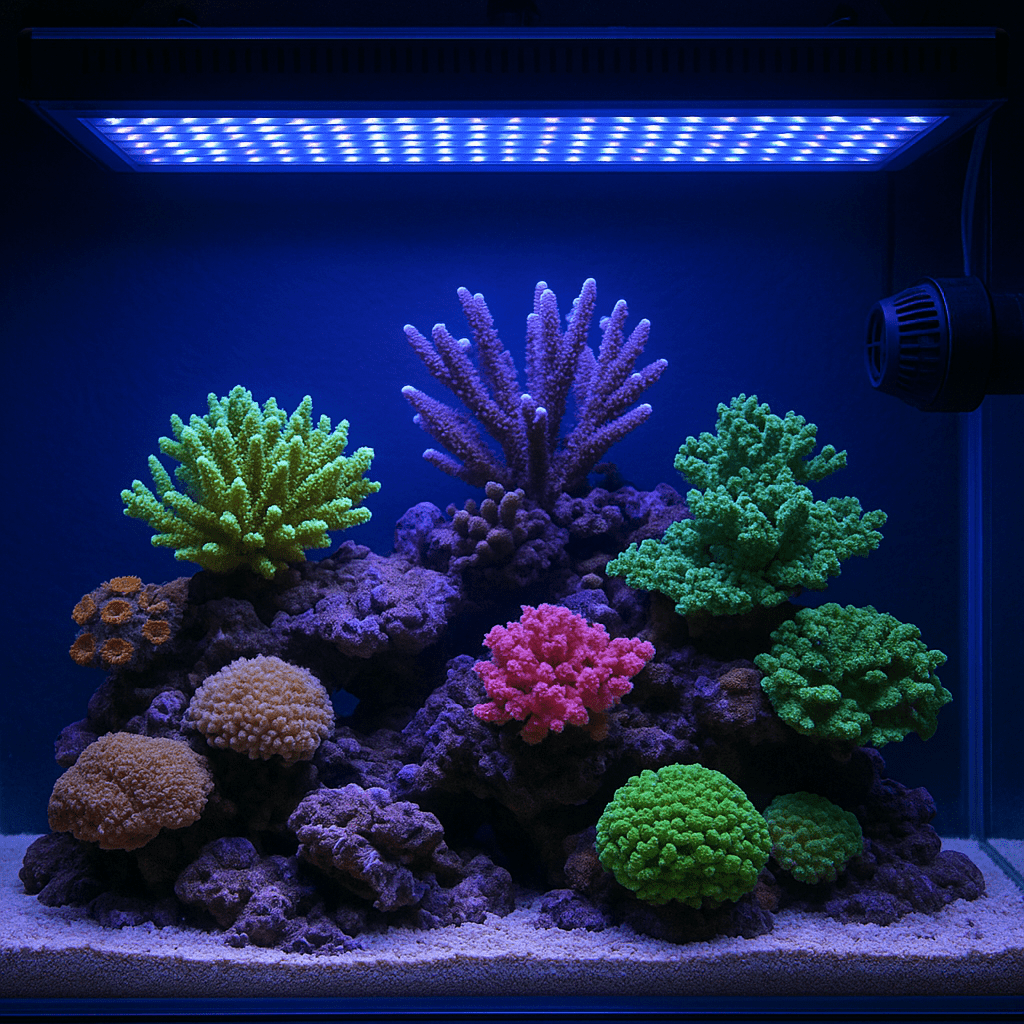
Slow tissue necrosis, or STN, is a gradual loss of coral tissue over days or weeks. It often starts at the base or a shaded edge. It can spread across a colony if the root cause stays in place.
STN is frustrating because it can look “mild” at first. Many reefs run for months before the first patch appears. The good news is that STN is usually stoppable with fast, methodical changes.
What Coral STN Looks Like (and What It Is Not)
STN shows as a clean, sharp line between healthy tissue and exposed white skeleton. The tissue recedes slowly. You may see a thin “halo” of pale tissue before it peels back. Algae often colonizes the bare skeleton after a few days.
STN is not the same as RTN. RTN is rapid tissue necrosis. RTN can strip a coral in hours. STN usually moves a few millimeters per day. Some cases move faster at night.
STN is also not simple bleaching. Bleaching turns tissue pale but leaves it in place. With STN, the tissue is gone. The skeleton becomes visible. Polyps in the affected area vanish.
Many hobbyists confuse STN with “shadowing” or low-light color loss. Low light can reduce pigmentation. It does not create a crisp recession line. If you can see bare skeleton, treat it as necrosis.
- STN sign: a slow, sharp recession edge with exposed skeleton.
- RTN sign: tissue sloughing fast, often in sheets.
- Bleaching sign: pale tissue remains, polyps still present.
Common Causes: Stability Problems First, “Pests” Second
Most STN cases trace back to instability. Corals hate swinging alkalinity. Many tanks drift 1.0 dKH in a day without noticing. That swing can trigger recession at the base. It can also reduce calcification.
Alkalinity is the top suspect for SPS STN. Aim for 7.5 to 8.5 dKH in mixed reefs. Keep daily swing under 0.3 dKH. Calcium should stay near 400 to 450 ppm. Magnesium should stay near 1250 to 1400 ppm.
Nutrients are the next common trigger. Ultra-low nitrate and phosphate can starve corals. That stress shows as pale tips and slow base loss. For many SPS tanks, nitrate of 2 to 10 ppm works well. Phosphate of 0.03 to 0.10 ppm is a common target.
Flow and light also matter. Low flow at the base traps detritus. That fuels bacteria and algae. Too much light after a change can shock tissue. Sudden LED increases are a frequent cause. Raise intensity no more than 5% per week.
True pests and predators can contribute, but they are less common. Acropora-eating flatworms can cause patchy bite marks. Red bugs can irritate polyps. Vermetid snails can cast mucus webs. Still, correct chemistry and stability first.
If you want a strong baseline, review your fundamentals in reef tank water parameters. If you suspect swings, tighten dosing with our alkalinity dosing guide. If you are battling detritus, see reef tank flow patterns.
Immediate Triage: Stop the Spread in the Next 24 Hours
When you see STN, act the same day. First, test alkalinity with a reliable kit. If you use a checker, confirm with a second test. Write down the number and time. Test again 12 hours later to measure swing.
Next, inspect the coral closely. Look for recession starting at the base. Check for shaded areas and detritus pockets. Use a turkey baster to blow debris off the colony. Improve flow so waste does not settle again.
Then consider fragging as a “firebreak.” Cut healthy tips at least 5 to 10 mm above the recession line. Use bone cutters for SPS. Use a clean blade for LPS. Mount frags on fresh plugs. Place them in stable light and strong flow.
Dips can help when bacteria or pests are involved. An iodine dip is a common first step. Follow the product label. Do not exceed time. Rinse in clean tank water before returning the coral. If pests are suspected, use a targeted dip and inspect for eggs.
- Test alkalinity now, then again in 12 hours for swing.
- Blow detritus off the base and increase cross-flow.
- Frag healthy tissue 5–10 mm above the recession edge.
- Dip if you suspect pests or bacterial film.
Fix the Root Cause: A Step-by-Step Stabilization Plan
Start with alkalinity stability. If alkalinity is low, raise it slowly. Increase no more than 0.5 dKH per day. If alkalinity is high, stop dosing and let it drift down. Avoid big water changes that shift dKH fast.
Dial in dosing using consumption, not guesses. Measure alkalinity at the same time daily for three days. Calculate average drop per day. Dose that amount spread across 24 hours. A dosing pump helps reduce peaks. Manual dosing can work if consistent.
Next, correct nutrients with small moves. If nitrate is 0 to 1 ppm, feed more. Add a fish meal and coral food schedule. If phosphate is 0.00 to 0.02 ppm, reduce GFO or phosphate media. If nutrients are high, reduce feeding and improve export. Aim for slow changes over two weeks.
Check salinity and temperature stability. Keep salinity at 35 ppt (1.026 SG). Use a calibrated refractometer or digital meter. Keep temperature at 77 to 79°F (25 to 26°C). Limit daily swing to 1°F. Use an ATO to prevent salinity creep.
Finally, review light and flow changes from the last month. Did you swap bulbs, lenses, or schedules? Did you clean the glass and increase PAR? If yes, reduce intensity 10% for a week. Then ramp back slowly. For flow, aim for random, turbulent movement. Eliminate dead spots behind rock.
Real-World STN Scenarios (and What Usually Fixes Them)
Scenario 1: An Acropora starts losing tissue at the base after a “big clean.” The hobbyist removed rocks and stirred sand. Detritus spiked and irritated the coral. Fixes include running fresh carbon, adding mechanical filtration, and improving flow at the base. A 10% water change can help if matched for dKH and salinity.
Scenario 2: STN appears after switching salt brands. The new mix has 11 dKH, but the tank ran at 8 dKH. Weekly changes cause repeated alkalinity jumps. The fix is matching new water to tank alkalinity. You can do this by adjusting with acid or buffer. Many reefers instead change less volume and dose steadily.
Scenario 3: A Montipora cap recedes along the rim. The tank has strong top-down light. The cap shades its underside. Flow is weak under the plate. The fix is adding side flow and repositioning. You can also trim the plate to improve circulation.
Scenario 4: Multiple SPS pale out and then STN. Nitrate reads 0 ppm. Phosphate reads 0.01 ppm. The skimmer is oversized and the refugium is strong. The fix is raising nutrients slowly. Feed more fish food. Dose nitrate if needed. Reduce export until nitrate stays 2 to 5 ppm.
Troubleshooting Checklist and Common Mistakes
STN can persist when you “fix everything” at once. That creates more swings. Make one change per day. Track each change in a log. Use photos every two days. You want to see the recession edge stop moving.
A common mistake is chasing a specific alkalinity number. Stability matters more than the exact set point. Another mistake is large water changes with mismatched temperature and salinity. That stress can accelerate necrosis. Always match new water within 0.001 SG and 1°F.
Do not ignore contamination risks. Rusting magnets can leach metals. Aerosols can enter open tanks. Hand lotions can cause oily films. Use carbon and poly-filter if you suspect contaminants. Run them for a week and reassess.
Also watch for alkalinity “false stability.” Some tanks test stable because corals stopped growing. STN reduces consumption. Your dosing then becomes too high. That can spike dKH later. Re-check consumption weekly until recovery is clear.
- Keep alkalinity swing under 0.3 dKH per day.
- Match water change dKH to the display within 0.5 dKH.
- Target nitrate 2–10 ppm and phosphate 0.03–0.10 ppm.
- Increase light by no more than 5% per week.
- Use photos to confirm the recession edge has stopped.
When to Quarantine, Dip, or Treat More Aggressively
If only one coral shows STN, focus on that coral first. Move it to a frag rack with high flow. Keep light moderate. Dip it if you see film, pests, or bite marks. Fragging is often the best insurance.
If many corals show STN at once, suspect a tank-wide issue. Look for alkalinity swings, temperature spikes, and nutrient crashes. Check recent equipment changes. Calibrate probes and refractometers. Consider an ICP test if the problem persists for weeks.
Antibiotic treatments are sometimes used for specific bacterial issues. They carry risk to the microbiome. They can also harm filtration in small systems. Use them only when you have strong evidence. Reserve them for a hospital container, not the display.
Quarantine helps prevent repeat events. New corals can carry pests and pathogens. A simple coral QT uses stable parameters, moderate light, and strong flow. Observe for two to four weeks. Dip on arrival and before transfer.
Conclusion
Coral STN is a slow warning sign, not a mystery curse. It usually points to instability, low flow zones, or nutrient imbalance. Act fast with testing, fragging, and small corrections.
Focus on steady alkalinity, reasonable nutrients, and consistent light and flow. Track changes and avoid big swings. With a calm plan, many corals recover and regrow over the dead edge.
Sources: Borneman, E. (2001) Aquarium Corals; Delbeek, J.C. & Sprung, J. (1994–2005) The Reef Aquarium (Vol. 1–3); Holmes-Farley, R. (2004–2006) Reef aquarium chemistry articles (alkalinity, calcium, nutrients).
Was this helpful?
Related Posts
Reef Lighting For Soft Corals
Learn the ideal PAR, spectrum, and photoperiod for reef lighting for soft corals, plus placement and troubleshooting tips.
 By
ByCoral Care Troubleshooting
Learn how to diagnose coral stress, match symptoms to causes, and fix common reef tank problems before they…
[favorite_button]
My Bookmarks:
To see full list click here
[user_favorites user_id="" include_links="true" site_id="" post_types="" include_thumbnails="true" thumbnail_size="thumbnail" include_excerpt="false"]