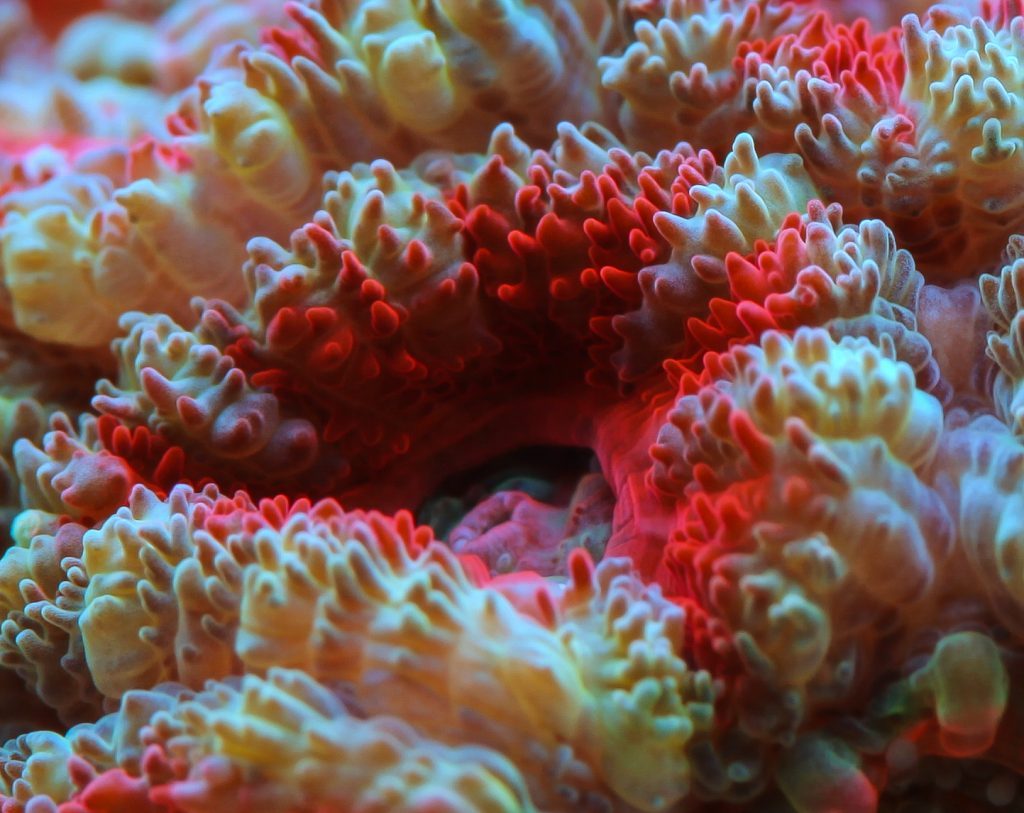
Micromussa, often sold as “acans,” are hardy LPS corals with big color. They reward stable water and steady feeding. They also punish sudden changes with quick tissue loss.
Identification and placement basics
Many “Acanthastrea” in shops are now Micromussa lordhowensis. You will see fleshy polyps and thick skeletal ridges. Polyps swell most at night. Feeding tentacles can appear after lights out.
Start on the sand bed or a low rock ledge. Use low to moderate light at first. Aim for 50–120 PAR for most strains. Raise intensity over two weeks if the color looks dull.
Flow should be gentle and indirect. You want the tissue to sway, not whip. Strong jet flow can peel tissue off sharp septa. Dead spots can trap detritus and cause recession.
Give them space from stinging neighbors. Keep 3–6 inches from euphyllia, galaxea, and favia. At night, sweepers can reach farther than you expect. Use a “night check” with a flashlight to confirm clearance.
- Start low: sand bed placement for the first 10–14 days.
- Target 50–120 PAR and ramp slowly to avoid bleaching.
- Use indirect flow that keeps food from rotting on the tissue.
For a quick system check, review your reef tank lighting guide and compare PAR and photoperiod. If you run a new LED, shorten the schedule first. Eight hours of full intensity is often enough. Add ramp time only after stability improves.
Water parameters that keep acans plump
Micromussa tolerate a range, but they hate swings. Keep salinity at 1.025–1.026 specific gravity. Hold temperature at 25–26°C (77–79°F). Avoid daily temperature swings over 1°F.
Stability in alkalinity matters most. Target 8.0–9.0 dKH for mixed reefs. Keep calcium at 400–450 ppm and magnesium at 1250–1400 ppm. Test alkalinity twice weekly until dosing is steady.
Nutrients should be present but controlled. Aim for nitrate 5–15 ppm and phosphate 0.03–0.10 ppm. Ultra-low nutrients can pale the coral and slow growth. High phosphate can dull color and slow skeleton building.
Use a consistent maintenance rhythm. Do 10–15% water changes weekly or every two weeks. Match salinity and temperature closely. If you run carbon, replace it monthly to avoid sudden clarity shifts.
- Alk: 8.0–9.0 dKH with less than 0.3 dKH daily change.
- NO3: 5–15 ppm and PO4: 0.03–0.10 ppm for color.
- Water change: 10–15% and match salinity within 0.001.
If your parameters drift, fix one thing at a time. Raise alkalinity no more than 0.5 dKH per day. Lower nitrate slowly with smaller feed changes and better export. For a checklist, see our reef tank water parameters reference.
Feeding, growth, and troubleshooting
Micromussa grows faster with direct feeding. Feed 2–3 times per week at night. Turn off pumps for 10–15 minutes. Offer small meaty foods like mysis, calanus, or reef roids paste.
Use a pipette to place food in each mouth. Start with pieces smaller than a pea. Watch for full capture within two minutes. If food blows away, reduce the flow or thicken the mix.
Common mistakes include blasting light after purchase. Another mistake is placing them near aggressive corals. Also, avoid letting detritus settle between polyps. A soft turkey baster blast helps once weekly.
Recession often starts at the base. Check for alkalinity swings first. Then check for pests like flatworms or vermetid snails. If a head is dying, frag above healthy tissue. Dip new frags and quarantine if possible. Our coral dipping and quarantine guide can help.
- Feed at night with pumps off for 10–15 minutes.
- Remove detritus weekly with a gentle baster flow.
- If recession spreads, stabilize alk and consider a clean frag cut.
In a real mixed reef, acans often sulk after a big aquascape change. Dust and bacteria can irritate the tissue. Run a filter sock for 24 hours and do a 10% change. Then leave the coral alone for a week.
Micromussa can be a centerpiece coral when you keep conditions steady. Start with low light and gentle flow. Feed consistently and avoid parameter swings. With patience, you will see new heads and deeper color.
Sources: Borneman, “Aquarium Corals” (TFH); Delbeek & Sprung, “The Reef Aquarium” Vol. 1–3; Veron, “Corals of the World.”
Was this helpful?
Related Posts
Dragonets Fish Care
Dragonets are beautiful reef fish, but they need mature tanks and steady food sources. Learn how to keep…
 By
By
Lighting For Aquarium
Lighting for Aquarium: Getting Saltwater Illumination Right Lighting for a saltwater aquarium is about much more than simply…