Keeping a thriving reef tank isn’t just about beautiful corals and colorful fish—it’s about stability. Regular water testing is how you “see” what’s happening below the surface and catch problems before they turn into algae blooms, dying corals, or sick fish. In this guide, we’ll walk through reef tank testing basics, what to test, how often, and how to get reliable results without feeling overwhelmed.
Core Reef Tank Parameters You Should Test
There are many things you can test, but a solid reef routine starts with a few essentials. For a deeper dive into starting your first system, see our guide on beginner reef tank setup.
Salinity
Salinity is the foundation of your reef. Most mixed reefs do best at 1.025–1.026 specific gravity.
- How to test: Use a calibrated refractometer or a high-quality digital meter.
- How often: 1–2 times per week, and anytime you mix new saltwater.
- Tip: Always calibrate with a proper 35 ppt solution, not RO/DI water.
Alkalinity, Calcium, and Magnesium
These three support coral skeleton growth and overall stability.
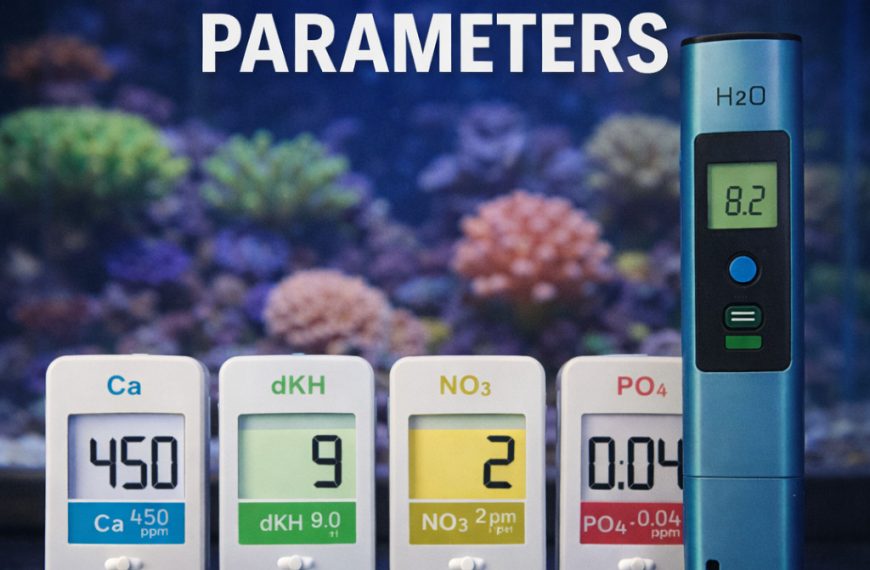
- Alkalinity: Aim for 7–9 dKH for most reef tanks. Test at least 2–3 times per week.
- Calcium: Target 400–450 ppm. Test weekly once stable.
- Magnesium: Keep 1250–1400 ppm. Test monthly or when you see swings in alkalinity or calcium.
If you’re planning to keep more demanding corals, check out our article on reef chemistry fundamentals for more detail on how these parameters interact.
Nitrate and Phosphate
These nutrients fuel both coral growth and nuisance algae. The goal is balance, not zero.
- Nitrate: Many reefs do well between 5–20 ppm.
- Phosphate: Common targets are 0.03–0.10 ppm.
- How often: 1–2 times per week in younger tanks; weekly in mature, stable systems.
Quick rule: If corals look pale and algae is minimal, nutrients may be too low. If algae is taking over, they may be too high.
Getting Accurate and Consistent Test Results
Testing only helps if the numbers are trustworthy. Small technique tweaks can make a big difference.
Use Quality Kits and Follow Instructions
- Choose reputable brands with clear color charts or digital readouts.
- Read the instructions every time—timing and shaking really matter.
- Replace kits before their expiration date; old reagents can give false readings.
Develop a Simple Testing Routine
- Pick a day and time: Test on the same day(s) each week, preferably at a similar time of day.
- Log your results: Use a notebook or app to track trends, not just single numbers.
- Change slowly: When adjusting dosing or filtration, make small changes and retest after a few days.
For help turning test results into an easy maintenance schedule, see our reef maintenance checklist.
When to Test More Often
- Right after setting up a new tank (cycling phase).
- After adding a lot of new corals or fish.
- When you change salt brands, dosing methods, or filtration equipment.
- If corals close up, lose color, or algae suddenly increases.
Think of testing as your early warning system. A small shift in alkalinity or phosphate caught early is far easier to correct than a full-blown crash.
With a few key test kits, a simple routine, and consistent logging, you’ll quickly learn what “normal” looks like for your reef. From there, keeping your tank stable becomes less guesswork and more fine-tuning—and that’s when your corals and fish really shine.
Sources
- Holmes-Farley, R. (2002–2010). Reef Aquarium Chemistry Articles. Reefkeeping Magazine.
- Sprung, J., & Delbeek, J. C. (1994–2005). The Reef Aquarium Vol. 1–3. Ricordea Publishing.
- Borneman, E. H. (2001). Aquarium Corals: Selection, Husbandry, and Natural History. TFH Publications.
 By
By