Ask any successful reefer their biggest “secret,” and you’ll hear the same thing: stable reef tank parameters. Corals and fish can adapt to a wide range of numbers, but they struggle with swings. Instead of chasing perfect values, your goal is to keep your parameters steady, predictable, and easy to maintain.
Core Reef Tank Parameters to Keep Stable
Salinity & Temperature
Salinity and temperature are the foundation of a healthy reef system. Sudden shifts stress fish, burn coral tips, and invite disease.
- Salinity: 1.025–1.026 specific gravity (35 ppt) is a common target.
- Temperature: 77–79°F (25–26°C) with less than 1°F daily swing.
Use a reliable refractometer and calibrate it regularly. An auto top-off (ATO) system is one of the best stability tools you can buy, preventing salinity spikes from evaporation. For temperature, pair a quality heater with a controller or at least a separate thermometer alarm.
For more on setting up your system correctly from the start, see our guide on beginner reef tank setup.
Alkalinity, Calcium & Magnesium
These three parameters drive coral skeleton growth and influence pH. Among them, alkalinity is the one you must keep the most stable.
- Alkalinity: 7.5–9.0 dKH (aim for a single number and hold it)
- Calcium: 400–450 ppm
- Magnesium: 1250–1400 ppm
Pick a salt mix whose parameters match your targets so that water changes don’t cause big jumps. As coral demand grows, consider:
- Two-part dosing (alkalinity and calcium)
- A kalkwasser ATO setup
- A calcium reactor for heavily stocked systems
Tip: Dose alkalinity in small, frequent amounts rather than one big daily shot to avoid rapid swings.
Nutrients: Nitrate & Phosphate
Ultra-clean water isn’t always better. Corals need a bit of “food” in the water column, and stable, low nutrients usually outperform zero readings.
- Nitrate: 2–15 ppm for most mixed reefs
- Phosphate: 0.03–0.10 ppm
Use consistent feeding routines, a reasonable fish load, and export methods such as protein skimming, refugiums, or filter media. Make changes slowly—dropping phosphate too fast with aggressive media use is a common cause of coral stress.
To understand how nutrient export fits into the bigger picture, check out our article on reef tank filtration basics.
Habits That Create Long-Term Stability
Test, Track, and Adjust Slowly
Regular testing is how you catch trends before they become problems.
- Test key parameters (salinity, temp, alkalinity, calcium, nitrate, phosphate) at least weekly.
- Log results in an app, spreadsheet, or notebook to spot patterns.
- Change only one thing at a time and wait a few days to see the impact.
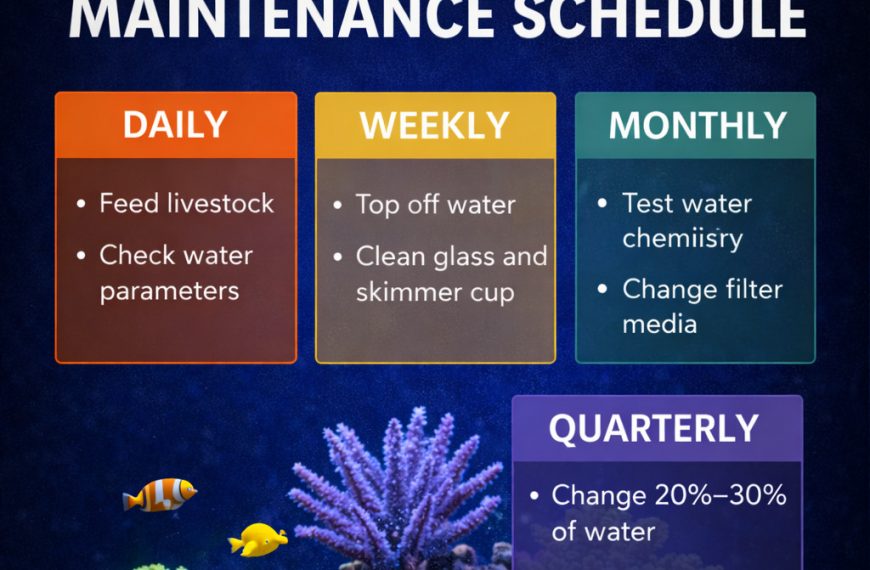
If you’re still dialing in your first system, our reef tank maintenance schedule can help you build a stable routine.
Consistency Over Perfection
Many thriving reefs run slightly outside the “ideal” textbook ranges, but they succeed because the numbers barely move. Focus on:
- Keeping your maintenance schedule realistic and repeatable.
- Avoiding big livestock additions all at once.
- Quarantining new fish to reduce disease-related stress events.
Stable reef tank parameters don’t happen by accident—they come from simple, consistent habits. Pick reasonable targets, match your salt and dosing to those numbers, test routinely, and resist the urge to constantly tinker. Your reward will be healthier fish, better coral growth, and a reef that looks the same tomorrow as it did yesterday—just a little fuller and more vibrant.
Sources
- Borneman, E. H. (2001). Aquarium Corals. TFH Publications.
- Sprung, J., & Delbeek, J. C. (1994–2005). The Reef Aquarium Vol. 1–3. Ricordea Publishing.
- Holmes-Farley, R. (2002–2023). Reef chemistry articles, Advanced Aquarist and Reefkeeping Magazine.
 By
By