Accurate salinity keeps reef animals stable and stress free. A refractometer is reliable, but only when it is calibrated. This guide shows a repeatable method you can trust.
Why calibration matters in a reef tank
Refractometers can drift with time, bumps, and temperature swings. A small error can be big in a reef tank. A 0.002 specific gravity mistake can shift salinity by about 2 to 3 ppt. Corals can react fast to that change.
Most marine tanks target 35 ppt. That is about 1.0264 specific gravity at 77°F. If your tool reads 1.024, you may run low salinity for weeks. Fish may look fine, but corals can lose color.
Calibration with RO/DI water sets “zero,” not seawater accuracy. Many hobby refractometers are designed around sodium chloride. Seawater has other ions. That can cause a consistent offset at 35 ppt.
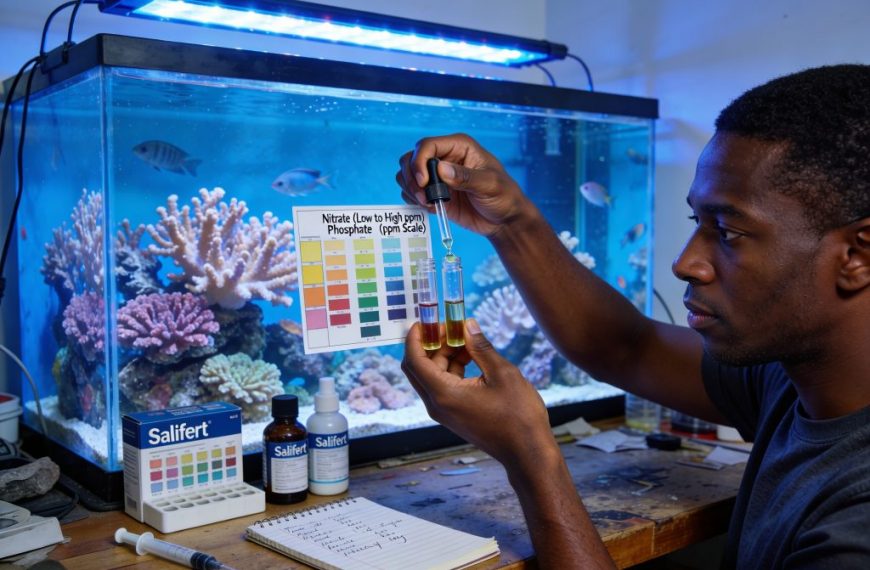
Use a 35 ppt calibration fluid for best results. It matches real tank ranges. Keep a log of your readings and adjustments. Pair this with good testing habits from our reef tank water parameters guide.
- Calibrate monthly, or after any hard drop or travel.
- Calibrate when room temperature changes by 5°F or more.
- Replace calibration fluid yearly if the bottle is often opened.
Step-by-step: calibrate with 35 ppt solution
Let the refractometer sit near the tank for 15 minutes. This helps it reach room temperature. Many units have ATC, but it is not magic. Stable temperature still improves repeatability.
Clean the prism with RO/DI water, then dry it. Use a soft lint free tissue. Salt film can change the light boundary. Avoid paper towels, since they can scratch the prism.
Add 2 to 3 drops of 35 ppt fluid to the prism. Close the cover plate gently. Wait 30 to 60 seconds for the fluid to spread. Look through the eyepiece at a bright light.
Focus the eyepiece until the scale is sharp. Find the blue and white boundary line. Adjust the calibration screw until it reads 35 ppt. If your scale is specific gravity, set it to 1.026 at 77°F.
- Rinse the prism after calibration and dry it fully.
- Test your tank water twice and average the results.
- Mix new saltwater to 35 ppt, then confirm before water changes.
After calibration, measure a known sample. Fresh mixed saltwater is a good check. Mix for 2 hours with a heater and powerhead. Then test at 77°F for consistency.
Troubleshooting and common mistakes
A fuzzy boundary line usually means a dirty prism or microbubbles. Clean again and reapply fluid. Press the cover plate gently to push bubbles out. Also check for scratches on the prism surface.
If readings drift during one session, suspect temperature or evaporation. Calibration fluid can concentrate if left open. Cap the bottle right away. Also keep the refractometer out of direct airflow.
If you calibrated with RO/DI at zero, expect errors at 35 ppt. Switch to a 35 ppt standard. If your unit has both ppt and SG, read ppt for clarity. Then convert only if needed for notes.
Use a second tool when results look wrong. A digital salinity meter can confirm trends. Or bring a sample to a trusted local shop. For stability tips, review our how to mix saltwater article and reef tank top off basics.
- Do not wipe the prism with your finger or a rough cloth.
- Do not calibrate with tank water or old saltwater.
- Do not store the refractometer with salt residue on the prism.
Conclusion
Calibrating a refractometer takes five minutes and prevents weeks of bad salinity. Use a 35 ppt standard, keep the prism clean, and control temperature. Your fish and corals will reward that consistency.
Sources: Holmes-Farley, R. “Reef Aquarium Salinity: Measurement and Control” (Reefkeeping Magazine); Delbeek & Sprung, The Reef Aquarium, Vol. 1–3; Manufacturer refractometer manuals (ATC and calibration guidance).
 By
By