Reef tanks lose water every day from evaporation. That loss raises salinity fast. A solid reef tank top off plan keeps salinity stable and corals calm.
Why top off matters in a reef tank
Evaporation removes only fresh water. Salt stays behind in the tank. That means specific gravity climbs unless you replace the lost water.
In a 40-gallon reef, 0.5 gallon per day is common. That is about 1.25% daily volume loss. Over two days, salinity can jump from 1.025 to 1.027 or higher.
Corals react to swings more than to imperfect numbers. Aim for 1.025 to 1.026 specific gravity. Keep daily change under 0.001 when possible.
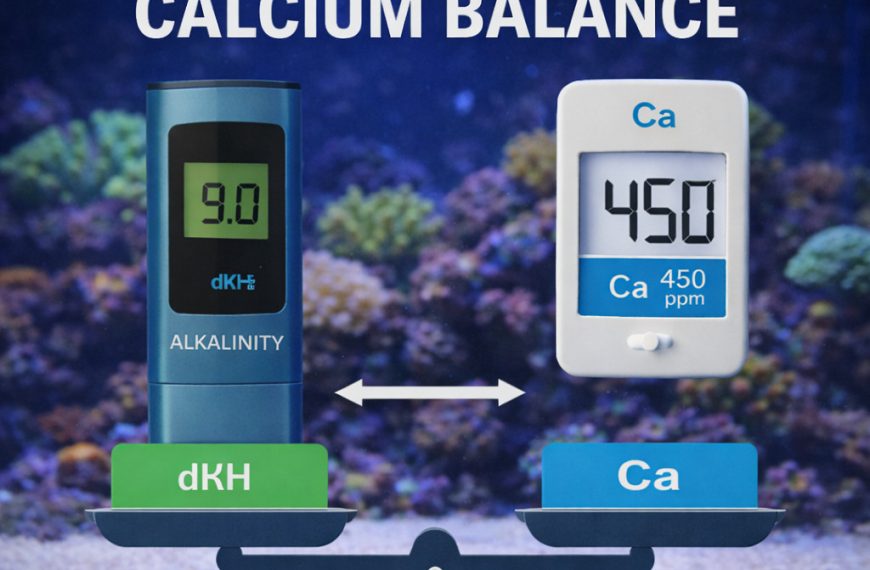
Top off also affects alkalinity and calcium readings. Concentration rises as water drops. You can chase “phantom” parameter shifts if you test at different water levels.
- Mark a fill line on your sump return chamber.
- Measure daily evaporation for one week.
- Set a salinity target and verify with a calibrated refractometer.
If your salinity creeps up, do not dump in a big correction. Replace with fresh water in small steps. Spread the change over 6 to 24 hours.
For more stability basics, review salinity stability in reef tanks. It helps you set safe swing limits. It also covers calibration habits.
Manual top off vs ATO: choosing a method
Manual top off works on small systems with low evaporation. You add RO/DI water once or twice daily. Use a measuring jug so you stay consistent.
An ATO adds water automatically using a sensor and pump. It keeps the return section level. It also keeps salinity steady during busy weeks.
Size your reservoir for at least 3 to 7 days. A 20-gallon reef that evaporates 0.3 gallon daily needs a 2 to 3 gallon container. A 75-gallon reef at 1 gallon daily needs 7 to 10 gallons.
Use RO/DI water for all top off. Aim for 0 to 2 TDS after the DI stage. Tap water adds silicates and phosphates. That often fuels diatoms and hair algae.
- Place the ATO sensor in the return chamber, not the display.
- Set a pump run-time limit, like 30 to 90 seconds.
- Keep the reservoir covered to reduce dust and CO2 absorption.
ATO failures are usually simple. A stuck float can overfill the sump. A dirty optical sensor can “see” bubbles as low water. Clean sensors weekly with RO/DI water and a soft cloth.
If you run kalkwasser in top off, go slow. Start with 1 teaspoon per gallon of RO/DI. Test alkalinity daily for the first week. Keep pH under 8.5 during the light cycle.
Need a bigger stability boost? Pair top off with sump design basics for a larger return section. That increases buffer before the pump runs dry.
Step-by-step: setting up a safe reef tank top off routine
Start by measuring evaporation. Fill to your sump line at night. Check the drop 24 hours later. Record the volume added to return to the line.
Next, confirm your salinity tool. Calibrate a refractometer with 35 ppt solution. Check it monthly. Hydrometers drift and trap bubbles.
Then, choose a delivery plan. Manual users should split the dose. Add half in the morning and half at night. ATO users should place the outlet near the return pump intake for mixing.
Finally, build in safeguards. Use a high-water backup sensor if possible. Keep the reservoir smaller than the sump’s free space. That limits damage if a sensor fails.
- If salinity rises, top off with fresh water over several hours.
- If salinity drops, mix saltwater and correct 0.001 per day.
- If your ATO chatters, reduce turbulence near the sensor.
Common mistake: topping off with saltwater. Do that only after water changes. Daily evaporation replacement is always fresh water. Another mistake is letting the return section run low and suck air.
Keep a quick log. Note daily top off volume, salinity, and ATO issues. Patterns show up fast. You can also compare changes after adding a lid or lowering fan speed.
If you want to automate beyond top off, see reef tank automation. It helps you plan sensors and fail-safes. It also covers power outage habits.
Sources: Randy Holmes-Farley, “Aquarium Chemistry” articles (Reefkeeping Magazine); Julian Sprung, The Reef Aquarium (reef husbandry sections); Craig Bingman, aquarium water chemistry notes.
Stable water level means stable salinity. Stable salinity supports better coral extension and fish health. Set a routine or an ATO, then verify it each week.
 By
By