Salinity drives coral health, fish comfort, and stable chemistry. Many reef issues start with bad salinity readings. Here is how refractometers and hydrometers compare, and how to use each well.
How each tool measures salinity
A hydrometer measures specific gravity by buoyancy. Most hobby models use a swing arm. Some use a floating glass stem. You fill it with tank water and read the scale.
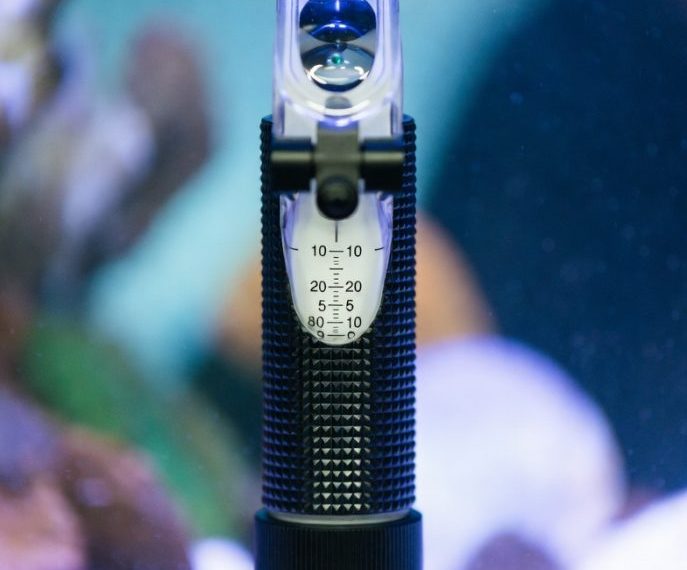
A refractometer measures refractive index through a prism. You add a few drops and look through the eyepiece. Many models show both specific gravity and ppt. Use a light source for a sharp line.
For reef tanks, target 35 ppt or 1.026 specific gravity at 25°C. Fish-only systems often run 1.020–1.023. Match your livestock needs. Keep it stable within ±0.001 SG day to day.
Refractometers tend to be more consistent with small samples. Hydrometers can be accurate, but they are easier to misread. Bubbles and residue can shift the swing arm. Scratches can also change drag.
- Use tank water at room temperature for any reading.
- Rinse tools with RO/DI after each use.
- Record results in a log to spot drift early.
Accuracy, calibration, and common mistakes
Calibration is the real difference in practice. Many hobbyists calibrate refractometers with RO/DI water. That sets “zero,” but it can still read 35 ppt wrong. Use 35 ppt calibration fluid when possible.
Calibrate at the same temperature you test. Most units have ATC, but it is not magic. Let the tool and fluid sit for five minutes. Then adjust the screw until it reads 35 ppt or 1.026.
Hydrometers have no true calibration screw. You verify them against a known standard. Compare to a trusted refractometer or a store meter. If it reads 1.023 when the standard is 1.026, note the offset.
Air bubbles are the top hydrometer error. Tap the body to dislodge bubbles. Fill slowly to avoid foam. Also watch the meniscus line. Read at eye level for a clean result.
- Refractometer tip: clean the prism with RO/DI and a soft cloth.
- Hydrometer tip: soak in warm vinegar monthly to remove deposits.
- Never test right after dosing salt mix into the display.
Which one to choose and how to use it in real tanks
Choose a refractometer for reef keeping and long-term stability. It is ideal for mixing saltwater and checking ATO issues. It also helps during quarantine when salinity may change. It costs more, but saves guesswork.
Choose a hydrometer for quick checks and backup. It works well for fish-only tanks and travel kits. Keep it clean and verify it monthly. Replace it if the swing arm sticks or the scale fades.
Use a simple routine on water change day. Mix new saltwater to 35 ppt. Heat it to 24–26°C. Aerate for 30–60 minutes. Then test again before adding it to the tank.
If corals stay closed after a change, suspect salinity mismatch. Check the display and the new water. A 0.003 SG swing can stress LPS fast. Fix it slowly with smaller top-offs or partial changes.
For more stability tips, see reef tank parameters. If you are mixing water often, review how to mix saltwater. For gear care, read aquarium maintenance schedule.
- Target range: 35 ppt or 1.026 SG for most mixed reefs.
- Check salinity twice weekly in new tanks.
- Recheck after adding new ATO water or changing salt brands.
Refractometers and hydrometers both work when used correctly. Refractometers win for repeatable reef results. Hydrometers still help as a cheap backup. Whichever you choose, calibrate, clean, and log your readings.
Sources: Holmes-Farley, R. “Reef Aquarium Salinity: Signs, Causes and Cures” (Reefkeeping Magazine); Delbeek & Sprung, “The Reef Aquarium” Vol. 1; Instant Ocean, “Sea Salt Mixing Guidelines.”
 By
By