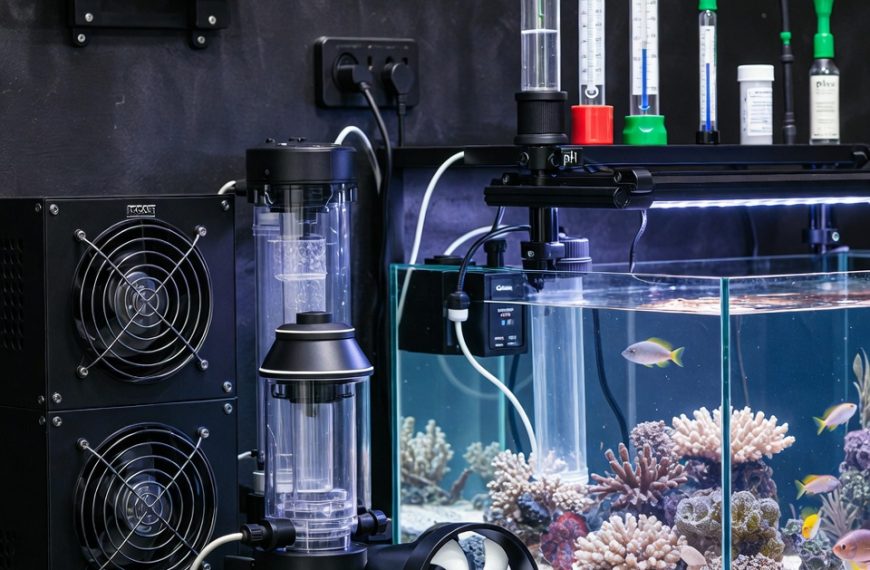
Test kits remove guesswork in saltwater tanks. They show what your eyes cannot see. Good testing prevents algae, disease, and coral loss.
What aquarium test kits measure and why it matters
Most reef issues start with unstable parameters. Test kits track those changes early. For fish-only tanks, focus on ammonia, nitrite, nitrate, pH, and salinity.
In reef tanks, add alkalinity, calcium, and magnesium. Alkalinity drives coral growth and pH stability. Aim for 7.5–9.0 dKH in most mixed reefs.
Nutrients need balance, not zero. Nitrate at 5–20 ppm works for many reefs. Phosphate often sits best around 0.03–0.10 ppm.
Match kit type to the job. Strips are fast but less precise. Liquid titration kits are slower but more accurate.
- Cycle testing: ammonia and nitrite every 1–2 days until zero.
- Weekly stability: alkalinity 2–3 times weekly in new reefs.
- Monthly checks: magnesium and nitrate trends for long-term drift.
Keep your routine simple. Log results in one place. Use a notebook or a phone note.
How to choose the right kit and get accurate results
Start with kits that match your livestock. Soft coral tanks need alkalinity control. SPS tanks need tight alkalinity and calcium tracking.
Check the kit’s resolution and range. A phosphate kit that reads 0.00–0.90 ppm helps reefs. A coarse kit may miss a jump from 0.03 to 0.15 ppm.
Accuracy depends on technique. Rinse vials with tank water first. Use a timer for color development. Hold vials against a white background.
Reagents expire and drift with heat. Store kits cool and dry. Replace most liquid reagents every 12–18 months, or sooner if clumping appears.
- Test at the same time of day for better comparisons.
- Use a dedicated syringe or pipette for each reagent.
- Swirl gently during titration to avoid false endpoints.
Build your kit lineup in stages. Start with ammonia, nitrite, nitrate, and alkalinity. Add calcium, magnesium, and phosphate once corals arrive.
For deeper setup help, review our stable reef parameters guide. For salinity tools, see refractometer calibration tips.
Reading results, fixing problems, and common mistakes
Use trends, not single numbers. A nitrate rise from 5 to 25 ppm in a week matters. That change often points to overfeeding or a clogged filter.
When ammonia shows above 0.10 ppm, act fast. Stop feeding for 24 hours. Add aeration and check for a dead snail or fish.
If alkalinity swings, slow down dosing. Limit changes to 0.5 dKH per day. Re-test after each adjustment before adding more buffer.
Low pH is often a gas exchange issue. Confirm alkalinity first. Then increase surface agitation and open a window if possible.
- Mistake: testing right after dosing. Fix: wait 30–60 minutes.
- Mistake: dirty vials. Fix: rinse with RO/DI and air dry.
- Mistake: chasing “perfect” numbers daily. Fix: aim for stable ranges.
If results look wrong, confirm with a second test. Cross-check with a different kit brand if needed. You can also test freshly mixed saltwater as a baseline.
For a stable maintenance plan, follow our weekly reef tank maintenance checklist. It pairs well with regular testing.
Test kits are simple tools with big impact. Choose the right set and use consistent technique. Your tank will reward you with steady growth and fewer surprises.
Sources: Holmes-Farley, R. “Reef Aquarium Water Parameters”; Delbeek & Sprung, “The Reef Aquarium”; Borneman, “Aquarium Corals”.
 By
By