
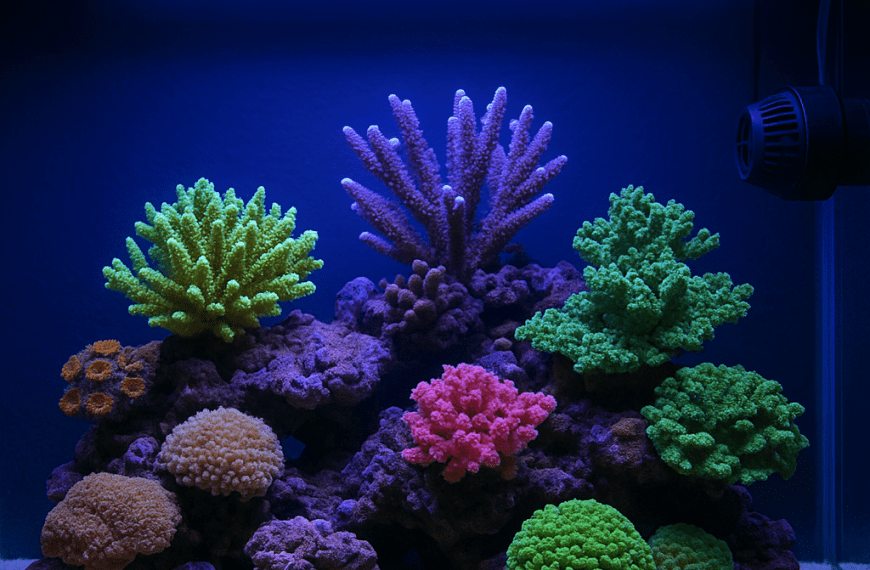
The Forest Fire Montipora samarensis is a standout SPS coral that brings blazing reds and glowing greens to any reef tank. With its branching plates, vivid contrast, and relatively forgiving care compared to many Acropora, it’s a fantastic choice for reef keepers looking to step deeper into the SPS world.
Identification & Natural Behavior
Forest Fire Montipora samarensis is a branching/plating Montipora species known for:
- Base color: Intense red to orange skeleton and tissue.
- Polyps: Bright neon green polyps that extend during the day under stable conditions.
- Growth form: A combination of upright branches and plating shelves, creating a layered, tree-like structure over time.
In the wild, Montipora species often grow in high-light, high-flow reef crests. In aquaria, they appreciate similar conditions but can adapt if changes are made slowly. If you’re just getting into SPS, read our guide on beginner SPS coral care to make sure your tank is ready.
Lighting, Flow & Placement
Dialing in light and flow correctly is the key to keeping the Forest Fire Montipora samarensis colorful and fast-growing.
Lighting Requirements
- PAR range: 200–350 PAR is ideal for most systems.
- Spectrum: Blue-heavy reef lighting (14–20K appearance) enhances the green polyp glow and keeps reds from washing out.
- Acclimation: Start lower on the rockwork and gradually move it up over 2–3 weeks to avoid bleaching.
If you’re unsure about your light levels, our reef lighting PAR guide explains how to measure and adjust intensity safely.
Flow & Placement Tips
- Flow: Moderate to strong, random flow is best. Aim for polyps to sway, not fold over.
- Placement: Mid to upper rockwork where it can receive both light and flow without being blasted directly by a powerhead.
- Space: Give it room to expand plates and branches; it can shade corals below as it grows.
Pro tip: Avoid placing it directly down-current from aggressive LPS with long sweeper tentacles. Montipora tissue can be damaged quickly by repeated stings.
Water Parameters, Nutrition & Growth
Like most SPS, Forest Fire Montipora samarensis thrives in clean, stable water. Sudden swings are more dangerous than slightly imperfect numbers.
- Temperature: 24–26°C (75–79°F)
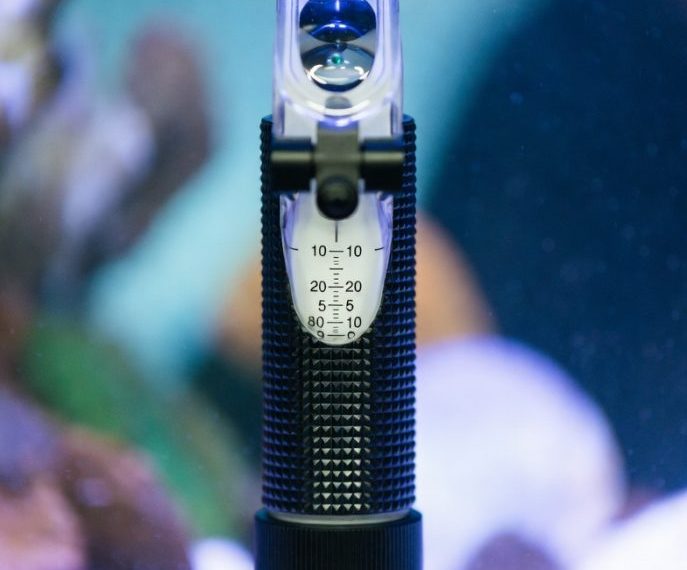
- Salinity: 1.025–1.026 specific gravity
- Alkalinity: 8–9.5 dKH (keep swings under 0.3 dKH per day)
- Calcium: 420–460 ppm
- Magnesium: 1300–1400 ppm
- Nitrate: 5–15 ppm
- Phosphate: 0.03–0.08 ppm
Montipora corals host symbiotic zooxanthellae, so they receive much of their energy from light, but they also benefit from:
- Regular feeding of fine particulate foods (e.g., rotifers, powdered coral foods).
- Stable, moderate nutrient levels rather than ultra-low nutrient systems.
For a broader look at how to keep SPS healthy, check out our article on maintaining stable reef parameters.
Color & Health Troubleshooting
- Pale or bleaching: Often from too much light or a big alkalinity swing. Lower intensity and test your KH.
- Browned-out tissue: Usually from elevated nutrients or very low light. Increase export slowly and adjust placement.
- Tissue recession from edges: Check for pests like nudibranchs, unstable parameters, or extremely low nutrients.
With thoughtful placement, stable conditions, and patient tuning of light and flow, Forest Fire Montipora samarensis can become a fiery centerpiece in your SPS collection. Its mix of branching and plating growth, along with the striking red-and-green contrast, rewards reef keepers who commit to consistency and careful observation.
Sources
- Borneman, E. H. (2001). Aquarium Corals: Selection, Husbandry, and Natural History. TFH Publications.
- Sprung, J. (2001). Corals: A Quick Reference Guide. Ricordea Publishing.
- Veron, J. E. N. (2000). Corals of the World. Australian Institute of Marine Science.
- Advanced Aquarist & Reefkeeping Magazine archives on Montipora husbandry and SPS reef systems.
 By
By