Reef LED Lighting Guide
Good lighting keeps your reef healthy and colorful. LED lights make this easier than ever. They offer control, efficiency, and long life. The challenge is dialing them in correctly.
If you are new to reef tanks, start simple. Avoid chasing every tiny lighting detail. Focus on consistency and basic settings first.
Choosing the Right Reef LED
Match your light to your tank size and coral types. Soft corals and LPS need moderate light. SPS corals demand stronger, more intense lighting.
Check PAR charts from the manufacturer. Aim for these rough PAR ranges:
- Soft corals and zoas: 50–150 PAR
- LPS corals: 75–200 PAR
- SPS corals and clams: 200–350 PAR
Use a PAR meter if you can borrow or rent one. If not, start conservative. Watch your corals and adjust slowly.
Consider spread and shadowing. One big light can create harsh shadows. Two smaller fixtures often give smoother coverage.
For more tank planning help, see our Beginner Reef Tank Setup guide.
Setting Spectrum and Color
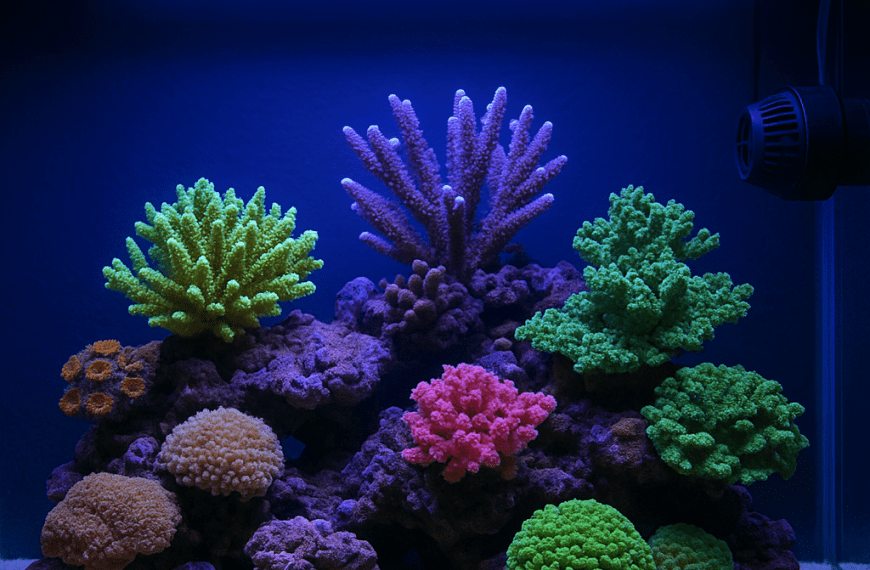
Reef corals prefer strong blue light. Blue wavelengths support photosynthesis and coral fluorescence. Many hobbyists run mostly blue with a little white.
A good starting spectrum:
- Royal blue and blue channels: 80–100%
- White channels: 20–40%
- Red and green: 0–10% total
Too much red and green can fuel nuisance algae. Keep those channels low. Adjust color for your eyes, but protect coral needs first.
Tip: Change only one setting at a time. Then wait a week before judging results.
Photoperiod and Daily Schedule
Corals like a steady light schedule. Most reef tanks run 8–10 hours of full intensity. Add 1–2 hours of ramp up and ramp down.
A simple daily schedule:
- Ramp up blues for 1 hour
- Full intensity for 8 hours
- Ramp down to blues for 1 hour
Moonlights are optional. If you use them, keep them very dim. Your fish need darkness to rest.
Acclimating Corals to New LEDs
Never blast new corals with full power. They need time to adjust. Light shock can bleach tissue quickly.
Use your LED’s acclimation mode if available. Otherwise, lower intensity 30–40% at first. Increase 5–10% each week while watching polyp extension and color.
You can also raise the light higher above the water. Then slowly lower it over several weeks.
For more coral care basics, check our Coral Placement Guide next.
Reading Coral Feedback
Your corals tell you how lighting feels. Learn their signals.
- Good sign: Polyp extension and steady growth tips
- Too much light: Faded color, retracted polyps, bleaching
- Too little light: Dark, dull colors and slow growth
Make slow changes only. Stability beats perfection in reef lighting. Keep notes on settings, height, and coral reactions.
Combine good lighting with strong filtration and flow. Together, these create a thriving reef. See our Reef Tank Flow Basics for help with circulation.
Sources
- BRS Investigates, Bulk Reef Supply video series on LED spectrum and PAR testing.
- WWC lighting recommendations from World Wide Corals farm systems.
- Ecotech Marine and AI manufacturer PAR charts and spectrum guidelines.
 By
By