Salinity swings stress fish and corals fast. Many tank crashes start with small, repeated changes. This guide shows how to keep salinity stable every day.
Section 1: Set a stable target and measure it correctly
Pick one target salinity and hold it. For most reef tanks, aim for 35 ppt. That equals 1.026 specific gravity at 25°C. Fish-only systems can run 32–35 ppt. Do not change targets often.
Use a quality refractometer or digital salinity meter. Hydrometers can drift and trap bubbles. Calibrate refractometers with 35 ppt calibration fluid. Do not use RO water for calibration. Check calibration every two weeks.
Measure at the same time each day. Evaporation raises salinity during the light cycle. Top-off lowers it again. Testing at random times hides the real swing. Test after lights have been on for two hours.
Watch temperature during testing. Specific gravity changes with temperature. Keep samples near 25°C when possible. If you use a digital meter, rinse the probe with RO water. Then blot dry before the next test.
- Target: 35 ppt (1.026 at 25°C) for mixed reefs
- Calibrate with 35 ppt fluid every 14 days
- Log readings in a notebook or app for trends
For more baseline setup steps, review our reef tank basics. If you struggle with tools, see our refractometer calibration guide.
Section 2: Control evaporation and mixing to prevent swings
Evaporation is the main cause of salinity drift. A typical 40-gallon reef can lose 0.5–1.5 gallons daily. That can raise salinity by 1–3 ppt. An ATO is the best fix. Set it to add only RO/DI water.
Place the ATO sensor in a stable sump chamber. Avoid the skimmer section with microbubbles. Use a second high-level safety sensor if possible. Limit the ATO pump run time to 30–60 seconds. This prevents a stuck sensor flood.
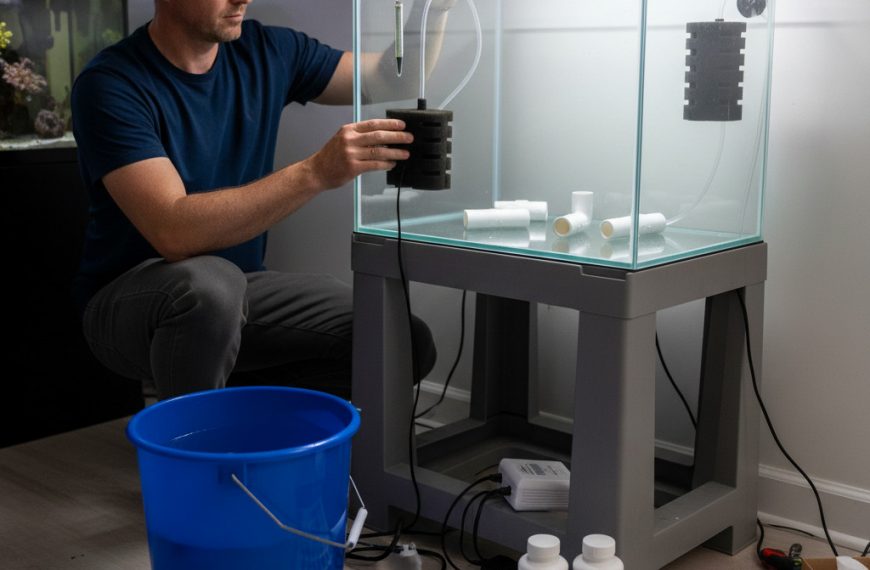
Mix saltwater the same way every time. Use a powerhead and heater in a mixing bin. Match temperature to within 1°F of the tank. Aerate for at least 2 hours. Many hobbyists mix for 12–24 hours for consistency.
Match salinity before any water change. Keep new water within 0.5 ppt of the display. A 10% change with 2 ppt mismatch can shift the tank by 0.2 ppt. That sounds small, but repeated errors add up. Always test the mixed batch before use.
- Cover the tank or sump to reduce evaporation by 10–30%
- Mark your sump waterline for quick visual checks
- Use a mixing bin with volume marks for repeatable batches
If you need help sizing equipment, check our ATO setup guide. It covers sensor placement and safety limits.
Section 3: Fix salinity problems safely and troubleshoot common mistakes
Correct salinity slowly. For fish and corals, change no more than 1 ppt per day. If salinity is high, replace evaporated water with RO/DI only. If salinity is low, top off with pre-mixed saltwater. Do not dump dry salt into the display.
Use a simple correction example. Your tank is 75 gallons at 37 ppt. You want 35 ppt. Remove 1 gallon of tank water. Add 1 gallon of RO/DI water. Re-test after 30 minutes of circulation. Repeat daily until stable.
Low salinity often comes from overfilling after a water change. It can also come from wet skimming. A skimmer can remove 0.25–1 gallon daily in a large system. Measure skimmate volume for a week. Then adjust your ATO reservoir size and refill schedule.
High salinity often comes from ATO failure. Check for clogged tubing and stuck float valves. Also check for salt creep on optical sensors. Clean sensors weekly with RO water. If corals stay retracted, test salinity first. Then check alkalinity and temperature.
- Do not change more than 1 ppt per day
- Clean ATO sensors weekly to prevent false readings
- Test salinity after any equipment change or sump adjustment
Stable salinity supports stable alkalinity and calcium use. It also reduces osmotic stress in fish. Build a routine and stick to it. Small daily checks prevent big weekend emergencies.
Sources: Randy Holmes-Farley, “Reef Aquarium Salinity: Measurement, Calibration, and Stability” (Advanced Aquarist); Instant Ocean Sea Salt mixing and salinity guidance (product documentation); NOAA ocean salinity reference range (35 ppt typical seawater).
 By
By