Quarantine protects your display tank from parasites and bacterial outbreaks. It also gives new fish time to eat well and settle in. Here is our timeline, with numbers you can follow at home.
Section 1: Prep and Day 0 setup
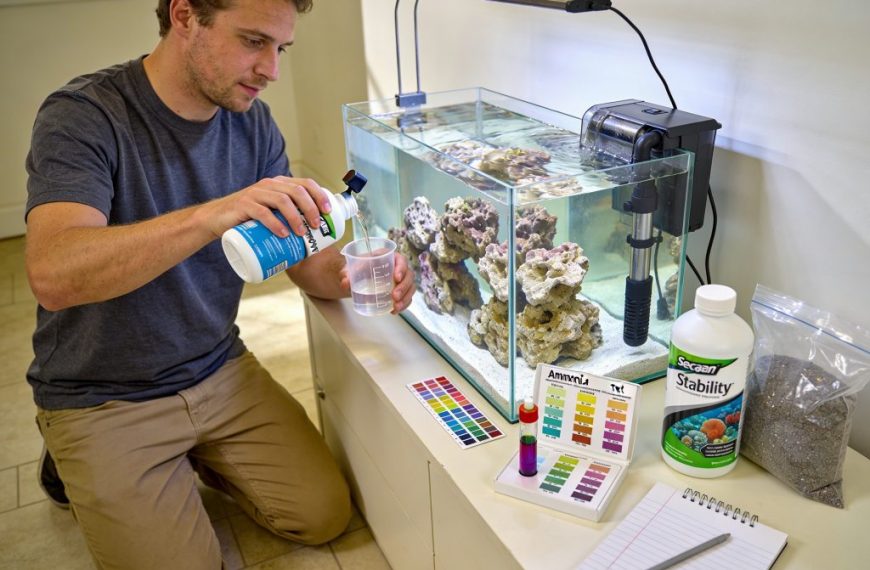
We set up quarantine one day before pickup. We use a bare-bottom 20-gallon long for most fish. For larger tangs, we use a 40-breeder. We add a heater, lid, and sponge filter.
We seed the sponge in our sump for at least 14 days. That gives fast biofiltration. If you cannot seed, use bottled bacteria and test daily. Keep ammonia at 0.00 ppm at all times.
We match salinity to the store bag water. It is often 1.018 to 1.022. We start at that value to reduce stress. We also match temperature to 78°F (25.5°C) within 1°F.
On Day 0, we dim lights and add PVC elbows. Fish need cover. We run an air stone if meds will reduce oxygen. We log baseline behavior and breathing rate.
- Tank: 20–40 gallons, bare bottom, tight lid
- Targets: 78°F, pH 8.0–8.3, ammonia 0 ppm, nitrite 0 ppm
- Gear: seeded sponge filter, air stone, PVC, ammonia badge
For more on stable parameters, see our reef tank water parameters guide. It helps you set safe ranges fast.
Section 2: Days 1–14 observation and feeding routine
Days 1 to 3 are for calm and appetite. We offer small meals three times daily. We remove leftovers after five minutes. That limits ammonia spikes in small tanks.
We watch for flashing, frayed fins, and heavy breathing. Normal gill movement is steady and not rapid. If breathing stays fast at rest, we increase aeration. We also recheck temperature and ammonia.
We do not medicate every fish on Day 1. Many issues are shipping stress. We only treat when symptoms show or risk is high. A common example is white spots after a stressful transfer.
We run a strict maintenance rhythm. We test ammonia daily for the first week. We change 10–20% water when ammonia hits 0.20 ppm. We add matching salinity water to avoid swings.
- Feed 2–3 times daily, small portions, varied foods
- Test ammonia daily for 7 days, then every other day
- Change 10–20% water if ammonia reaches 0.20 ppm
New to reading fish behavior? Our saltwater fish stress signs checklist helps you spot trouble early.
Optional Section 3: Days 15–30 treatment windows and graduation
If we treat for ich, we choose one method and stay consistent. For copper, we ramp up over 48 hours. We target 2.0–2.5 ppm for chelated copper. We confirm with a matching test kit.
We hold therapeutic copper for 14 consecutive days. We test copper daily at first. We then test every other day once stable. We also watch appetite, since copper can reduce feeding.
For flukes, we use praziquantel in two rounds. Round one runs for 5–7 days. We then do a 25–50% water change and run carbon for 24 hours. Round two repeats for 5–7 days.
Graduation starts when the fish eats hard and looks clean. We want 7 symptom-free days after the last treatment. We also match salinity to the display over 3–5 days. We raise 0.001 specific gravity per day.
- Copper: ramp 48 hours, hold 2.0–2.5 ppm for 14 days
- Prazi: 5–7 days, water change, carbon, then repeat 5–7 days
- Salinity match: increase 0.001 per day until display level
Before transfer, we review our drip acclimation method. It reduces shock during the final move.
Conclusion
A clear quarantine timeline keeps decisions simple under stress. Start stable, feed well, and test often. Treat only with a plan, and do not rush the final transfer.
Sources: HumbleFish quarantine guidance (general protocols); Noga, “Fish Disease: Diagnosis and Treatment”; UF/IFAS marine fish health publications.

 By
By