Good water tests prevent most reef problems. They also help you spot issues before livestock shows stress. This guide explains what to test, how to test, and how to act.
Pick the right tests and know your targets
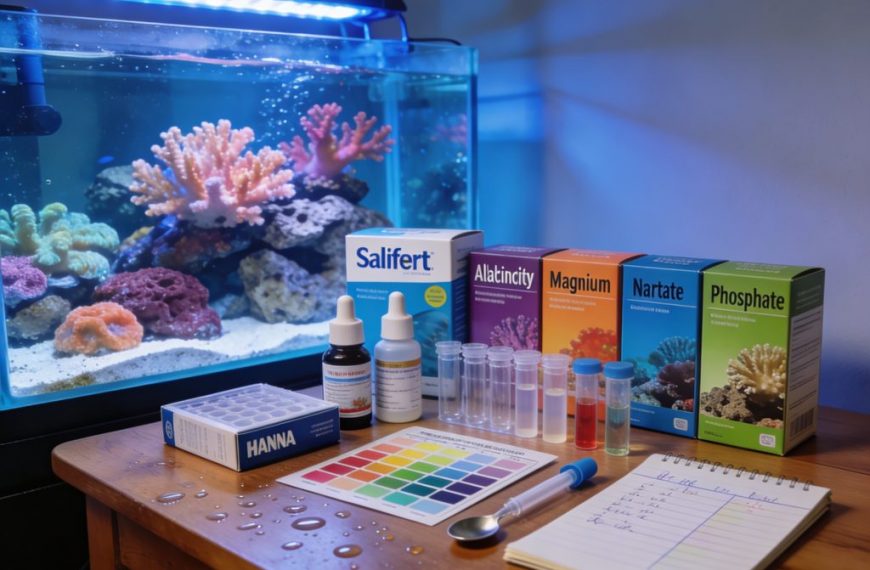
Start with a core set of tests. These cover stability and basic safety. For most tanks, test salinity, temperature, pH, alkalinity, ammonia, nitrite, and nitrate.
Add reef tests if you keep corals or coralline algae. Include calcium, magnesium, and phosphate. If you run a new tank, test ammonia daily for the first week.
Use clear targets to guide decisions. Aim for 1.025 specific gravity at 25°C (77°F). Keep alkalinity 7.5–9.0 dKH for mixed reefs. Keep nitrate 2–20 ppm for most reefs.
Phosphate goals depend on coral type and algae pressure. Many reefs do well at 0.03–0.10 ppm. Fish-only tanks can run higher nitrate, like 20–40 ppm. Stability matters more than perfection.
- Fish-only targets: nitrate 10–40 ppm, phosphate under 0.30 ppm, pH 7.9–8.3.
- Mixed reef targets: nitrate 2–20 ppm, phosphate 0.03–0.10 ppm, calcium 400–450 ppm.
- SPS-leaning targets: nitrate 2–10 ppm, phosphate 0.02–0.08 ppm, alkalinity stable within 0.3 dKH.
For a deeper parameter overview, see reef water parameters. If you are cycling a new system, review how to cycle a saltwater tank.
How to test: step-by-step for accurate results
Use clean vials and consistent timing. Test at the same hour when possible. Rinse vials with tank water before each test. Avoid soap residue.
For salinity, use a calibrated refractometer. Calibrate with 35 ppt solution, not RO water. Wipe the prism and wait 30 seconds before reading. Check salinity weekly, or after top-off issues.
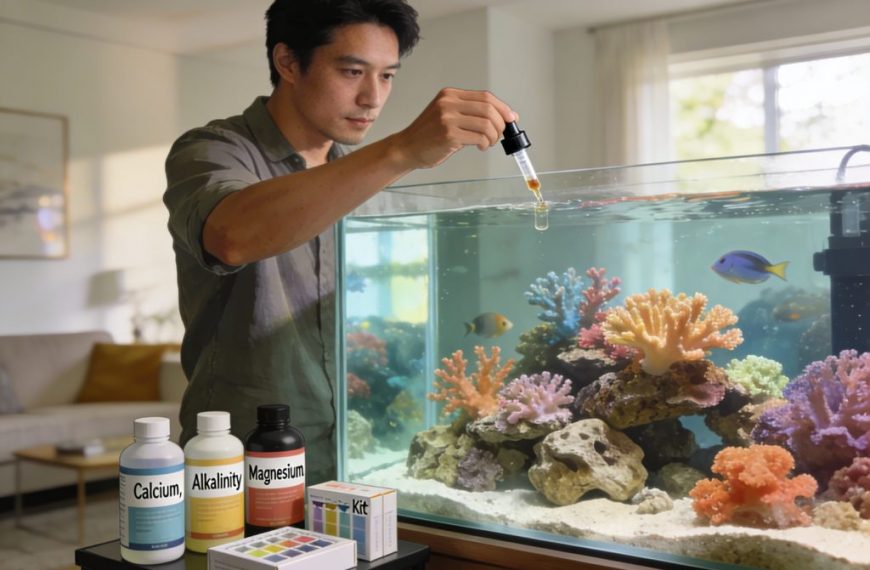
For alkalinity, follow the kit exactly. Swirl between drops and watch the color change. Record the result in dKH. Test alkalinity 2–3 times per week in reef tanks.
For ammonia and nitrite, use kits with clear color charts. Read under white light. Wait the full reaction time. A false high can happen if you read early.
- Test before water changes, not after.
- Use a notebook or app for trends.
- Replace reagents every 12–18 months.
- Match sample volume exactly, like 5 ml or 10 ml.
Keep a simple schedule. Daily: temperature and equipment check. Weekly: salinity, nitrate, and phosphate. Twice weekly in reefs: alkalinity. Monthly: calcium and magnesium, unless demand is high.
Interpret results and fix problems fast
Numbers only help if you act correctly. Look for trends over single readings. A slow drift often points to dosing or top-off issues. A sudden swing points to equipment failure.
If ammonia is above 0.1 ppm, act the same day. Stop feeding for 24 hours. Add fresh carbon and increase aeration. Do a 25–50% water change with matched salinity and temperature.
If alkalinity swings more than 1 dKH in a day, reduce dosing changes. Split dosing into smaller daily amounts. Verify your test with a second kit if possible. Check for clogged dosing lines.
High nitrate often comes from overfeeding or dirty filters. Rinse filter socks every 2–3 days. Vacuum detritus from bare spots. Increase water changes to 10–15% weekly until stable.
High phosphate can follow heavy frozen feeding. Rinse frozen food in a fine net. Use a small amount of GFO or phosphate media. Change it when phosphate stops dropping.
- Common mistake: chasing pH with buffers. Fix aeration and CO2 first.
- Common mistake: topping off with saltwater. Use fresh RO/DI only.
- Common mistake: testing after dosing. Wait 2–4 hours for mixing.
If you need a stable plan for additions, read reef dosing basics. It helps you match dosing to test results. It also reduces guesswork.
Sources: Instant Ocean Sea Salt Guide (mixing and salinity references); Randy Holmes-Farley, Reefkeeping Magazine articles on alkalinity, calcium, and magnesium; API and Salifert test kit instructions (procedure and timing).
Testing is a habit, not a one-time event. Keep your method consistent and your records clear. With steady parameters, fish eat better and corals grow faster.
 By
By