Evaporation changes salinity every day. An auto top-off (ATO) fixes that with steady freshwater dosing. A good setup protects your reef and saves time.
Choose the right ATO and reservoir
Start with your tank size and evaporation rate. Many reefs lose 0.5 to 2.0% daily. A 40-gallon tank can lose 0.2 to 0.8 gallons per day. A 120-gallon tank can lose 0.6 to 2.4 gallons per day.
Pick a reservoir that lasts 5 to 10 days. This reduces refill mistakes. For a tank losing 1 gallon per day, use a 7 to 10 gallon container. Keep the reservoir covered. This reduces dust and CO2 pickup.
Most ATO kits use a small pump and one or two sensors. Optical sensors are precise and resist snails. Float switches are simple and cheap. Dual-sensor systems are safer. They add a backup high-level cutoff.
Plan the water you will add. Use RO/DI at 0 to 2 TDS. Do not top off with saltwater. Top-off only replaces freshwater. If you need help sizing, see salinity stability basics.
- Target salinity: 1.025 to 1.026 specific gravity at 25°C.
- Reservoir size: 5 to 10 days of evaporation.
- Use RO/DI: 0 to 2 TDS, stored with a lid.
Install sensors and set safe limits
Place the ATO sensor in the return pump section of the sump. This section shows water level changes first. Keep it away from skimmer bubbles. Bubbles can trick optical sensors.
Mount the primary sensor at your normal operating level. Mount the backup sensor 0.5 to 1.0 inch higher. Use a solid bracket, not suction cups alone. Clean the glass or acrylic before mounting.
Route the top-off tube to prevent back-siphon. Keep the tube end above the sump water line. Use a check valve only as a secondary aid. Check valves can fail. A simple air gap is more reliable.
Set pump run-time limits if your controller allows it. A common limit is 30 to 120 seconds per dose. Also set a daily max volume if available. This limits damage from stuck sensors. For more sump layout help, read sump design for reef tanks.
- Put sensors in the return chamber for best control.
- Keep sensors 2 to 4 inches from bubble sources.
- End the tube above water to stop siphons.
- Use a max run-time to prevent floods.
Test, calibrate, and troubleshoot common problems
Test the ATO with freshwater before you trust it. Lower the sump level by 0.5 inch. Watch one full top-off cycle. Confirm the pump stops cleanly and does not siphon after shutdown.
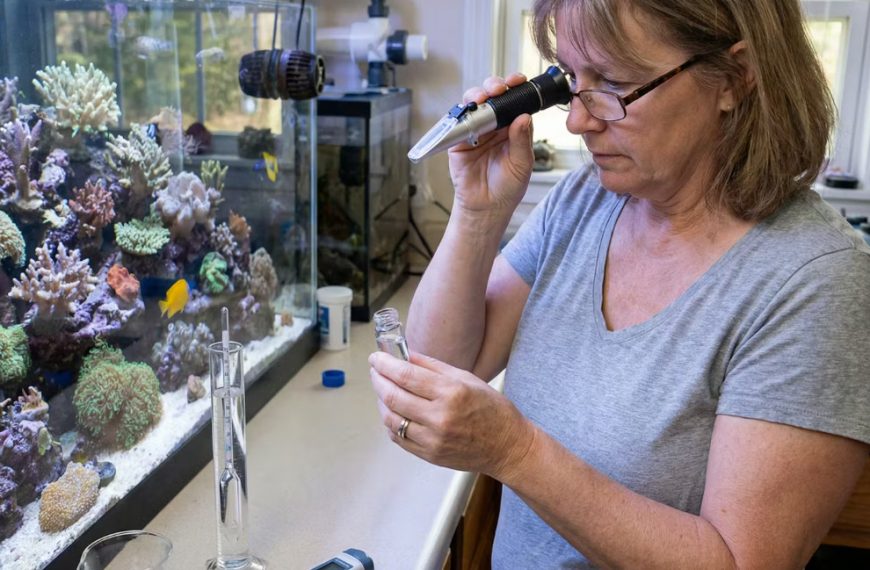
Track salinity for the first week. Use a calibrated refractometer or digital checker. Salinity should stay within 0.001 specific gravity day to day. If it drifts down, you may have a slow siphon. If it drifts up, the ATO may not be keeping up.
Common failure is a dirty sensor. Salt creep and biofilm can block optical sensors. Clean sensors weekly in high-splash sumps. Use warm water and a soft cloth. Avoid soap. Also check for snails and algae on float switches.
Another mistake is an undersized reservoir. Running dry can burn out small pumps. Add a low-water alarm if you can. If your tank uses kalkwasser in the ATO, start slow. Dose no more than your evaporation rate. Keep pH swings under 0.2 per day. For dosing safety, see kalkwasser in reef tanks.
- Weekly: wipe sensors and remove salt creep.
- Monthly: inspect tubing for kinks and brittle spots.
- After power loss: confirm the ATO restarts and does not siphon.
An ATO is one of the best stability upgrades you can make. Size the reservoir for your real evaporation. Add backups and run-time limits for safety. With testing and simple cleaning, your salinity will stay steady.
Sources: Reef aquarium husbandry guides; manufacturer manuals for optical and float ATO systems; standard reef parameters from common marine aquarium references.
 By
By