Reef tanks look simple. The gear behind them is not. The right tools keep your water stable and your animals safe.
Core life-support gear you should not skip
Start with a reliable heater and controller. Aim for 77–79°F with under 1°F swing daily. Use 3–5 watts per gallon as a rough heater guide. Add a temperature controller for a hard safety stop.
Flow is next. Most reefs need 20–40x display turnover per hour. A 50-gallon tank often needs 1,000–2,000 GPH total. Split flow between two powerheads for redundancy. Point them to avoid blasting coral tissue.
Filtration should match your nutrient goals. A protein skimmer helps most mixed reefs. Choose a skimmer rated for 1.5–2x your total system volume. Run it wet for export or dry for stability.
Top-off is a stability tool, not a luxury. An ATO keeps salinity steady as water evaporates. Keep salinity at 1.025–1.026 specific gravity. Use an ATO reservoir that lasts 3–7 days.
- Use two smaller heaters instead of one large unit.
- Clean powerheads monthly to keep flow consistent.
- Test ATO sensors weekly with a manual fill check.
For setup basics, review your reef tank cycle guide. For long-term stability, see our salinity stability tips.
Testing, mixing, and water quality tools that save reefs
Good water starts with pure source water. Use an RO/DI unit that reads 0 TDS. Change sediment and carbon every 6 months for most homes. Replace DI resin when TDS rises above 1.
Mix saltwater with a dedicated container and pump. Heat new water to match your tank within 1°F. Mix to 35 ppt, or 1.026 specific gravity. Let it circulate for 2–24 hours before use.
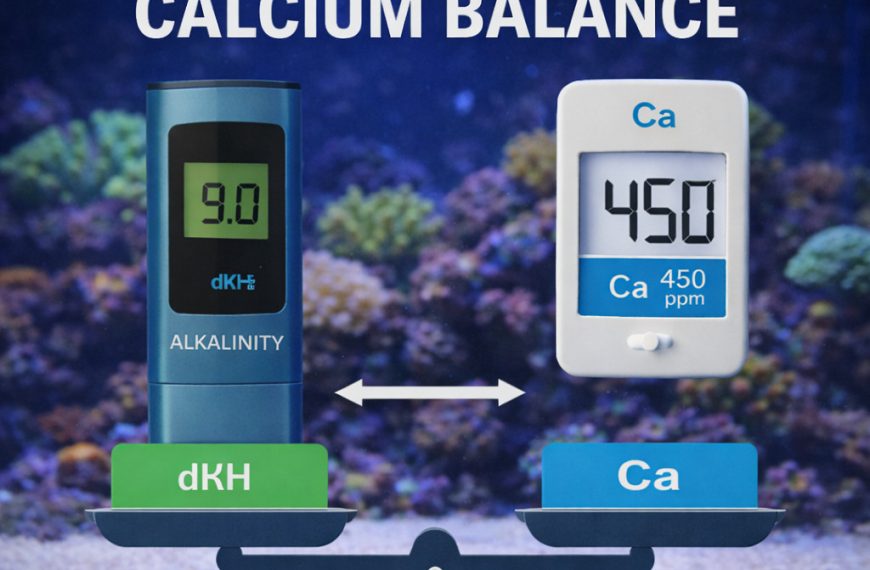
Testing gear should fit your tank style. At minimum, track alkalinity, calcium, magnesium, nitrate, and phosphate. Many reefs run alkalinity at 7.5–9.0 dKH. Keep nitrate around 2–15 ppm and phosphate 0.03–0.10 ppm.
Use a refractometer with calibration fluid at 35 ppt. Hydrometers drift and trap bubbles. Also keep a log. Trends matter more than single numbers. A simple weekly chart prevents surprises.
- Calibrate your refractometer monthly with 35 ppt fluid.
- Test alkalinity 2–3 times weekly in young SPS systems.
- Warm RO/DI water before mixing to reduce precipitation.
If you want a clear testing routine, use our reef tank testing schedule. It helps you pick the right cadence.
Lighting, dosing, and troubleshooting gear for growth
Lighting drives coral color and growth. Match lights to coral goals and tank depth. Many LEDs target 100–200 PAR for soft corals. LPS often like 75–150 PAR. SPS usually need 200–350 PAR, depending on species.
A PAR meter rental can prevent costly mistakes. Start at 30–50% intensity and ramp up over 3–4 weeks. Use a consistent photoperiod of 8–10 hours. Add a 1–2 hour ramp for sunrise and sunset.
Dosing gear becomes important as coral demand rises. Two-part dosing often starts when alkalinity drops more than 0.3 dKH per day. Use dosing pumps for small, frequent additions. Dose alkalinity and calcium in separate high-flow areas.
Keep a few troubleshooting tools on hand. A battery air pump helps during outages. A fish trap reduces rock removal stress. Coral dip and iodine can help with pests and cuts. Quarantine gear prevents disease from entering your display.
- Label dosing lines to avoid swapping alkalinity and calcium.
- Use a GFCI outlet and drip loops on every cord.
- Keep spare impellers and tubing for pumps and skimmers.
Common mistakes include chasing numbers daily. Another mistake is adding gear without a plan. Example: a strong skimmer and heavy carbon can strip nutrients fast. Corals may pale within a week. Reduce export and feed more slowly.
Another common issue is unstable alkalinity. It often follows missed top-off or inconsistent dosing. Verify salinity first, then re-test alkalinity. Adjust by no more than 0.5 dKH per day. Stability beats speed in reef recovery.
Sources: Bulk Reef Supply Investigates (BRS), Reef Aquaria Volume 1 by Delbeek & Sprung, Borneman “Aquarium Corals”, Randy Holmes-Farley reef chemistry articles (print compilations)
Essential reef tank gear is about stability and backups. Start with heat, flow, and top-off. Then build testing, lighting, and dosing around your animals. Buy slowly and measure often for the best results.

 By
By