Starting a reef tank feels exciting and risky at once. A simple checklist keeps you calm and prevents expensive mistakes. Use this guide before you buy livestock.
Section 1: Plan the tank, gear, and water
Pick a tank size that matches your goals. A 20–40 gallon tank suits many beginners. A 75–120 gallon tank offers more stability. Bigger water volume buffers mistakes and heat swings.
Choose a reef-ready setup with an overflow if possible. A sump adds water volume and hides gear. Use a protein skimmer rated for 1.5–2x your total gallons. Add a heater sized at 3–5 watts per gallon.
Plan flow early, not later. Aim for 20–40x display turnover each hour. Use two powerheads for cross flow. Place them to avoid blasting sand and corals.
Make clean water your first habit. Use RO/DI water at 0 TDS. Mix salt to 1.025 specific gravity at 77°F. Let it mix and aerate for 12–24 hours before use.
- Target temperature: 77–79°F with less than 1°F swing daily.
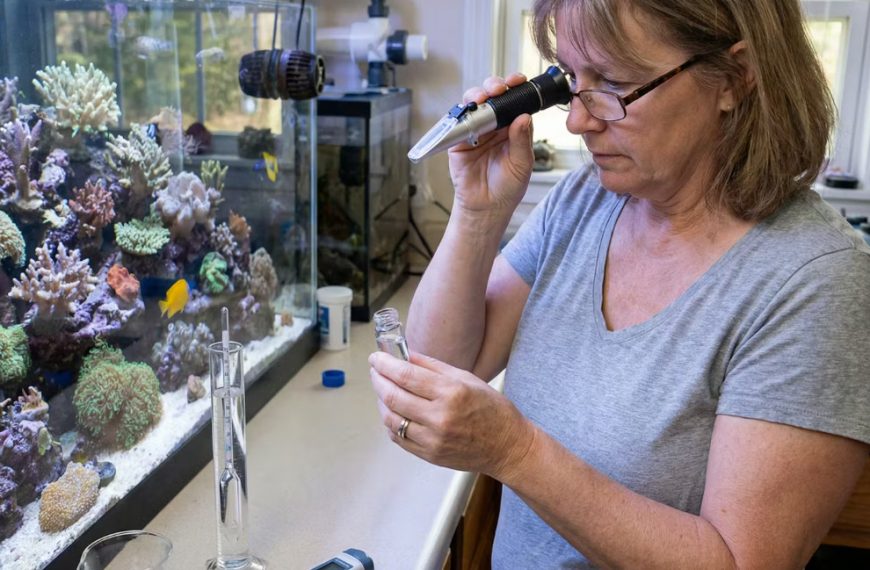
- Target salinity: 1.025 (35 ppt) and keep it steady.
- Buy test kits for ammonia, nitrite, nitrate, and phosphate.
Common mistake: buying livestock before you can test basics. Another mistake is skipping a quarantine plan. Review our quarantine tank setup before you buy fish. It saves money and lives.
Section 2: Build the aquascape and start the cycle
Start with rock and sand choices. Use 0.8–1.0 pounds of rock per gallon as a guide. Use 1–2 inches of sand for most reefs. Rinse dry sand until water runs clearer.
Build a stable aquascape with gaps and swim lanes. Keep rock 1–2 inches off the glass. Use epoxy or cement for tall structures. Test stability by pushing gently from several angles.
Begin cycling with a measured ammonia source. Dose to 2.0 ppm total ammonia nitrogen. Add bottled bacteria the same day. Keep lights off to limit early algae.
Track the cycle with numbers, not guesses. Ammonia should fall to 0 ppm first. Nitrite then rises and returns to 0 ppm. Nitrate often ends at 10–40 ppm after the cycle.
- Cycle checkpoint: 2.0 ppm ammonia clears to 0 in 24 hours.
- Do a 25–50% water change when nitrate exceeds 20–30 ppm.
- Run carbon only if you need to remove odors or yellowing.
Common mistake: adding fish when nitrite is still present. Another mistake is chasing pH with chemicals. Focus on alkalinity and gas exchange instead. Our reef tank cycling guide explains safe timelines.
Section 3: Stabilize parameters and add livestock slowly
After the cycle, stabilize core parameters for two weeks. Keep alkalinity at 8–9 dKH for mixed reefs. Keep calcium at 400–450 ppm and magnesium at 1250–1350 ppm. Keep nitrate at 5–15 ppm and phosphate at 0.03–0.10 ppm.
Add a small clean-up crew first. Try 1 snail per 3–5 gallons as a start. Add them only if you see algae and film. Starving snails is a common early problem.
Add fish in stages, not all at once. Start with one hardy fish after quarantine. Wait 10–14 days before the next fish. Feed lightly and test nitrate twice per week.
Introduce corals after stability, not after excitement. Start with soft corals or easy LPS. Set lights low at first. Increase intensity by 5% each week to avoid bleaching.
- Top off daily with RO/DI to prevent salinity swings.
- Calibrate your refractometer monthly with 35 ppt fluid.
- Log test results and changes in a simple notebook.
Troubleshooting example: you see brown dust on sand in week three. That is often diatoms. Check silicates and replace DI resin if TDS rises above 0. Reduce photoperiod to 6 hours until it fades.
Another common issue is cloudy water after adding sand. Run filter floss and change it daily for three days. Avoid adding clarifiers. Patience fixes most early haze.
For long-term success, build a maintenance rhythm. Plan a 10% water change each week. Clean the skimmer cup twice per week. Review our weekly reef tank maintenance checklist for a steady routine.
Sources: Fenner, R. “The Conscientious Marine Aquarist”; Delbeek & Sprung, “The Reef Aquarium” Vol. 1–3; Borneman, E. “Aquarium Corals”.
 By
By