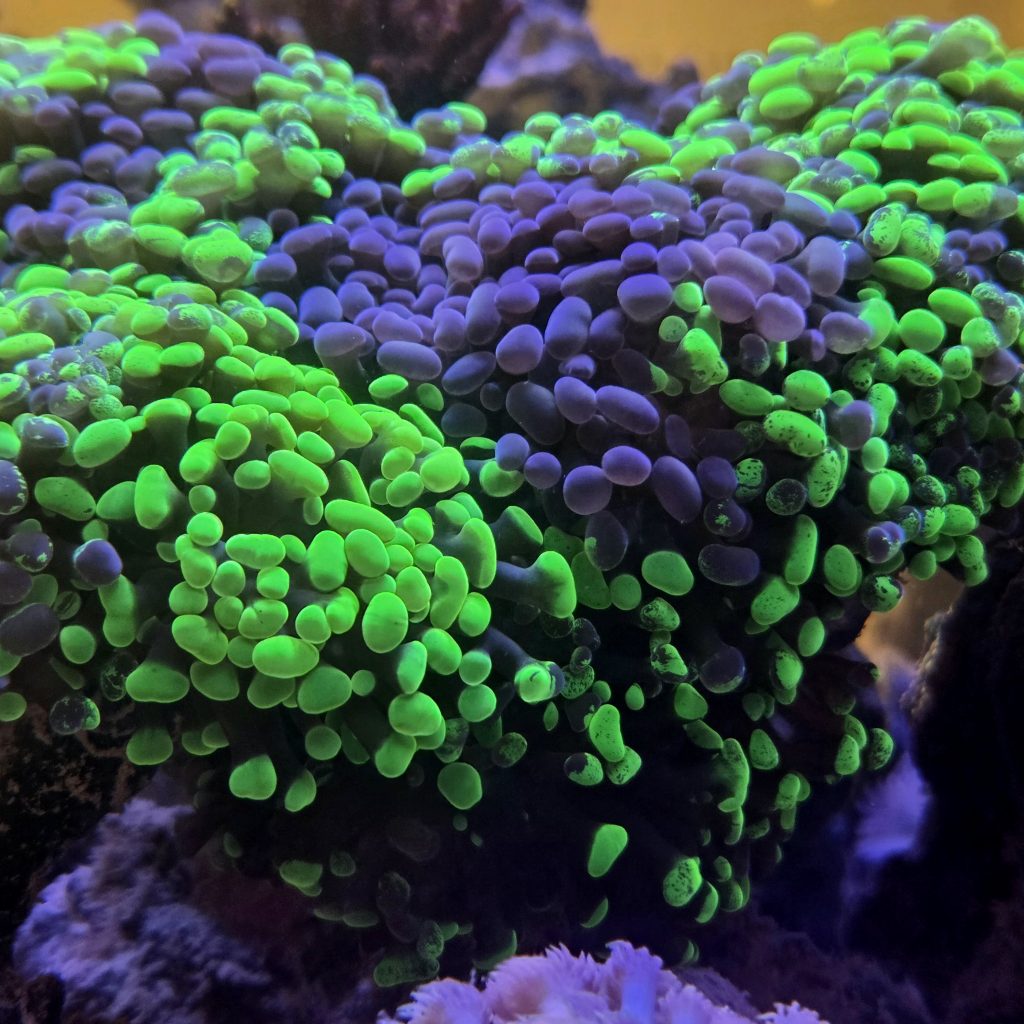
Hammer coral (Euphyllia ancora and Euphyllia paraancora) is one of the most eye-catching LPS corals you can add to a reef tank. With its meaty polyps and hammer- or anchor-shaped tips, it brings motion, color, and personality to your aquascape—without being as demanding as many SPS corals. This guide walks you through hammer coral care so you can enjoy long-term growth and vibrant extension.
Hammer Coral Placement, Flow, and Lighting
Getting placement right is the foundation of hammer coral health. These corals prefer moderate conditions rather than extremes.
Ideal Placement
Place your hammer coral on the lower to middle sections of the rockwork where it can expand fully without touching neighbors. Their sweeper tentacles can extend several inches and may sting nearby corals.
- Tank size: Works well in tanks 20 gallons and up.
- Distance from other corals: Leave 3–4 inches of space in all directions.
- Substrate vs. rock: Can be kept on sand or rock, but ensure a stable base.
Flow and Lighting
Hammer corals enjoy a gentle, swaying motion in their tentacles—not blasting, chaotic flow.
- Flow: Low to moderate, indirect flow is ideal.
- Lighting: Moderate PAR (80–150) with a spectrum suited for reef tanks.
- Signs of too much light: Bleaching, retracted polyps, or a “shrunken” appearance.
- Signs of too little light: Dull coloration and slow growth.
If you’re unsure about your tank’s light intensity, check our guide on reef lighting setup and PAR basics to dial in the right range.
Water Parameters and Feeding for Hammer Coral
Stable water parameters are more important than chasing perfect numbers. Hammer corals respond well to consistent, reef-safe conditions.
- Temperature: 76–78°F (24–26°C)
- Salinity: 1.025–1.026 specific gravity
- Alkalinity: 8–9.5 dKH
- Calcium: 420–450 ppm
- Magnesium: 1300–1400 ppm
- Nitrate: 5–15 ppm
- Phosphate: 0.03–0.08 ppm
Tip: Avoid rapid swings in alkalinity and salinity. Sudden changes are a common trigger for hammer coral recession.
Feeding Your Hammer Coral
Hammer corals host zooxanthellae and get much of their energy from light, but they also benefit from supplemental feeding.
- Offer small meaty foods (mysis shrimp, finely chopped seafood, or quality LPS pellets) once or twice per week.
- Turn off flow briefly and gently target-feed using a turkey baster or pipette.
- Avoid overfeeding; excess food can fuel nuisance algae and poor water quality.
For more detail on nutrition, see our article on LPS coral care and feeding strategies.
Common Hammer Coral Problems and Quick Fixes
Even with good husbandry, hammer corals can occasionally struggle. Catching issues early is key.
- Tissue recession at the base: Often linked to unstable alkalinity or salinity. Test daily for a week and correct slowly.
- Brown jelly disease: A fast-moving bacterial infection. Siphon away affected tissue, perform an iodine dip, and increase aeration and export.
- Closed or shrunken polyps: Check for excessive flow, recent parameter swings, or pests such as flatworms.
Regular testing, water changes, and observation will prevent most issues. If you’re setting up your first reef, our beginner reef tank setup guide walks through building a stable foundation before adding sensitive corals.
With moderate lighting, gentle flow, and stable water chemistry, hammer coral can become a centerpiece in your reef. Its rhythmic movement and bold coloration reward consistent, thoughtful care—and over time, you’ll watch it grow into a full, multi-headed colony that brings your aquascape to life.
Sources
- Borneman, E. H. (2001). Aquarium Corals: Selection, Husbandry, and Natural History. TFH Publications.
- Sprung, J. (2009). Corals: A Quick Reference Guide. Ricordea Publishing.
- Delbeek, J. C., & Sprung, J. (1994–2005). The Reef Aquarium Vol. 1–3. Ricordea Publishing.
 By
By