Lighting can make or break a reef tank. A good schedule supports coral health, algae control, and fish behavior. This guide helps you set a stable routine that matches your livestock.
Build a stable daily schedule first
Start with consistency. Corals and fish adapt to steady light cycles. Sudden changes often trigger algae and stress. Pick a schedule you can keep every day.
For most mixed reefs, aim for 8 to 10 hours of full-intensity light. Add 1 to 2 hours for ramp-up and ramp-down. This mimics sunrise and sunset. It also reduces light shock.
A simple example works well. Ramp from 0% to peak over 60 to 90 minutes. Hold peak for 8 hours. Ramp down over 60 minutes. Keep moonlight low, or skip it.
Match intensity to your tank goals. Soft corals often like 50 to 150 PAR. LPS often sit at 75 to 200 PAR. Many SPS thrive at 200 to 350 PAR. Use a PAR meter if possible. If not, start low and increase slowly.
- Set a fixed “lights on” time and keep it within 15 minutes daily.
- Start new tanks at 6 to 7 peak hours for the first month.
- Use a 60 to 90 minute ramp to reduce coral retraction.
If you need help with nutrient balance, review reef tank nutrient control basics. Light and nutrients must match. High light with low nutrients can bleach corals. Low light with high nutrients can fuel algae.
Choose spectrum and intensity with coral placement
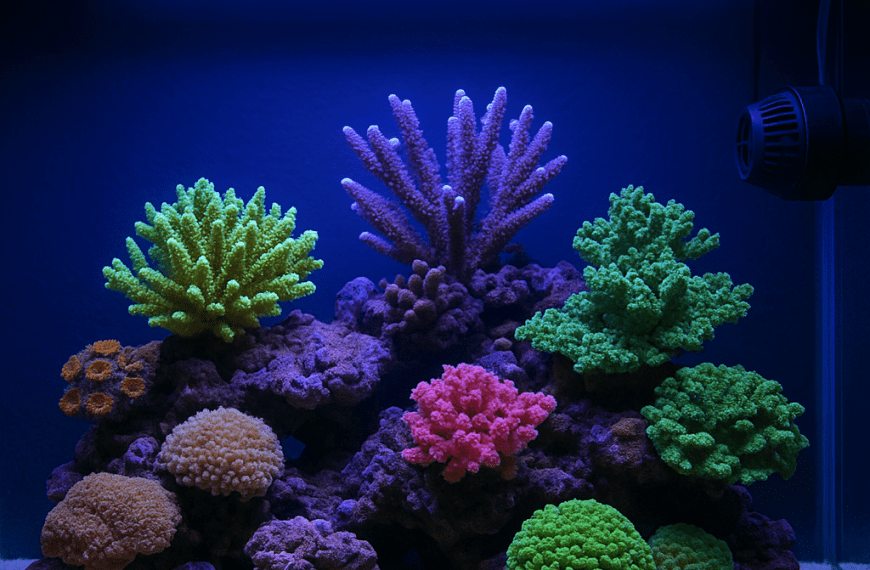
Spectrum matters, but stability matters more. Many reefs look best with a blue-heavy profile. Keep white channels moderate to limit nuisance algae. A common starting point is 70% blue, 20% violet, and 10% white.
Place corals by light demand. Put SPS high and centered under the strongest spread. Place LPS on the sand or lower rock shelves. Keep soft corals in lower to moderate zones. Give each coral space for flow and growth.
Make changes slowly. Increase intensity by 3% to 5% per week. Or add 15 minutes of peak time per week. Watch coral tips and tissue. Pale tissue often means too much light. Brown tissue often means too little light or high nutrients.
Use real-world checks. If your acans stay puffy all day, light is often fine. If your euphyllia stretches upward, it may want more light. If your montipora fades on the top surface, reduce peak intensity. Then re-check after seven days.
- Target 9 hours peak for mixed reefs, and 10 hours for soft coral tanks.
- Keep UV and violet strong, but avoid sudden jumps in those channels.
- Acclimate new corals with 50% intensity for 7 to 14 days.
For a step-by-step coral intake routine, see coral acclimation step-by-step. Light acclimation is part of that process. It prevents shock and tissue loss.
Troubleshoot common lighting problems
Algae blooms often follow long photoperiods and high white light. First, reduce peak hours by 60 minutes. Then cut white by 5% to 10%. Do not change everything at once. Make one change and wait a week.
Bleaching is usually too much light, low nutrients, or both. Lower intensity by 10% right away. Shorten peak by one hour for two weeks. Keep nitrate at 5 to 15 ppm. Keep phosphate at 0.03 to 0.10 ppm. Stable alkalinity also helps.
Shimmer and shadows can hide problems. LEDs can create hot spots. Raise the fixture 2 to 4 inches to improve spread. Or add a diffuser if your model supports it. Check corners with a PAR meter if you can borrow one.
Fish also need darkness. Too much night light can reduce rest. Keep moonlight under 1% to 2% brightness. Limit it to 2 to 4 hours. If fish pace at night, turn moonlight off.
- If algae appears, cut peak time first, not blue channels.
- If corals brown, test nitrate and phosphate before adding more light.
- If corals bleach, reduce intensity 10% and stabilize nutrients.
For system-wide stability, revisit reef tank parameter stability guide. Light changes work best with steady salinity and alkalinity. Keep salinity at 1.025 to 1.026. Keep alkalinity at 8 to 9 dKH when possible.
Sources: Dana Riddle, “Lighting the Reef Aquarium” (technical articles); Julian Sprung, The Reef Aquarium series; Sanjay Joshi, reef lighting and PAR measurement articles.
 By
By