Fish rarely get “sick” without warning. Stress signals often show up days earlier. If you spot them fast, you can prevent losses.
What stress looks like in marine fish
Fast breathing is a top red flag. Count gill beats for 15 seconds. Multiply by four for breaths per minute. Many reef fish sit near 60–90 at rest. Over 120 suggests trouble.
Hiding and reduced appetite often come next. A fish that stops eating for 48 hours needs attention. Watch for hovering in corners or staying behind rockwork. These are common after bullying or parameter swings.
Color changes can be subtle. Many fish “wash out” when stressed. Some show dark bars or blotches. A clownfish may turn dull orange. A tang may show pale patches after lights on.
Physical signs include clamped fins and flashing. Flashing means rubbing on rocks or sand. It can point to parasites or irritation. Also note frayed fins and cloudy eyes. These often follow chronic stress.
- Breathing: over 120 breaths per minute at rest
- Behavior: hiding, pacing, glass surfing, or sudden aggression
- Body: clamped fins, faded color, excess mucus, flashing
Track these signs in a simple log. Note time, tankmates, and feeding response. Photos help you compare day to day. For a baseline, review your reef tank water parameters guide.
Common causes you can fix today
Water quality triggers stress fast. Test ammonia and nitrite first. Both should be 0 ppm. Keep nitrate under 20 ppm for most mixed reefs. Aim phosphate near 0.03–0.10 ppm for stability.
Oxygen and flow matter more than many think. Low surface agitation can cause rapid breathing. Point a powerhead toward the surface. Clean salt creep from lids and overflow teeth. In warm tanks, add a fan for cooling.
Temperature swings are a silent stressor. Keep 24.5–26.0°C (76–79°F). Limit daily swings to 0.5°C (1°F). Salinity should stay near 1.025 specific gravity. Use a refractometer and calibrate with 35 ppt fluid.
Aggression and crowding cause chronic stress. Watch for fin nips and blocked access to food. Add rock “break lines” and caves. In a 75-gallon tank, avoid mixing multiple similar tang shapes. If needed, use an acclimation box for 3–7 days.
- Test ammonia, nitrite, and pH before dosing anything
- Increase aeration during heat waves and after heavy feeding
- Feed smaller portions twice daily to reduce waste spikes
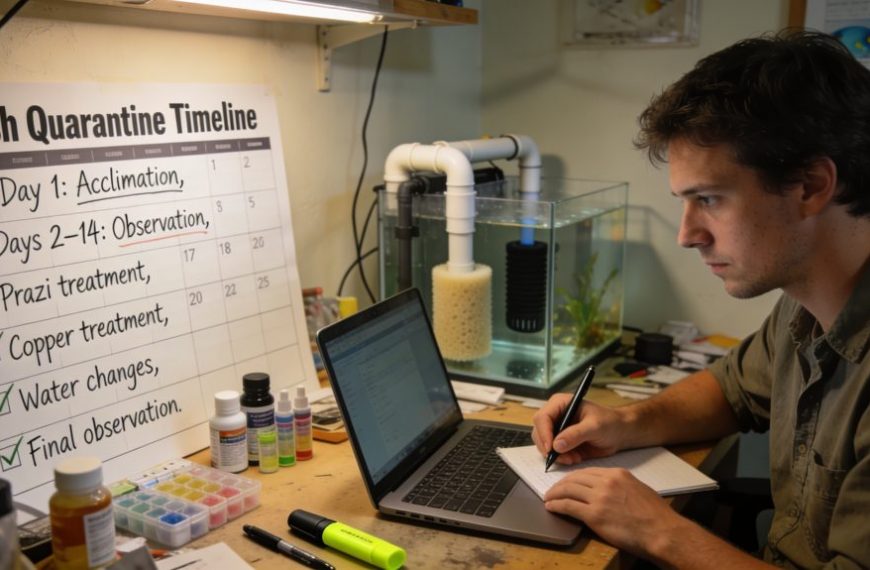
If you suspect stress from new additions, revisit your quarantine protocol for saltwater fish. Many “mystery” issues trace back to skipped quarantine. A short observation period can save a display tank.
Step-by-step response and troubleshooting
Start with a quick triage routine. Check temperature, salinity, and pH. Then test ammonia and nitrite. If either is above 0 ppm, do a 25–50% water change. Match salinity and temperature within 0.001 SG and 1°F.
Next, reduce stressors. Dim lights for the day if fish are frantic. Pause feeding for 12–24 hours if ammonia is present. Add fresh carbon in a media bag. This helps after coral toxins or accidental contamination.
If breathing stays high, increase aeration immediately. Add an airstone in the sump or display. Aim for strong surface ripples. In emergencies, point two powerheads up. This often stabilizes fish within 30–60 minutes.
Finally, decide if isolation is needed. If one fish is targeted, move it to a hospital tank. Use a 10–20 gallon bare tank with heater and sponge filter. Keep salinity stable at 1.025. Observe for spots, velvet dusting, or heavy mucus.
- Common mistake: treating without testing first
- Common mistake: big salinity swings during top-off
- Common mistake: adding fish before biofilter can handle load
When symptoms point to parasites, avoid guessing in the display. Confirm signs and plan a controlled treatment. For planning, see marine ich vs velvet comparisons. Stress drops when you act with a clear plan.
Stress signals are your early warning system. Watch breathing, behavior, and color changes daily. Fix water, oxygen, and aggression fast. Small corrections today prevent big losses tomorrow.
Sources: Humblefish Disease Forum (symptom patterns and treatment principles); Fenner, R. “The Conscientious Marine Aquarist”; Noga, E.J. “Fish Disease: Diagnosis and Treatment”
 By
By